

India's Deepening Energy Woes: A National Crisis Unfolds
The ongoing war in West Asia and the subsequent closure of the Strait of Hormuz has plunged India into a severe energy crisis, sending shockwaves from kitchens to factories and farms. This strategic waterway, a mere 33 kilometers wide between Iran and Oman, is critical for India's energy security, as it facilitates the transit of 45 percent of the country's crude oil and 60 percent of its gas supplies. The situation represents a defining moment for India's ability to sustain its agricultural and industrial output in the face of unprecedented disruptions.
A Test of National Resilience
This crisis transcends mere market fluctuations; it is a rigorous test of national resilience that demands diplomatic dexterity and robust measures to cushion the impact of soaring crude and natural gas prices. Minister for Petroleum and Natural Gas Hardeep Puri emphasized the gravity of the situation in Parliament, stating, "The world has not faced a moment like this in modern energy history." New Delhi is now bracing to absorb the spike in crude oil prices, which settled at $101 per barrel on Friday, a sharp increase from pre-conflict levels of $60 to $71.
According to an SBI Research report from March 7, every $10 increase in crude oil prices could lead to heightened inflation and a slowdown in economic growth. Official data released on Thursday showed India's Consumer Price Index, or retail inflation, for February at 3.21 percent, the highest in ten months, underscoring the economic strain.

Diversifying Energy Sources
To mitigate the supply-side crisis, India has aggressively diversified its energy sources. The country requires approximately 4.8 million barrels of crude oil daily and is now seeking additional supplies from West Africa, the United States, and Latin America—regions that do not rely on the Hormuz route. Prior to the conflict, crude supplies from 'non-Hormuz' routes accounted for 55 percent of imports; this figure has now surged to 70 percent.
In the case of liquefied petroleum gas (LPG), India previously imported around 60 percent of its needs from Gulf nations. In response to the closure, additional cargoes have been secured from the US, Norway, Canada, Algeria, and Russia. Sanjay Kathuria, a visiting senior fellow at the Centre for Social and Economic Progress (CSEP), noted, "It is a very difficult situation and this type of surge in prices could not have been planned for."
Tackling the Kitchen Crisis
The foremost priority for the government has been to prevent a 'kitchen-table crisis' affecting 33 crore households across the nation. India's daily LPG consumption stands at 189 million metric standard cubic meters per day, with supplies of 47.4 MMSCMD currently disrupted due to 'force majeure' conditions invoked by suppliers in the Persian Gulf. Households account for roughly 86 percent of India's LPG consumption, making the situation particularly sensitive.
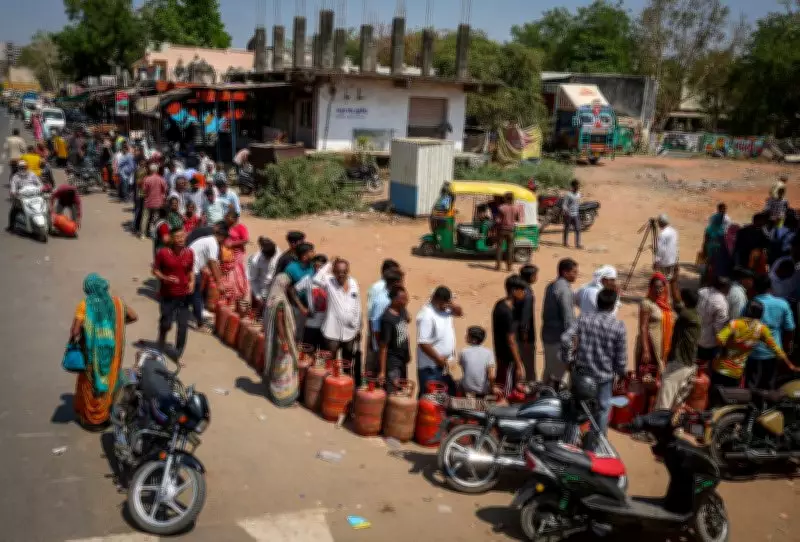
Media images of long queues for LPG cylinder refills have highlighted the urgency. On March 8, a government notification re-prioritized gas allocation: LPG for households and compressed natural gas (CNG) for transport are to be met at 100 percent capacity. Industrial and manufacturing users will receive up to 80 percent of their average LNG consumption over the previous six months, while fertiliser plants will get up to 70 percent of their earlier allocation.
Minister Puri announced that domestic LPG production has been increased by 28 percent in the past five days. The notification also imposes a minimum gap of 25 days between cylinder bookings in urban areas and 45 days in rural areas to manage demand. Kathuria added, "We are a large economy and need lots of imports; LNG demand is, for now, outstripping supply."
Cross-Sector Impact
The ripple effects of this energy crisis extend far beyond restaurants, hospitality, and transportation, impacting sectors from industry to agriculture. In industries such as paints, chemicals, and ceramics, fuel constitutes nearly 30 percent of production costs, threatening operational viability.

Urea production, a critical component for agriculture and a major livelihood source in northern states, relies on LNG both as an energy source and a key manufacturing input. Fortunately, stockpiles of fertiliser, including urea, were about 18 million tonnes as of this week, marking a 37 percent increase from a year earlier, providing a temporary buffer.
Diplomatic Dexterity in Action
India faces a classic 'butterfly effect'—where a small change, like the Hormuz blockage, leads to massive, unpredictable consequences. In a notable shift, the United States, which had previously imposed punitive tariffs on India for purchasing Russian crude, has now approved India and other countries to buy the same oil. The US has even praised New Delhi for helping to keep international prices low through these purchases. This waiver allowed Indian refiners to acquire an additional 30 million barrels of Russian crude, easing some pressure.
Alternate Choices and Backup Plans
Currently, state-run Oil Marketing Companies (OMCs) are absorbing high crude costs by utilizing margins built up during periods of lower prices. The Ministry of Petroleum has indicated no immediate plans to hike retail fuel prices, citing a 'comfortable' inventory position. However, domestic LPG prices were increased by Rs 60 per cylinder to manage costs.
A promising technological solution has emerged from the Council of Scientific and Industrial Research (CSIR): Dimethyl Ether (DME), a substitute for LPG with cleaner combustion properties. DME can be produced from methanol derived from India's own coal or biomass, with technology first tested in 2020. RA Mashelkar, former Director-General of CSIR, highlighted this innovation on social media, stating, "National emergency requires emergent actions … Indian innovation has the power to secure sovereignty." He urged the Centre for High Technology (CHT), which has funds for such projects, to step in and accelerate deployment.
As India navigates this deepening energy crisis, the combination of strategic diversification, diplomatic efforts, and technological innovation will be crucial in safeguarding the nation's economic stability and energy security in the challenging days ahead.





