India's Critical Energy Dependence and Security Challenges
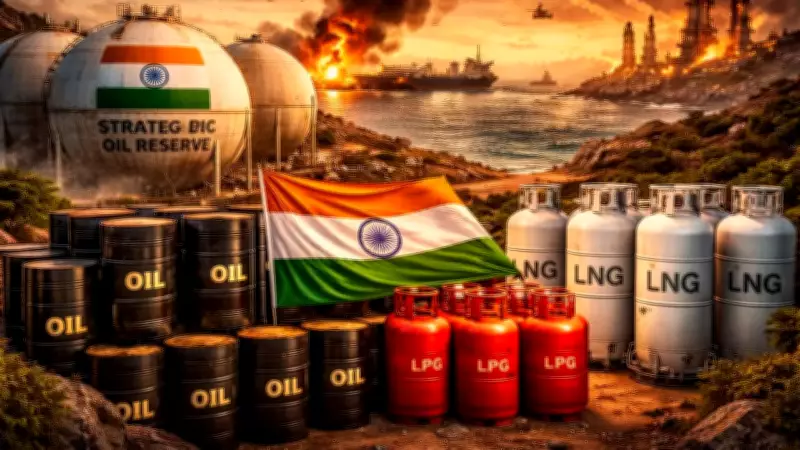
India's reliance on imported energy is stark, with approximately 90% of its crude oil, 60% of its liquefied petroleum gas (LPG), and 50% of its liquefied natural gas (LNG) needs sourced from abroad. These figures are not just statistical data; they represent a profound vulnerability for one of the world's largest and fastest-growing economies. The ongoing geopolitical tensions, particularly the US-Iran conflict, have severely disrupted energy supplies through the Strait of Hormuz, a vital maritime route. This crisis has highlighted a crucial reality: while India maintains it has adequate short-term supplies, there is an urgent need to accelerate long-term strategies to fortify energy security against prolonged disruptions.
Current Status of India's Energy Security and Strategic Reserves
According to the Global Trade Research Initiative (GTRI), West Asia remains a pivotal supplier, accounting for 48.7% of India's crude oil imports, 68.4% of LNG imports, and over 91% of LPG imports in 2025. This heavy concentration exposes the Indian economy to sudden supply shocks. Experts note that while domestic buffers for oil are relatively robust, LPG and LNG supplies require significant enhancement. The government reports that India possesses 25 days of crude oil reserves, with petrol and diesel stocks lasting an additional 25 days, separate from strategic petroleum reserves. Cooking gas stocks can sustain for 25–30 days, and LNG stocks are available for around 10 days.
India has established strategic petroleum reserves with a capacity of 5.33 million tonnes, stored in underground caverns at Visakhapatnam, Mangaluru, and Padur, equivalent to roughly 40 million barrels or 9–10 days of national demand. Currently, about 80% of this capacity is utilized. To mitigate immediate deficits, India has increased purchases of Russian crude oil. Sourav Mitra, Partner – Oil & Gas at Grant Thornton Bharat, asserts that India has quietly strengthened its energy security depth. He emphasizes that while price volatility may be inevitable, the risk of sudden physical shortages is diminishing. During the current regional uncertainty, cargo-tracking data indicates nearly 100 million barrels of commercial crude, including shipments in transit, are accessible, providing a cushion for 40–45 days if Hormuz flows are interrupted. Mitra clarifies that the immediate threat is not scarcity but cost.

Strengths and Weaknesses in LPG and LNG Infrastructure
LPG supplies are on a firmer footing with two underground storage anchors on opposite coasts—Visakhapatnam and Mangaluru—offering about 140,000 tonnes of deep storage. However, natural gas remains a weak spot. India operates eight LNG import terminals but lacks a formal gas strategic reserve. Policymakers are considering a practical solution: designating a small, government-callable buffer within existing LNG tanks to manage supply or price shocks, as noted by Mitra.
Upcoming Strategic Reserves Projects and Future Plans
The second phase of strategic petroleum reserves (SPR-II) aims to increase capacity from 5.33 million metric tonnes (MMT) to 11.83 MMT, extending coverage from 9–10 days to around 20 days, depending on demand. However, land acquisition at Chandikhol and Padur-II is pending, with commissioning expected later in the decade. For LPG, the HPCL Mangalore cavern, commissioned in September 2025, has boosted underground capacity to approximately 140,000 metric tonnes, providing east-west strategic anchors. LNG initiatives include a draft proposal for a 10% terminal-level strategic buffer, which would establish a national LNG backstop through additional tankage or designated volumes with government protocols.

Expert Recommendations for Insulating Against Future Shocks
Experts advocate a multi-pronged strategy to safeguard against future supply disruptions. Gaurav Moda of EY-Parthenon India prioritizes accelerating SPR-II and exploring six new reserve locations. Sourav Mitra recommends shifting from an LNG strategy to an LNG architecture, emphasizing diversification beyond a single anchor source. He suggests broadening supply to include non-Hormuz regions like the US, Australia, and West Africa, ensuring no single source exceeds 30–35% of imports. Additionally, pursuing equity in producing assets outside Hormuz, strengthening trading and shipping capabilities, and notifying the 10% LNG buffer rule are crucial steps.
Mitra also advises completing SPR-II, planning SPR-III to approach International Energy Agency (IEA) norms of 90-day coverage, deepening LPG resilience with a third storage site, and maintaining crisis playbooks with protocols for fuel substitution and price-risk hedging. GTRI founder Ajay Srivastava advocates for long-term crude oil supply contracts with Russia to provide stable volumes and predictable pricing, reducing reliance on volatile markets. Gaurav Moda further suggests institutionalizing a 10% LNG storage mandate and developing underground gas storage reserves led by entities like GAIL, ONGC, and OIL. He highlights that countries like Japan and China maintain buffers averaging over six months, urging India to adopt a similar three-pronged framework involving national reserves, private storage mandates, and joint stockpiling abroad.
In summary, while India has made strides in energy security, the current global tensions underscore the imperative for accelerated action. Diversifying procurement sources, expanding strategic reserves, and enhancing infrastructure are essential to ensuring long-term stability and insulating the economy from future energy shocks.