

India's Economic Ascent Meets Global Challenges
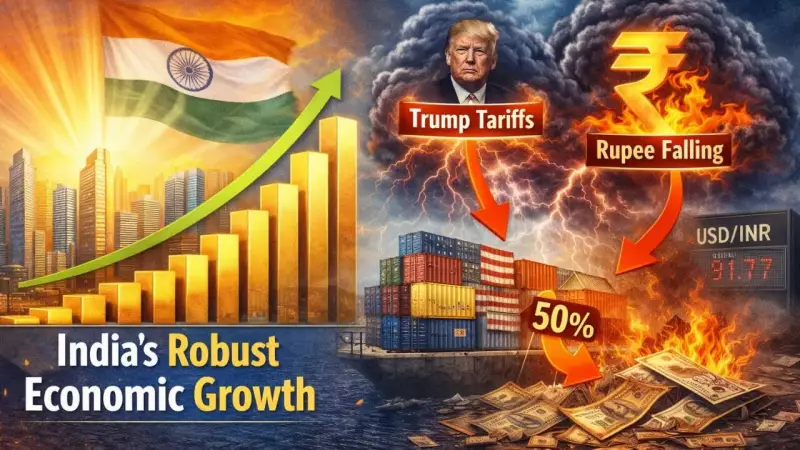
India stands as the world's fastest-growing major economy, boasting an impressive GDP growth rate exceeding 6-7%. This remarkable performance has positioned the nation as the fifth-largest economy globally, serving as a crucial engine for worldwide economic expansion. The International Monetary Fund (IMF) has formally recognized India's pivotal role in driving global growth, highlighting its significance on the international stage.
External Headwinds Threaten Domestic Momentum
Despite India's strong economic fundamentals and domestic-driven growth, the nation confronts significant external challenges. The global economic landscape is increasingly volatile, marked by geopolitical tensions and policy uncertainties. A primary concern stems from the United States, where former President Donald Trump's administration has implemented substantial tariffs, including a 50% levy on certain Indian exports. This trade war has yet to be resolved through a finalized India-US trade agreement, creating persistent uncertainty.
Financial markets reflect these pressures. Indian stock markets experienced a disappointing performance in 2025, while the rupee emerged as the worst-performing currency during the same period. These developments underscore the vulnerability of even a domestically robust economy to international turbulence in today's interconnected world.

Economists Identify Key Macroeconomic Risks
A survey of leading economists reveals consensus around several critical threats to India's growth trajectory. The most frequently cited risks include:
- Rupee Depreciation: A sustained decline in the currency's value could trigger imported inflation, increasing costs for consumers and businesses alike.
- US Trade Policies: Ongoing tariff disputes and the absence of a trade deal with the United States pose direct challenges to export-oriented sectors.
- Global Uncertainty: Escalating trade wars and fragile capital flows create an unpredictable environment for emerging markets.
Madan Sabnavis, Chief Economist at Bank of Baroda, emphasizes that while domestic fundamentals remain strong, external vulnerabilities persist. "The Indian economy is largely a domestic economy and here we do not see any major risk besides the usual assumption of a normal monsoon," he notes. "The risk on the external side is still in the realm of tariffs as the affected industries are dependent on export markets of which the USA is a major player."
Yuvika Singhal, Economist at QuantEco, echoes this sentiment, stating, "The biggest macro risk India faces is from global uncertainty and rupee depreciation. In a global environment marked by heightened escalation of trade wars and economic policy uncertainty, it is essential to remain steadfast towards preserving domestic macro stability."
Budget 2026: A Crucial Tool for Risk Mitigation
As Finance Minister Nirmala Sitharaman prepares the Union Budget for 2026, economists propose specific measures to safeguard India's economic momentum. The budget's role in maintaining fiscal discipline while supporting vulnerable sectors is considered paramount.
Sujan Hajra, Chief Economist at Anand Rathi Group, advocates for targeted interventions. "Since exports support over 40 million jobs, Budget 2026 needs to focus on targeted support for labour-intensive sectors such as textiles, leather and electronics to protect employment and competitiveness," he explains.
Rumki Majumdar, Economist at Deloitte India, outlines a multi-pronged approach:

- Credit Support: Strengthening cash flow for MSMEs facing export stress through enforced payment timelines and targeted credit guarantees.
- Infrastructure Investment: Addressing logistics, power reliability, and legacy infrastructure issues to reduce supply-side costs.
- Fiscal Prudence: Maintaining deficit targets while preserving capital expenditure multipliers that drive long-term growth.
- Trade Diversification: Accelerating free trade agreement implementation to reduce dependence on single markets.
The Path Forward: Balancing Growth and Stability
Economists universally stress the importance of continued fiscal credibility. Ranen Banerjee of PwC India highlights, "Since monetary policy is outside the purview of the budget, the only way the budget can support the macro is through continued adherence to fiscal prudence by keeping the deficit in check, reducing the debt GDP ratio and keeping the quality of budgetary spend high."
Rishi Shah of Grant Thornton Bharat adds a forward-looking perspective: "Maintaining a strong pipeline of public capital expenditure remains critical to anchor growth and crowd in private investment when global capital flows turn cautious. At the same time, improving efficiency of expenditure and maintaining credible deficit trajectories will be key to preserving investor confidence."
As India navigates these complex challenges, Budget 2026 represents more than just an annual financial statement—it serves as a strategic instrument for reinforcing economic resilience. By addressing external vulnerabilities while nurturing domestic strengths, India can continue its trajectory as a global growth leader despite the gathering storms in the international economic landscape.





