

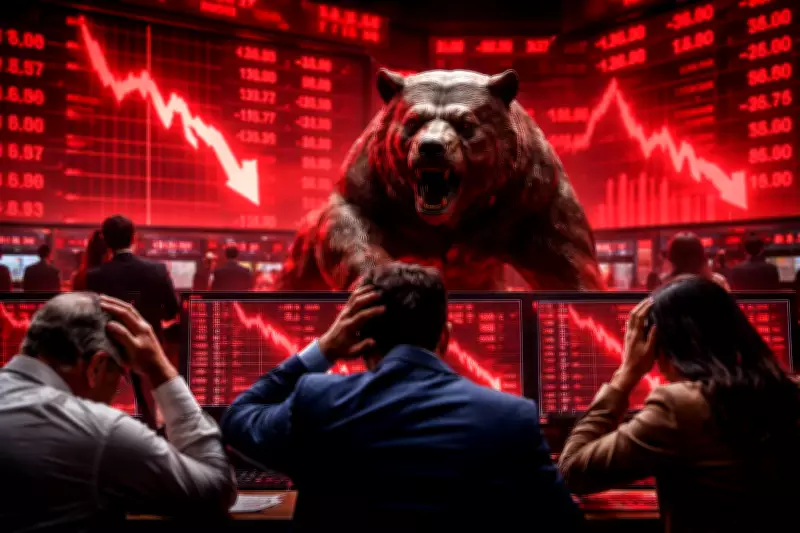
Global Markets Plunge Amid Escalating Middle East Conflict
Global financial markets have experienced significant turbulence recently, driven by the ongoing Middle East conflict, which has now entered its fourth week. This geopolitical unrest has triggered sharp sell-offs, with investor wealth suffering massive losses. On Thursday alone, the intense market downturn wiped off approximately Rs 12.87 lakh crore from investor portfolios, as Dalal Street witnessed a severe bloodbath.
Mounting Losses and Investor Anxiety
Extending the timeline further, since the crisis began unfolding in the region, investors have collectively lost over Rs 37 lakh crore as of March 19. As market indices swing wildly, many investors are left staring at red screens, grappling with uncertainty over whether to take immediate action or adopt a wait-and-see approach. The central dilemma revolves around whether to make strategic moves now or hold out for potential golden opportunities in the future.
Expert Advice: Stay Steady Amid Volatility
Amid the noise and panic, a familiar reminder is circulating: while market movements can be sharp in the short term, reacting too hastily often does more harm than good. Harish K Ahuja, Head of Sustainability, Power & Carbon Markets, Listing & Social Stock Exchange at the National Stock Exchange of India (NSE), has emphasized the importance of retail investors maintaining composure and avoiding knee-jerk reactions to short-term market swings.

Commenting on recent trends, Ahuja noted that the current correction is not isolated to India but is part of a broader global phenomenon. “Most of the exchanges across the globe are seeing a correction of 7% to 10%. And this up and down is a part of the very market,” he explained.
Caution Against Panic-Driven Decisions
He specifically cautioned retail participants against making panic-driven decisions during periods of uncertainty. “My suggestion to retail investors: don't panic. Show the patience, you are an investor, not a trader,” Ahuja advised. According to him, India’s economic fundamentals remain robust despite external pressures, providing a solid foundation for long-term growth.
“My understanding of the Indian market, India is growing. Indian fundamentals in terms of GDP growth, inflation, most of the indicators, be it industrial growth, electricity consumption, are very positive,” he stated confidently.
Strength of India’s Capital Markets
Ahuja also highlighted the strength and scale of India’s capital markets, pointing to strong participation levels and vibrant activity. “India has witnessed the largest number of IPOs in the world. We are one of the largest exchanges in terms of the number of unique investors and unique accounts,” he remarked, underscoring the market's resilience and potential.
Long-Term Perspective Over Daily Trading
Emphasizing a strategic approach, Ahuja stressed that investing should be viewed with a long-term perspective rather than a daily trading mindset. “Investment means, for me, the definition of investment is once you buy a stock, at least for the next five to ten years, don't watch the stock daily,” he advised.
Reiterating his optimistic outlook, he added that patience and a deep understanding of macroeconomic fundamentals are crucial for navigating volatility successfully. “I think I am always positive about the market because I am a patient investor. Once you have patience, once you understand the fundamentals of the economy and the country as a whole, you should not panic.”
He further indicated that investors who maintain discipline and focus on long-term horizons are more likely to withstand short-term geopolitical disruptions and benefit from sustained market growth over time.






