

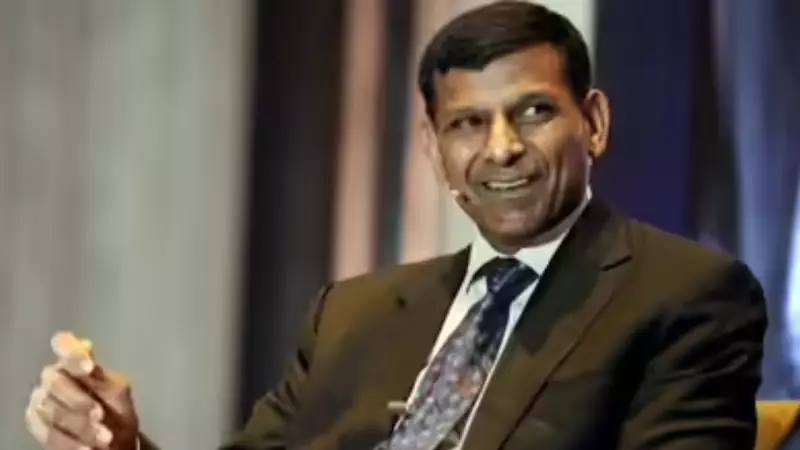
Former Reserve Bank of India governor Raghuram Rajan has called for the upcoming Union Budget to be anchored in a comprehensive, long-term vision aimed at bolstering the Indian economy's resilience and independence while accelerating growth. In an interview with PTI Videos, Rajan highlighted that the world is navigating an "extremely dangerous time," making strategic economic planning more critical than ever.
Integrating Budget with Broader Strategic Roadmap
Rajan stressed that India must move beyond annual fiscal exercises and integrate the Budget for 2026–27 into a broader strategic roadmap. He noted that while India previously had five-year plans, budgets were not always well-aligned with these longer-term goals. "I think it should be integrated with a longer-term vision. How do we become more resilient, more independent as an economy, but also fast-growing, so that everybody else wants to be friends with India," Rajan said, adding that such an approach requires sustained effort.
Opportunities and Risks in the Global Landscape
The former RBI governor pointed out that both the global and Indian economies face heightened risks, even as new opportunities emerge from significant investments in artificial intelligence. "We are seeing lots of positive opportunities from the tremendous investment in AI," he remarked. However, he cautioned against excessive dependence on a narrow set of external partners, which could leave India vulnerable. Rajan underscored that India lacks a nearby, wealthy natural market other than its own, emphasizing the need for careful economic positioning.

Reforms and Economic Relationships
Rajan, currently the Katherine Dusak Miller Distinguished Service Professor of Finance at the University of Chicago Booth School of Business, expressed hope that Finance Minister Nirmala Sitharaman's forthcoming Budget, to be presented on February 1, would move in the direction of long-term vision. He acknowledged that the Budget may involve cutting certain tariff rates that currently hinder India's integration into global supply chains. While states have begun adopting more investment-friendly policies, Rajan asserted that more needs to be done.
Describing India as the fastest-growing large economy—a fact he said should be celebrated—Rajan stressed the importance of building a wider set of economic relationships. "We also need to make as many sorts of relationships as we can, including with our neighbours, Bangladesh, Sri Lanka, Nepal," he said.
Responding to Trade Tensions and Focusing on Reforms
When asked how India should respond if trade tensions with the United States escalate further, Rajan advised that the priority should be to temporarily tune out external noise and focus inward on reforms that can lift the growth trajectory. He recalled that India undertook a series of major reforms in the 1990s and early 2000s, followed by a period of relative slowdown. "I think it is time to start that process again," he said, while acknowledging that the Narendra Modi government has implemented several reforms in recent years. According to Rajan, the focus now should be on identifying measures that can add two percentage points or more to India's growth rate.
Global Supply Chains and Sustainable Growth
Rajan noted that current global uncertainty, driven in part by policy shifts among major powers, has created an opportunity for India to reinsert itself into global supply chains. However, he observed that India is not naturally embedded in such chains, given its geography and the fact that its only large neighbour is China, with which it has a border dispute. "It would be important for India going forward to diversify across the supply chains that it has access to, including with China, but also importantly, with Europe, with Australia, with Canada, with the Middle East, as also with the East Asian countries," he explained.
He added that India may have missed earlier opportunities but now has a fresh chance to catch up. "It is not just manufacturing, it is services, and it is all kinds of services," Rajan said, questioning whether India can start thinking more systematically about expanding its presence in these areas. If accompanied by credible reforms, he believes this could attract more foreign direct investment and deepen India's integration with global supply chains.

Quality of Growth and Infrastructure Investments
On whether India should aspire to sustain growth rates of 8–9% over long periods, as China and some East Asian economies did, Rajan argued that India need not follow the same "helter-skelter" path. He pointed out that some of China's rapid growth was unsustainable, citing ongoing problems in its property market. Rajan also flagged concerns about the quality of growth in India, particularly in infrastructure. "Every city seems to want a metro, but not every city has the ability to put metro stations in the right place," he warned, noting that some investments may prove difficult to recover over time. He stressed that public infrastructure should be built only where it can be effectively used.
Emphasizing the need for sustainable growth, Rajan said policymakers must be cautious about investments that generate only short-term momentum. This includes housing, he noted, explaining that not all housing projects, even in a country with significant unmet demand, can be utilized effectively. "We have to be careful about helter-skelter growth," he concluded, urging a balanced and strategic approach to economic development.





