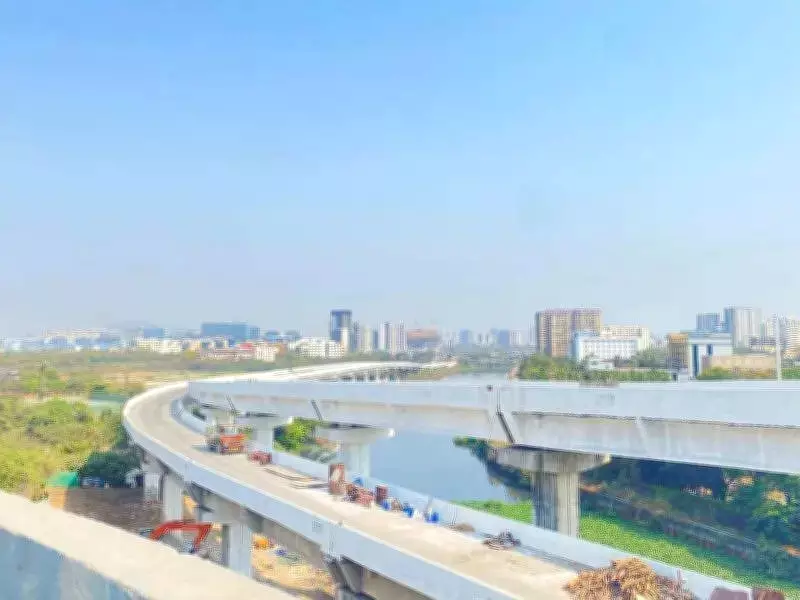
The Mumbai Metropolitan Region Development Authority (MMRDA) has completed the crucial BKC-Vakola arm of the Santacruz-Chembur Link Road (SCLR), paving the way for the entire 10.88-kilometer east-west corridor to become fully operational before the monsoon season. This final stretch connects the Bharat Diamond Bourse in Bandra-Kurla Complex (BKC) to Vakola, integrating multiple elevated arms into a continuous, signal-free corridor spanning nearly 11 kilometers.
Engineering Feat Over Vakola Nullah
The final link was achieved with the launch of twin 54-meter composite girders at two levels over the Vakola nullah. This section acts as the key link that integrates the entire SCLR network. The work was executed in one of the most congested urban stretches, over the existing nullah bridge, where conventional support systems were not feasible. Engineers used full-span launching with 700-metric-ton and 500-metric-ton cranes to place the girders. Each girder is 54 meters long, 8.5 meters wide, and weighs approximately 358 tonnes, supported by three longitudinal girders of 3.13 meters depth. The spans were erected in phases and aligned with precision while maintaining traffic flow and safety.
Critical BKC-Vakola Arm
The BKC-Vakola arm, though only about 1.4 kilometers long, includes a 500-meter four-lane elevated carriageway and 900 meters of two-lane connectors. It plays a critical role in ensuring traffic disperses across multiple arms instead of converging at key choke points. Once operational, the SCLR will provide direct, signal-free connectivity between the Eastern Express Highway and Western Express Highway via BKC, improving travel across Santacruz, Vakola, Kalina, Kurla, and Chembur. Officials said the corridor will ease congestion, cut travel time, and improve reliability of cross-city movement.

Official Reactions
Chief Minister Devendra Fadnavis stated that the project will help deliver faster and more efficient mobility across Mumbai. Deputy Chief Minister Eknath Shinde termed it a lifeline that will ease commuting across key residential and commercial hubs. MMRDA Metropolitan Commissioner Sanjay Mukherjee said the final arm completes a continuous east-west mobility spine, unlocking the full potential of the corridor.
The SCLR is expected to significantly reduce travel time for daily commuters and provide a much-needed alternative route, decongesting existing roads and improving overall traffic flow in Mumbai.