

The Telangana Legislative Assembly witnessed a fiery exchange on Monday as lawmakers debated the state's Goods and Services Tax (Amendment) Bill, 2026. The discussion quickly escalated into a sharp political confrontation between the All India Majlis-e-Ittehadul Muslimeen (AIMIM) and the Bharatiya Janata Party (BJP).
AIMIM's Scathing Critique of GST Regime
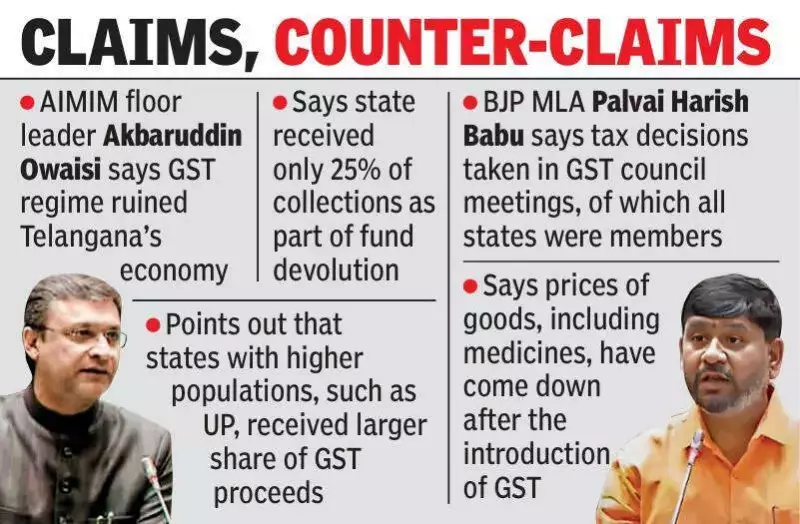
AIMIM floor leader Akbaruddin Owaisi launched a strong attack on the current GST system. He argued that the unified tax regime has severely damaged Telangana's economy. Owaisi highlighted a critical point of contention: despite the state contributing a significant share of taxes to the central pool, it receives back only 25% of the collections through fund devolution.
He further criticized the central government for not passing on benefits to consumers. Owaisi pointed out that even though the Centre allowed the blending of ethanol up to 15% in petrol, which should lower costs, the prices in Telangana saw no reduction. The AIMIM leader also framed the GST distribution as penalizing progressive states. He stated that populous states like Uttar Pradesh get a larger share, while states like Telangana and Andhra Pradesh, which have controlled population growth, are unfairly disadvantaged by the policy.

Following the passage of the Bill, Akbaruddin Owaisi staged a walkout, boycotting the proceedings in protest against what he termed an unjust system.
BJP's Defense of the "One Nation, One Tax" System
BJP MLA Palvai Harish Babu countered Owaisi's allegations vigorously. He emphasized that all tax decisions under GST are made collectively in the GST Council meetings, where every state has representation and a voice. Harish Babu defended the reform by listing its benefits, noting that the prices of several essential goods, including certain medicines, have decreased since GST's implementation.
Another BJP legislator, Payal Shankar, reinforced the argument, describing GST as a crucial reform aimed at creating a common tax system across the country. "The tax system changes from state to state. Investors are confused by the different tax systems," Shankar stated, underlining the need for uniformity to boost investment.
BJP members also criticized the state government's stance, accusing it of inconsistency. They said the government complains of revenue loss when GST rates are lowered on some items but then blames the Centre for high tax rates when GST is higher.
Government's Clarification and Technical Nature of Bill
Responding to the heated debate, state minister Jupally Krishna Rao provided clarification. He stated that the GST amendment Bill was introduced primarily to address a technical issue. Importantly, he clarified that the move was undertaken on the instructions of the Central Government, and the state government had no active role in its formulation.
The debate underscored the deep-seated political and economic disagreements surrounding the GST framework, with regional parties highlighting perceived inequities in revenue sharing and the ruling party at the centre defending it as a landmark economic reform.






