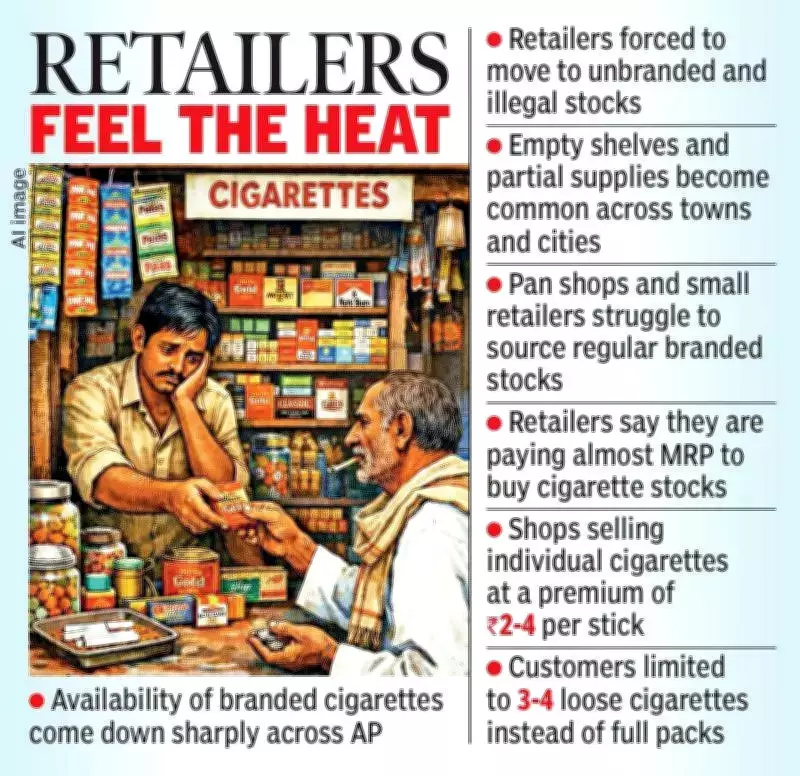
As the February 1, 2026 deadline for India's revamped tobacco tax framework approaches, Andhra Pradesh is experiencing a significant disruption in the cigarette market. Branded cigarette availability has sharply declined across the state, triggering price increases and a quiet surge in grey-market sales that is affecting both retailers and consumers.
Retailers Struggle with Restricted Supplies
For the past two weeks, pan shops and small retailers in towns and cities throughout Andhra Pradesh have faced difficulties sourcing regular branded cigarette stocks. This scarcity has forced many to turn to unbranded and illegal alternatives to meet customer demand. Empty shelves and partial supplies have become increasingly common, leaving consumers with limited options beyond purchasing loose cigarettes at inflated prices.
Retailers attribute these challenges to restricted dispatches from distributors, who they claim are releasing stocks sparingly and, in many cases, billing at or even above the printed maximum retail price (MRP). Consequently, shops have resorted to selling individual cigarettes at premiums ranging from Rs 2 to Rs 4 per stick or limiting customers to just 3 or 4 loose cigarettes instead of full packs.

The Upcoming Taxation Overhaul
The market disruption is widely linked to the new taxation regime for tobacco products scheduled to take effect on February 1, 2026. This framework introduces a tighter levy structure by calculating Goods and Services Tax (GST) on the retail sale price (RSP) rather than invoice value. Additionally, it revives central excise alongside GST and cess, while linking tax liability to manufacturing capacity—measures expected to significantly raise production costs for tobacco products.
Tax analyst K Srinivasa Rao explained that these changes are designed to close loopholes that previously allowed under-reporting and misuse of input tax credits. "From February 1, the government will tax tobacco and pan masala products based on declared RSP and installed machine capacity, not transactional values. This fundamentally alters the cost structure. Excise duty, which existed before GST, is also being brought back," he stated, adding that where multiple RSPs are printed, the highest one will be used for tax calculation.
Managed Scarcity in Vijayawada
Across busy commercial hubs in Vijayawada, shopkeepers describe what they term as "managed scarcity." Orders placed for 10 packets often arrive as just 6 or 7. Loose cigarettes are being sold at premiums of Rs 2-4 per stick, while packs with an MRP of Rs 300—previously supplied at a discount—now reach retailers at full price or higher.
"We are paying almost MRP to buy stocks now," said Ramakrishna, who operates a pan shop near Besant Road. "There's no room for profit. For regular customers, we try not to overcharge, but otherwise, selling at a small premium is the only way to survive. Even bulk orders are being cut short."
Consumer Impact and Grey Market Growth
Consumers are feeling the pinch as well. Mahesh, a private sector employee and habitual smoker, reported that buying a full pack of his favourite brand has become increasingly difficult over the past two weeks. "Most shops hand just 3 or 4 loose sticks and charge extra. It's happening everywhere," he noted, adding that he has been compelled to purchase unbranded (and often illegal, untaxed) sticks available at pan shops.
A distributor, speaking anonymously, revealed that while no official price hike has been announced yet, wholesalers are already factoring in higher post-tax costs. "We feel it is better to source some unbranded cigarettes and make quick money instead of facing this heat," he admitted, while acknowledging that retailers are paying Rs 10 more per pack in advance. "They recover it by breaking packs or charging more per stick," he added.
Industry Denials and Regional Concerns
Industry bodies, however, reject claims of genuine shortage. K Prabhakar Chowdary, who holds a senior position at a reputed tobacco company, asserted that supply remains adequate. "There is no scarcity. But traders seem to be stocking additional quantities ahead of February 1 to cushion the impact of higher taxes," he explained.

As Andhra Pradesh's tobacco-growing regions already voice concerns over rising costs and illegal trade, the current situation highlights an uneasy transition phase. Tighter tax enforcement, market speculation, and consumer demand are colliding on the state's streets, creating a complex economic landscape that will likely evolve as the 2026 deadline approaches.