

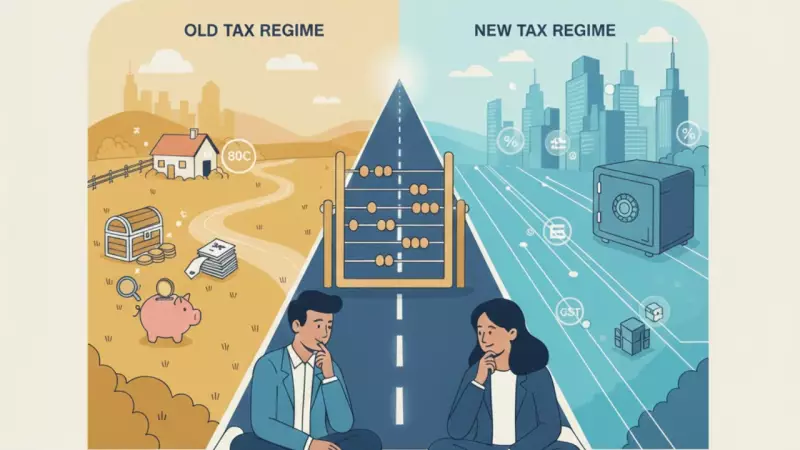
The landscape of income tax filing in India has undergone a significant shift. With the new tax regime now set as the default option, the annual decision between the old and new systems is no longer a mere formality. For the assessment year 2024-25, this choice has emerged as a critical financial decision with a direct impact on the final tax liability of countless individuals. Tax professionals report that a misunderstanding of exemptions, rent structures, and documentation has led many to inadvertently pay more tax than necessary.
Why the Regime Choice is More Critical Than Ever
According to Ashish Mehta, Partner at Khaitan & Co, filing trends show a steady migration towards the new regime, driven by government incentives. "The new tax regime is being increasingly pushed and made attractive with relaxed slab rates, a higher standard deduction of Rs 75,000, and an enhanced rebate," he explained. This effectively ensures that income up to approximately Rs 12–12.75 lakh is tax-free for salaried taxpayers under the new system. Its simplicity appeals to young professionals and those without significant deductions.
CA Ashish Niraj, Partner at A S N & Company, emphasizes the heightened importance of the decision. "With different tax rates and different exemptions allowability, choosing the correct regime is crucial. Although the new regime is the default, one can choose the old regime if it is beneficial," he stated. The government's intent to promote the new, exemption-light system is clear, but the optimal choice remains highly individual.

The Deciding Factor: House Rent Allowance (HRA) and Rent Payments
Analysis of filings for FY 2024-25 reveals that the structure of House Rent Allowance (HRA) and actual rent paid is a primary determinant. Taxpayers in high-rent metros like Bengaluru, Gurugram, and Noida with a high HRA component and correspondingly high rent payments found substantial benefits in the old regime.
CA Ashish Niraj provided a case illustration: A taxpayer with HRA and rent payments of Rs 8,00,000 each could achieve a tax saving of Rs 52,000 by opting for the old regime. However, the scenario flips when rent payments are low. In another case, where HRA was high but the actual rent was only Rs 2,00,000, the taxpayer's liability was Rs 1,10,240 lower under the new regime.
Navigating Deductions: Old Regime vs New Regime
CA Aastha Gupta clarified the deduction landscape. While the new regime offers lower slab rates and a higher standard deduction, several key deductions are exclusively available under the old regime. These include:
- Deduction for House Rent Allowance under Section 10(13A).
- Interest on housing loan for a self-occupied property under Section 24(b).
- Chapter VI-A deductions like 80C (PPF, LIC), 80D (health insurance), and 80G (donations).
- Leave travel allowance (LTA) and professional tax.
Conversely, the new regime still allows specific deductions that taxpayers often overlook. CA Ashish Niraj highlighted these:
- Employment-related conveyance allowance for travel, with proper documentation.
- Employer's contribution to NPS under Section 80CCD(2), up to 14% of salary.
- Home loan interest for a property that is let out (not self-occupied).
- Benefits under the Agniveer Scheme and certain retirement benefits like gratuity.
Common Pitfalls and Documentation Discipline
CA Shefali Mundra, Tax Expert at ClearTax, identified widespread confusion this assessment year. Many taxpayers, unaware they were defaulted into the new regime, lacked the documentation to support claims under the old one. Key errors involved:

- HRA claims failing due to missing rent agreements, receipts, or landlord PAN details.
- LTA confusion regarding eligible expenses and the four-year block cycle.
- Home-loan claim mix-ups between self-occupied and let-out property benefits.
- Unnecessary last-minute investments under 80C/80D by those already in the new regime.
CA Ashish Niraj warned of stricter compliance. The ITR now requires detailed entries like policy numbers and loan account details for deductions. With the government cross-verifying data directly from banks and insurers, claiming only genuine deductions and maintaining proof is essential. He also reminded those paying rent exceeding Rs 50,000 per month of their obligation to deduct 2% TDS under section 194-IB.
Ashish Mehta of Khaitan & Co concluded that for those choosing the old regime, rigorous document maintenance is non-negotiable. "With tighter verification and data matching, maintaining proper investment proofs, payment proofs, and loan statements can significantly reduce the risk of scrutiny," he advised. The unanimous expert recommendation is clear: taxpayers must project their income and deductions under both regimes before filing, ensuring an informed, optimal choice.





