Agra Braces for Severe Economic and Employment Crisis Over Taj Mahal Pollution Controls
The historic city of Agra is confronting a potentially devastating economic and employment crisis following the release of Report No. 61 by the Central Empowered Committee (CEC). This critical document proposes implementing extremely stringent pollution control measures within a 10-kilometer aerial radius surrounding the iconic Taj Mahal, a move that threatens to cripple key local industries.
Stringent Pollution Thresholds Create Regulatory Uncertainty
The CEC report, which is anticipated to be presented to the Supreme Court for consideration in the near future, outlines specific Air Pollution Score limits for industrial operations. Within the critical 10-kilometer radius of the Taj Mahal, the committee recommends permitting only those industries that score below 10 according to the Central Pollution Control Board's (CPCB) 2016 classification system, or below 30 under the board's forthcoming 2025 classification standards.
For areas located beyond this immediate 10-kilometer protective zone, the proposed permissible pollution score limits are slightly more lenient, set at below 20 (2016 classification) and below 60 (2025 classification). However, the deliberate use of the term "below" in the recommendations introduces significant regulatory ambiguity. This wording suggests that industrial units scoring exactly at the threshold numbers—10, 30, 20, or 60—may still be deemed ineligible for operation, creating widespread confusion and uncertainty among business owners and investors.

Footwear Industry, a Key Economic Pillar, Faces Existential Threat
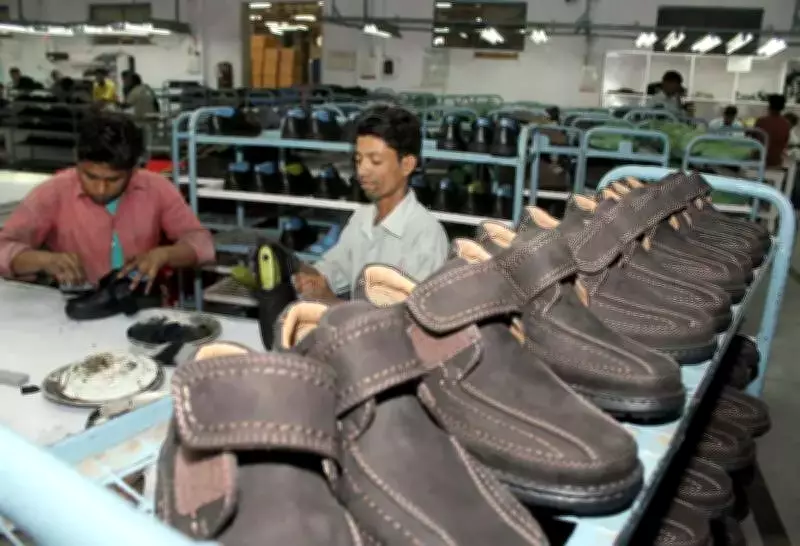
The proposed regulations pose a particularly severe threat to Agra's renowned footwear manufacturing sector, which serves as a fundamental pillar of the local economy and employment landscape. Under the CPCB's 2016 classification norms, non-tanning leather footwear manufacturing was assigned a pollution score of 10.
This score places it directly at the proposed threshold, meaning that under the "below 10" condition, new footwear manufacturing units would be completely ineligible for establishment within the 10-kilometer radius. While the updated 2025 classification assigns this activity a slightly improved score of 20—which would technically fall within the "below 30" limit for that classification—the report's simultaneous reference to both the old and new standards has generated substantial confusion and anxiety.
Industry representatives have issued stark warnings, indicating that thousands of Micro, Small, and Medium Enterprises (MSMEs) could be adversely affected if these recommendations are implemented. The potential fallout extends to lakhs of jobs being placed in immediate jeopardy, threatening the livelihoods of countless families dependent on this sector.
Centuries-Old Marble Inlay Craft Also in Peril
Adding to the crisis, Agra's centuries-old tradition of marble inlay work, known locally as pietra dura—a craft intimately connected to the cultural legacy and construction of the Taj Mahal itself—also faces an uncertain future. This artisan craft was historically assigned a pollution score of 0 in the 2016 CPCB classification, reflecting its minimal environmental impact.
Alarmingly, the draft 2025 classification reassigns this traditional activity a significantly higher pollution score of 30. Consequently, with the CEC report proposing a "below 30" threshold for new units within the protected radius, the establishment of new marble inlay workshops would be effectively prohibited. This places the entire community of skilled artisans and their families, who have preserved this heritage craft for generations, at severe risk of economic displacement.

Industry and Legal Experts Voice Grave Concerns
"The Supreme Court has consistently emphasised that environmental protection and development must coexist under the principle of sustainable development," stated a senior industry representative, who spoke on condition of anonymity due to the sensitivity of the matter. "While protecting the Taj Mahal from pollution is absolutely essential, undermining traditional crafts, vital MSMEs, and the livelihoods of thousands without a clear and scientifically robust basis would be profoundly unjust."
Echoing these concerns, senior advocate and prominent social activist K C Jain has urgently called upon the Uttar Pradesh state government to formally present the legitimate fears and detailed impact assessments of the local industry before the Supreme Court. Jain warned that if the CEC's recommendations are implemented in their current form without necessary modifications, they could effectively halt all industrial growth and development across large sections of Agra city, triggering a prolonged regional economic downturn.
Background on the Taj Trapezium Zone (TTZ)
The Taj Trapezium Zone is a specially designated environmental protection area encompassing approximately 10,400 square kilometers around the Taj Mahal. It was established with the primary objective of safeguarding the 16th-century UNESCO World Heritage monument from the detrimental effects of industrial and urban pollution.
This vast zone spans multiple districts across two states:
- Uttar Pradesh: Agra, Mathura, Firozabad, Hathras, Etah, and parts of Aligarh.
- Rajasthan: Bharatpur and parts of Dholpur.
The impending decision on the CEC report therefore holds consequences not just for Agra, but for economic activity across this entire interconnected region.