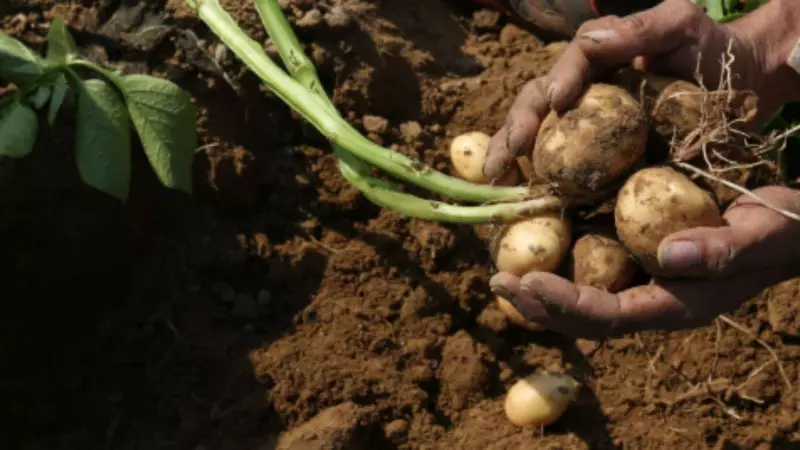
Bathinda Farmer's Aeroponic Potato Seed Venture Nets Over Rs 1 Crore in Debut Year
In a remarkable demonstration of agricultural innovation, a young farmer from Bathinda district has achieved a turnover exceeding Rs 1 crore in his very first year of cultivating potato seeds using aeroponic technology. This success story emerges at a time when Punjab's agricultural sector faces significant challenges, including diminishing farm incomes, escalating input costs, and an overreliance on traditional wheat-paddy cycles.
From Traditional Farming to High-Tech Cultivation
Ramandeep Singh, a 30-year-old resident of Maur Khurd village in Bathinda, has transformed just 2.5 kanal of land—less than one-third of an acre—into a thriving aeroponic potato seed production facility. Coming from a family that traditionally cultivated wheat and paddy seeds on their four-acre plot, Ramandeep recognized the need to move beyond conventional methods to ensure sustainable agricultural livelihoods.
With a BSc in Agriculture from Punjab Agricultural University (PAU, Ludhiana) and currently pursuing an MSc in Plant Breeding, Ramandeep combined academic knowledge with practical innovation. "Like most farming families in Punjab, our livelihood revolved entirely around the wheat-paddy cycle," he recalled. "Three years ago, I realized that surviving in agriculture required moving beyond conventional crops and adopting advanced technologies."

The Aeroponic Technology Advantage
Aeroponic cultivation represents a sophisticated approach to agriculture where plants are supported on specially designed sheets with holes, allowing roots to hang freely in the air. This system incorporates precise mechanisms for water and nutrient application, enabling meticulous control over environmental factors.
"This allows precise control over nutrients, water, temperature, moisture and disease, making it ideal for producing genetically pure, virus-free planting material," Ramandeep explained. His facility includes high-tech greenhouses, dark chambers for root and tuber development, drying chambers, cold rooms, and cold storage units—all designed to optimize production conditions.
Economic Impact and Production Scale
The economic returns from this venture are substantial. Ramandeep's aeroponic facility houses double greenhouse units, each measuring 40×100 feet, with a combined production capacity of nearly one million G-0 mini-tubers per season. Depending on the variety, the G-0 produce alone is valued at over Rs 1 crore.
When these initial tubers are multiplied into G-1 seed, their quantity increases nearly five-fold, potentially raising the turnover to Rs 2–2.5 crore. The unit became operational in 2023, with the first harvest taken in early 2024. Now in its third year of production, Ramandeep has almost recovered the entire setup cost and is earning over 50 percent profit annually.
Technical Collaboration and Institutional Support
This innovative approach benefits from institutional collaboration. The ICAR–Central Potato Research Institute (CPRI), Badshahpur, Jalandhar, developed the aeroponic technology and is disseminating it to interested farmers through technology transfer memorandums of understanding (MoUs).
"We are grateful to Dr Sukhwinder Singh of CPRI, who developed this aeroponic technology and provided us with complete knowledge and support in setting up this facility," Ramandeep acknowledged. The total investment in the project ranges between Rs 1.65 crore and Rs 1.70 crore, with no government subsidies currently available for aeroponic potato seed production.
Production Process and Market Potential
The cultivation process begins with fresh tissue culture plants costing Rs 16 per plant, each producing 70–80 mini-tubers. The planting cycle starts in October-November, with tuber formation beginning after a month of growth. Harvesting continues from December through April or May.
"G-0 mini-tubers are planted in open fields to produce G-1 seed, which is further multiplied into G-2 and G-3," Ramandeep detailed. "Around 40,000 G-0 tubers are required per acre, which can produce nearly two lakh G-1 tubers—increasing nearly five times at each stage, making early-generation seed extremely valuable."

From one million G-0 tubers, nearly five million G-1 tubers are produced through contract farming across approximately 25 acres. Ramandeep supplies G-0 seed to farmers free of cost and later procures the entire produce at pre-agreed per-acre rates. G-1 seed sells at Rs 4-5 per tuber, with net annual profits ranging between 50 and 60 percent after expenses.
Varieties and Regional Impact
The Bathinda facility produces multiple potato varieties including Santana Fry and Dona Fry, chipping varieties like Chipsona-1, Chipsona-2 and LR, and table varieties such as Diamond and Pukhraj. This diversity caters to different market segments and agricultural needs.
Ramandeep's father, Sarabjit Singh, noted that the initiative is already benefiting other small farmers. "Many purchase G-0 seed in limited quantities and multiply it on small landholdings to produce seed for much larger acreage," he observed. The Bathinda facility stands among the largest aeroponic potato seed units in the region, potentially transforming India's seed supply system.
Challenges and Future Prospects
Despite the success, Ramandeep cautions that aeroponics requires substantial initial investment, technical understanding, and constant monitoring. "Even a minor pump failure or power outage must be avoided," he emphasized.
However, he remains optimistic about the technology's potential. "Once the chain is established, it becomes a long-term ecosystem involving farmers, seed producers and processing companies," Ramandeep explained. "With proper training and institutional support, aeroponics can be a game changer in the production of virus-free seed."
This innovation addresses a significant market gap, as only around eight percent of India's potato seed requirement is currently met through organized, virus-free systems. For forward-thinking farmers willing to invest in technology, this presents immense opportunities to revolutionize agricultural productivity and profitability.