

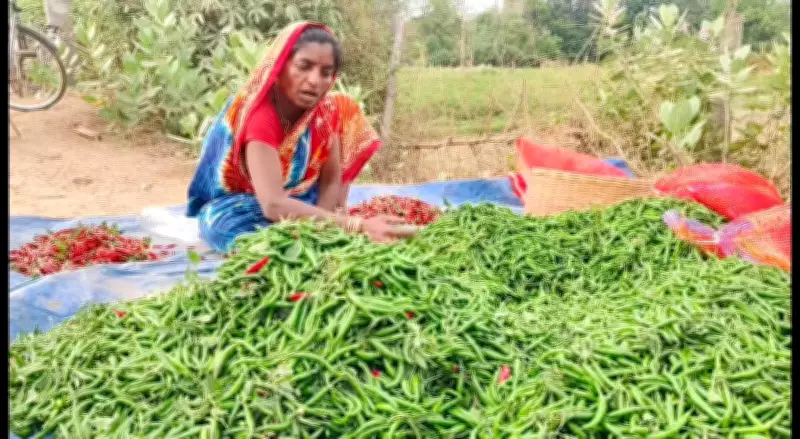
Chilli Farmers in Ganjam Grapple with Severe Price Plunge
Following the recent tomato crisis, farmers in Ganjam district, Odisha, are now confronting significant financial distress as green chilli prices have collapsed dramatically over the past several weeks. The situation has forced many to sell their produce at a mere Rs 15 to Rs 20 per kilogram directly in the fields, a stark contrast to earlier rates.
Export Disruptions and Declining Demand Cripple Trade
The primary factors behind this sharp price drop are twofold. Firstly, the ongoing conflict in West Asia has severely hampered export channels, which traditionally handle a substantial portion of Ganjam's chilli shipments. Secondly, there has been a noticeable slowdown in demand from other Indian states, compounding the market stagnation.
Kishore Kumar Reddy, a chilli cultivator from Bada Madhapur in Chhatrapur block, explained the usual process. "Traders from various states typically arrive in Ganjam during the peak harvest season from March to May to procure green chillies directly from farmers. These are then exported through specialized export houses," he stated. However, this year, that direct procurement has nearly halted.

Reddy pointed to the geopolitical tensions, specifically mentioning the war involving the US, Israel, and Iran, as a likely cause for the export slowdown. "This conflict might have disrupted the export of chillies from India, which is why traders are not coming to buy from us directly this season," he added.
Farmers Express Deep Disappointment and Financial Strain
The price crash has left farmers reeling. Abhimanyu Behera, who cultivates chillies on two acres in Poirasi within Ganjam block, voiced his frustration. "We are extremely disappointed by this price collapse and are struggling immensely to recover our initial investments. It's becoming very difficult to sustain our operations," he said.
Another farmer, Sudhir Sabat from the Ranajhali area in Purushottampur block, shared his experience. He had earned approximately Rs 3 lakh from selling green chillies grown on his two-plus acres of land previously, with exporters sending his high-quality produce to international markets. "Presently, we are solely dependent on local markets, which offer much lower prices," Sabat lamented.
Agricultural Scope and Official Perspective
Kandha Jena, the Deputy Director of Horticulture for the district, provided context on the cultivation scale. He noted that chillies are grown as a summer crop across roughly 6,000 hectares in Ganjam district. Major chilli-producing blocks include Chhatrapur, Ganjam, Purushottampur, and Hinjili. Jena reported that about 70-80% of the crop has already been harvested this year.
Regarding the price decline, Jena acknowledged that reduced demand from both other states and foreign countries could be contributing factors. However, he offered a note of cautious optimism, describing the situation as likely temporary. "The demand for green chillies is expected to increase once export activities regain momentum," he assured.
The current scenario underscores the vulnerability of agricultural communities to global geopolitical events and market fluctuations, with Ganjam's chilli farmers bearing the brunt of this unexpected downturn.






