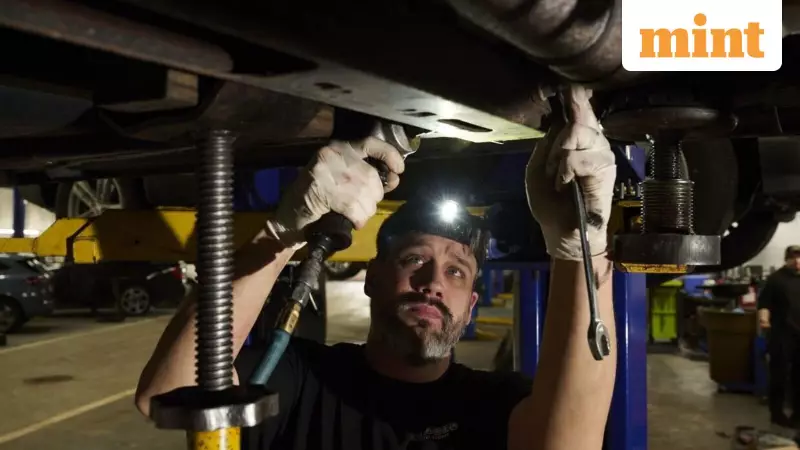
In a surprising revelation that highlights a deep crisis in the skilled trades, Ford Motor Company's CEO, Jim Farley, stated in November that the automaker's dealerships across the United States have a staggering 5,000 open jobs for mechanics. These are not minimum-wage positions; they are roles that can pay upwards of $120,000 to $160,000 annually for top performers. Yet, the bays remain empty, tools unused, and the jobs unfilled.
The $160,000 Technician: A Rare Breed
Ted Hummel, a 39-year-old father of two working at Klaben Ford Lincoln in Kent, Ohio, represents the pinnacle of this profession. As a 'senior master' technician, the highest certification offered by Ford, Hummel earned approximately $160,000 in 2025. His specialty is the arduous task of replacing transmissions—300-pound, duffel-bag-shaped units that most mechanics avoid. On a recent morning, he confidently tackled a 10-hour transmission job on a 2019 Ford F-150, aiming to finish it in under five.
"I wish we could clone Ted," said Sean Bradford, the service manager at Klaben Ford. But there simply aren't enough technicians like him. Hummel's high earnings are tied to a 'flat rate' pay system common in dealerships. He is paid a fixed fee for each job, regardless of how long it actually takes. His speed and efficiency, born from over a decade of experience, allow him to bill far more hours than he physically works, turning a complex repair into a lucrative payday.

The Gruelling Path to a Six-Figure Paycheck
Despite the potential for high earnings, the journey to that level is fraught with barriers. Ford's CEO noted that these jobs take five years to learn. The initial investment is steep: aspiring mechanics often need to spend tens of thousands of dollars on their own tools, frequently financed through weekly payments to specialised "tool trucks." Hummel himself owns specialised torque wrenches mandated by Ford that cost $800 each.
The starting pay is a far cry from six figures. Hummel began his career in 2007 at a muffler shop earning less than $10 an hour. After obtaining a two-year automotive technology degree costing $30,000 and joining the Ford dealership in 2012, it took him a full decade to cross the $100,000 mark in 2022. The median pay for a dealership mechanic in the U.S. was $58,580 in 2024, according to the Bureau of Labor Statistics.
The physical toll is another major deterrent. The work is gruelling, involving heavy lifting and contorting into tight spaces. Jim Eisenberger, another transmission expert at Klaben Ford who also earned a six-figure salary, was forced to leave the job after developing hernias and enduring chronic pain. "I still pushed... but it was never the same," he said, having now moved to a startup creating digital guides for mechanics.
A Systemic Shortage with Rising Costs
The mechanic shortage is not new, but it is intensifying, with direct consequences for consumers. The cost of car maintenance and repairs is soaring, rising 6.9% in November year-over-year, significantly faster than overall inflation. From 2014 to 2024, repair costs jumped 59%, while mechanic wages grew only 34%.
Ford acknowledges that while senior master technicians average about $67,000 after five years, only those at the very top, like Hummel, reach the $120,000+ bracket. The company is attempting to address the gap through initiatives like 33 technician training centers in the U.S. and scholarship programs for tuition and tools.
Back in Kent, as Hummel finished his transmission swap in about 5.5 hours—logging 14.6 billed hours—and took the truck for a smooth test drive, the reality of the shortage was clear. The other bays were full. The next morning at 7 a.m., he would be ready to do it all over again, a highly skilled professional in a field desperate for more like him. The auto industry's lucrative promise remains, but the path to claiming it is proving too steep for many.