Ahmedabad: The government of India has increased the import duty on gold and silver to 15%, prompting major concerns within the gems and jewellery industry in Gujarat over liquidity and potential job losses. Bullion traders have also cautioned about a possible surge in unofficial trade channels.
New Duty Structure
Under the revised structure, the basic customs duty on gold and silver imports has been doubled from 5% to 10%, while the Agriculture Infrastructure and Development Cess (AIDC) has been raised from 1% to 5%. This brings the total effective levy to 15%. In the Ahmedabad market, gold prices surged by Rs 10,000 in a single trading session, reaching Rs 1.65 lakh per 10 grams. The government's move aims to curb rising precious metal imports, narrow the trade deficit, and support the rupee amid external pressures.
Industry Reactions
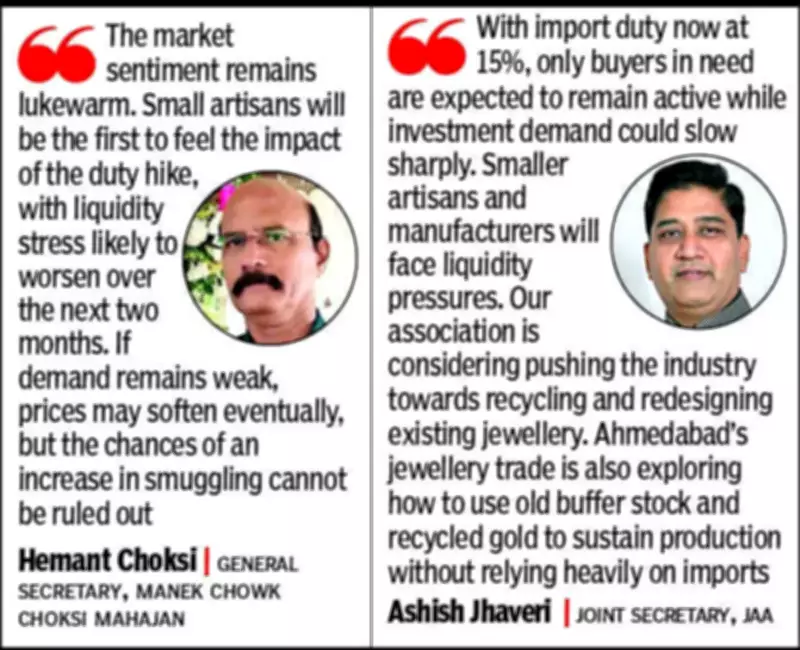
Industry representatives have expressed concerns over weakening domestic demand and employment generation in the sector following the duty hike. Haresh Acharya, director of the India Bullion and Jewellers’ Association (IBJA), stated: “The industry supports the government’s broader economic objectives. However, the rise in duties and the PM’s call to avoid gold purchases has already begun to impact demand. Gold is already being sold at a discounted rate of $200 per ounce, as buyers are staying away amid elevated prices and uncertainty following the customs duty hike. In the near-term, we do not expect any major demand to sustain. A recessionary trend is becoming visible in the trade, and this could put jobs across the jewellery value chain at risk.”

Proposals to Mitigate Impact
The Gems and Jewellery Export Promotion Council (GJEPC) convened a meeting with major retailers and manufacturers and submitted recommendations to the Prime Minister aimed at reducing import dependence and strengthening domestic recycling. Proposed measures include:
- Greater promotion of lower-carat jewellery, such as 14K and 9K products, which could reduce gold imports by 20-30%.
- Encouraging exchange of old gold for new jewellery purchases.
- Revamping the Gold Monetisation Scheme (GMS) to mobilise India’s estimated 25,000 tonnes of idle household gold stock.
- Discouraging investment demand for gold bars, billets, and coins.
The council also sought a dedicated policy framework for jewellery exporters, arguing that the sector earns significant foreign exchange and requires support amid global economic uncertainty. According to GJEPC, exporters now face bank guarantees of nearly Rs 28 lakh to Rs 30 lakh per kg of duty-free gold, creating severe liquidity stress, particularly for micro, small and medium enterprises (MSMEs), which account for nearly 80% of the council’s membership base.
Call for Gold Exchange Programmes
Industry stakeholders have indicated their willingness to align with the government’s objective of reducing import dependence and promoting recycling-led consumption. Jigar Soni, president of the Jewellers’ Association Ahmedabad (JAA), said: “We are encouraging gold exchange programmes in a big way so that consumers recycle existing jewellery instead of purchasing fresh bullion. We have also requested the government to consider pausing investments into gold ETFs for a year to ease import pressure. Demand for 24-carat purchases has already slowed sharply, and many businesses across the sector are now rethinking their business models in response to the changing market dynamics.”