Pune Industrialist's Dramatic Helicopter Escape Highlights Expressway Crisis
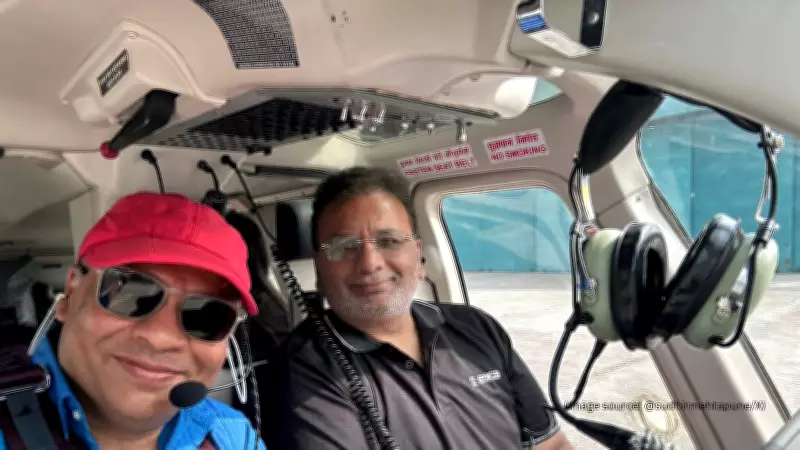
In a dramatic incident that has exposed critical infrastructure gaps, prominent Pune industrialist Dr Sudhir Mehta resorted to an unconventional solution when trapped in a massive 33-hour traffic jam on the Mumbai-Pune Expressway. After being stranded for nearly eight hours following a gas tanker accident, Dr Mehta arranged for a helicopter to fly him back to Pune, bypassing the complete gridlock that had paralyzed one of Maharashtra's busiest highways.
The Incident That Triggered Chaos
The crisis began on Tuesday afternoon when a gas tanker overturned at approximately 4:45 PM near the Borghat stretch of the Khandala ghat section in Raigad district. The accident occurred roughly 50 meters ahead of a tunnel, creating an immediate bottleneck that quickly escalated into a complete standstill. Thousands of commuters found themselves trapped on the expressway, with many reporting being stuck for over 30 hours without movement.
Dr Mehta, who was among those stranded, took to social media platform X to document the ordeal and highlight what he called "poor emergency preparedness" on this crucial transportation artery. "Lacs of people are stuck on the #Mumbai #Pune expressway for the last 18 hours for 'one gas tanker'," he wrote in a post that quickly went viral.

Industrialist's Scathing Assessment of Ground Situation
Describing the chaotic scene on the ground, Dr Mehta reported that traffic discipline had completely collapsed during the crisis. "This is the state of the #Mumbai #Pune highway. Complete free for all including wrong side driving," he observed. "The lifeline of connectivity for the region is deteriorating by the day."
He further emphasized the safety risks involved, stating, "Travelling on the same is playing roulette on one's life plus 7 hours to reach." Despite the challenging circumstances, Dr Mehta acknowledged the assistance he received from officials, specifically thanking @nitinwelde for helping arrange his return to Pune after the eight-hour ordeal.
Proposed Solutions for Future Emergencies
Beyond documenting the crisis, Dr Mehta proposed concrete solutions to prevent similar situations in the future. His primary recommendation involves creating emergency infrastructure along the expressway:
- Emergency Exits: He suggested that authorities should build emergency exits at multiple points along the Mumbai-Pune Expressway to allow vehicles to turn around during such crises, preventing complete gridlock.
- Helipad Installation: Dr Mehta called for mandatory helipads to be installed at various points near the expressway for emergency evacuations. He noted that "Helipads cost less than Rs 10 lacs to make and require less than one acre of open area."
Public Reaction and Broader Implications
The industrialist's post generated significant public engagement, with many users echoing his concerns about infrastructure preparedness. One user commented, "What we need is people to be held accountable for such a mess. Civic authority should be equipped/prepared and ready for all eventualities."
Another user supported the emergency exit proposal while adding, "Along with emergency exits plan, restoration of normal traffic should be planned in a time bound manner by removing or airlifting the damaged vehicles immediately." A third response highlighted broader governance issues: "High time for govt to do some serious work on facility when people paying high tax. Scams just ruins our life."
This incident has sparked a crucial conversation about emergency preparedness on India's major transportation corridors. As expressways become increasingly vital for economic connectivity between major cities like Mumbai and Pune, the need for robust contingency planning becomes more apparent. The 33-hour standstill and Dr Mehta's extraordinary escape by helicopter serve as a stark reminder that infrastructure development must include emergency response mechanisms alongside regular traffic management systems.