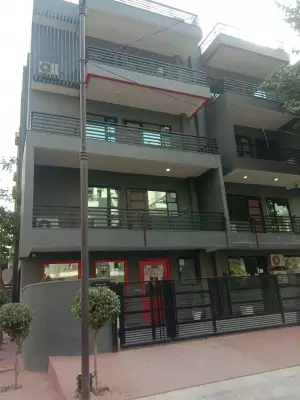
Builders and urban planning experts have urged the Jaipur Development Authority (JDA) to relax setback norms for plots falling within Jaipur's five proposed Transit-Oriented Development (TOD) corridors. They argue that rigid rules could reduce developable land, increase project costs, and weaken the effectiveness of the policy.
Proposal Submitted to JDA Commissioner
A proposal submitted to JDA Commissioner Siddharth Mahajan on Wednesday stated that the Rajasthan government's TOD framework, if implemented with uniform setback requirements, may discourage real estate investment in the designated corridors.
"The policy promulgated by the Rajasthan government suggests that plots in these areas should have mandatory side and rear setbacks as per prevailing building bylaws, which is a maximum of 12 metres. We have requested not to keep this provision uniform. Rather, they can give exigencies for three categories," said Anmol Devendra, a lawyer who filed the proposal on behalf of a group of builders and town planners.

Flexible Approach Recommended
The experts recommended adopting a more flexible approach similar to TOD models followed in cities such as Mumbai, Ahmedabad, Bengaluru, and Delhi. According to them, lower setback requirements would improve land-use efficiency and make projects more viable for both developers and property owners.
"We are proposing a 30% to 40% reduction in the setback for a lot abutting a public park, green belt, playground, or water body on the rear or on one or both sides of the plot," said a town planner associated with the Urban Development and Housing (UDH) department.
Proposed Changes for Rear Setbacks
The proposal further suggested that plots with roads on the rear side should treat the rear portion as secondary frontage, allowing rear setbacks to comply with front setback norms.
Experts also sought special provisions for plots adjoining government, railway, and utility land, excluding defence areas. In such cases, they recommended reducing rear setbacks to minimum fire separation standards.
Industry Perspective
"Since it's a pan-India policy, it is good to have uniformity with policies adopted by other states. Otherwise, either the TOD policy won't be successful, or builders would try to manipulate government bodies to increase FARs and BARs, ultimately burdening property owners," said builder Amit Surana.