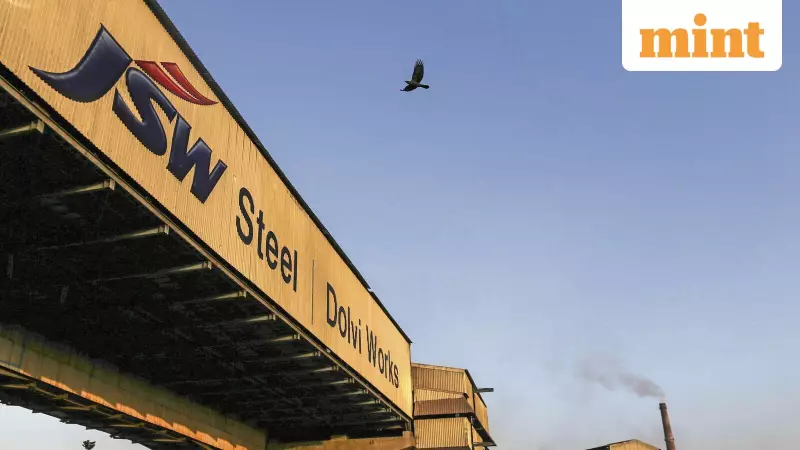
MUMBAI: In a significant strategic shift, JSW Steel Limited, India's largest steelmaker by installed capacity, has dramatically accelerated its growth trajectory. The company now projects reaching approximately 56 million tonnes per annum (mtpa) of production capacity by the fiscal year 2031, substantially surpassing its previous guidance of 50 mtpa. This ambitious revision comes as the steel giant emerges from a challenging period characterized by weak pricing and margin compression, while simultaneously intensifying efforts to secure critical raw materials and capitalizing on early indicators of demand recovery.
Revised Expansion Targets and Strategic Investments
Jayant Acharya, Joint Managing Director and Chief Executive Officer of JSW Steel, revealed in an exclusive interview that the revised 56 mtpa target specifically excludes capacity from the company's recently established joint venture with Japan's JFE Steel Corporation. Under this partnership, JSW divested a fifty percent stake in its subsidiary, Bhushan Power and Steel Limited (BPSL). Acharya clarified that inclusive of BPSL's potential contributions, the consolidated capacity could potentially exceed 60 mtpa by the target fiscal year.
"We expect to achieve—without accounting for expansion within the BPSL joint venture—a capacity of 56 million tonnes by the conclusion of fiscal year 2031," Acharya stated. This expanded footprint will include 1.5 mtpa located in the United States, with the remaining 54.5 mtpa situated across various facilities in India.

Detailed Capacity Breakdown and Future Upside
Currently, JSW Steel's operational capacity stands at 35.7 mtpa. This figure encompasses the 4.5 mtpa from BPSL and the 1.5 mtpa plant in Ohio, USA. The management has identified further potential upside from the BPSL asset, where capacity could be expanded independently by the joint venture partners from the current 4.5 million tonnes to a potential 10 million tonnes.
"That expansion pathway will operate on a parallel track, with decisions and execution resting solely with the joint venture partners," Acharya explained regarding the BPSL potential.
To fuel this aggressive growth, the company has charted a monumental capital expenditure plan. JSW Steel intends to invest approximately ₹1 trillion (one lakh crore rupees) over the coming four to five years specifically for capacity augmentation.
"We will provide a detailed year-wise breakdown during our annual and fourth-quarter results announcement in May. However, broadly speaking, this investment will be spread relatively evenly across the period, with a slightly higher allocation in the initial two years before gradually tapering," Acharya informed analysts during a post-earnings interaction.
Industry-Wide Capacity Expansion Context
JSW Steel's ambitious plans are part of a broader industry surge. Collectively, major Indian steel producers—JSW Steel, Tata Steel, Steel Authority of India Limited (SAIL), and ArcelorMittal Nippon Steel India (AMNS)—are projected to add approximately 63.7 mtpa of new capacity by 2031.
- Tata Steel plans to add roughly 13.4 mtpa, elevating its capacity from 26.6 mtpa to 40 mtpa.
- SAIL's expansion initiatives will contribute an additional 14 mtpa, raising its capacity from 21 mtpa to 35 mtpa.
- AMNS India is undertaking a sharp scale-up of 16 mtpa, aiming to increase capacity from 9 mtpa to 25 mtpa.
Securing Raw Material Supply Chains
Parallel to its capacity growth, JSW Steel is aggressively working to secure its raw material supply, a critical factor for cost control and operational stability. The company aims to meet about 50% of its iron ore requirements from captive mines by FY31. This target is supported by its portfolio of 23 operational mines spread across multiple Indian states.
Regarding coking coal, a key input, JSW is targeting 25% captive sourcing. This proportion could potentially increase to 33-35% upon the successful completion of a pending acquisition of a coking coal mine in Mozambique.

Financial Performance and Market Outlook
The announcement follows the company's financial results for the quarter ended December 31, 2025. JSW Steel reported a consolidated net profit of ₹2,139 crore, a substantial increase from ₹717 crore in the corresponding quarter of the previous year. This performance exceeded the consensus estimate of ₹1,406.7 crore from a Bloomberg poll of thirteen analysts.
Operational revenue witnessed an 11% year-on-year jump to ₹45,991 crore. Adjusted Earnings Before Interest, Taxes, Depreciation, and Amortization (EBITDA) rose by 22% to ₹6,620 crore, resulting in an EBITDA margin of 14.4%.
Acharya noted that the quarterly profit was bolstered by specific one-time items: a deferred tax asset recognition of ₹1,439 crore linked to BPSL and an exceptional employee-related provision of ₹529 crore due to changes in labor codes. Excluding these items, profitability faced sequential pressure from weaker realizations and elevated coal costs, though the impact was partially cushioned by a favorable product mix leaning towards value-added steel.
Looking ahead, after a prolonged period of multi-year low steel prices and high input costs weighing on earnings, Acharya expressed cautious optimism. "I believe that with factors like rupee depreciation and some improvement in domestic demand, prices should move to more reasonable levels during this current quarter," the CEO stated. While refraining from specific price guidance, he indicated that rising coking coal costs would necessitate price increases.
"We estimate an impact of $15 to $20 per tonne from higher coking coal prices this quarter, which we expect to mitigate through strategic pricing adjustments and cost-control measures," Acharya added.
Addressing Regulatory Scrutiny
On the topic of recent media reports alleging industry-wide price collusion, Acharya firmly stated that JSW Steel sees no merit in such allegations and remains fully compliant with all competition laws.
"JSW Steel remains fully confident in its compliance with all applicable competition laws and regulations of the land," he asserted. He further emphasized that the market for Thermo-Mechanically Treated (TMT) bars, the product in question, is highly price-sensitive and predominantly served by secondary players, making collusion unlikely.
This statement comes in response to a recent Reuters report citing a confidential document from India's competition watchdog, which allegedly found that market leaders including JSW Steel, Tata Steel, SAIL, and 25 other firms colluded on steel selling prices, potentially exposing them to significant penalties.