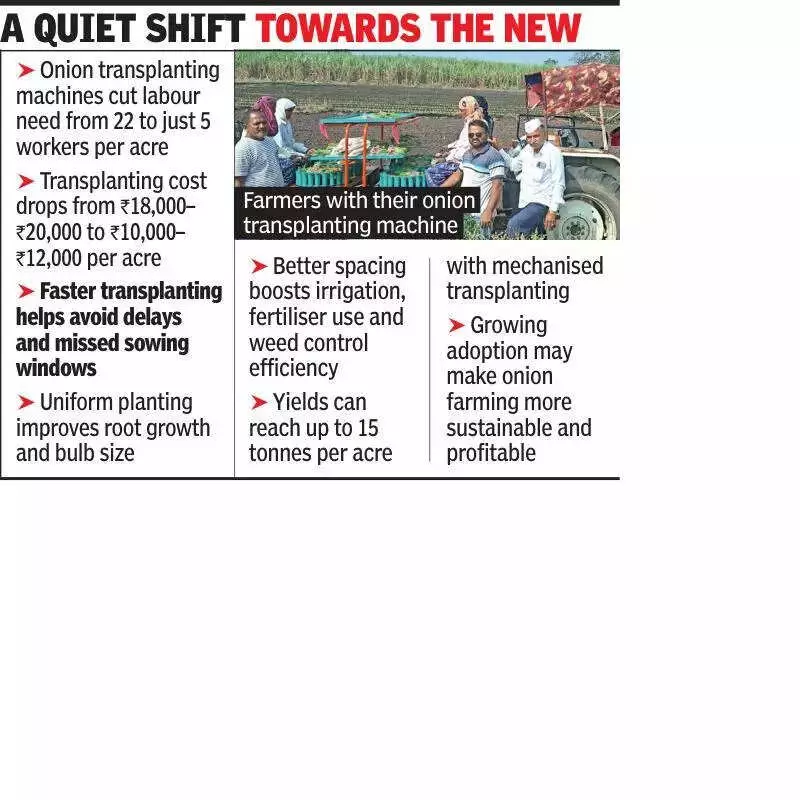
In the agricultural heartlands of Maharashtra, a quiet revolution is underway as farmers increasingly turn to mechanized solutions to sustain their livelihoods. Faced with the dual challenges of escalating labor costs and severe worker shortages during critical farming seasons, onion growers are embracing transplanting machines as a game-changing innovation.
The Labor Challenge in Traditional Onion Cultivation
Onion transplanting has historically represented one of the most demanding phases of cultivation, requiring intensive manual labor that has become increasingly problematic for farmers. The traditional approach necessitated between 20 to 22 workers to transplant seedlings across a single acre of land, with wage expenses alone ranging from Rs18,000 to Rs20,000. This substantial financial outlay was further compounded by additional costs for transportation and food provisions for the workforce.
"Earlier, arranging workers was the biggest challenge," explained Bhalchandra Khokarle, a farmer from Hirdewadi village near Narayangaon. "They were not available on time even if we had money. The uncertainty caused significant delays that often resulted in missed optimal sowing windows, directly impacting final yields."

Mechanized Transformation in Pune District
In Pune district's Junnar taluka, onion transplanting machines have rapidly gained acceptance among the farming community. These innovative agricultural implements have demonstrated remarkable efficiency, allowing farmers to complete transplanting operations on one acre with just five workers and a tractor driver, at a substantially reduced cost of Rs10,000 to Rs12,000.
The time savings are equally impressive, with mechanized transplanting dramatically reducing the hours required compared to traditional manual methods. "Manual transplanting on an acre took nearly 20 hours and a large workforce earlier," noted farmer Ramesh Bangar, highlighting the transformative efficiency of the new technology.
Beyond Cost Savings: Quality Improvements
While financial benefits are significant, farmers report that the advantages of mechanized transplanting extend far beyond mere cost reduction. The machines provide unprecedented uniformity in planting, ensuring seedlings are placed at consistent depth and spacing across the field.
"Spacing varies and affects growth with manual planting," observed Deepak Ukirde, a farmer from Junnar taluka. "Every sapling gets equal space and nutrients with the machine. The crop is healthier and better yields are a reality."
This uniformity facilitates better root development and promotes consistent bulb size, while also making subsequent agricultural operations more efficient. Irrigation, fertilizer application, and weeding become significantly easier to manage when plants are arranged in perfectly spaced rows.
Expert Perspectives on Mechanization Benefits
Agricultural experts and officials have noted the broader implications of this technological shift. According to state agriculture officials, mechanized transplanting can improve overall productivity by ensuring optimal plant population per acre while conserving valuable resources.
"Uniform rows help save water, as drip or flood irrigation can be managed precisely," explained officials. "Farmers estimate that an acre planted using the machine can yield up to 15 tonnes of onions, depending on the variety and management practices."
The technology also reduces farmers' dependence on seasonal migrant workers, whose availability has become increasingly unreliable in recent years. This increased autonomy allows for better planning and timing of critical agricultural operations.
Future Implications for Maharashtra Agriculture
The growing adoption of transplanting machines carries significant implications for Maharashtra, which stands as one of India's largest onion producers. As mechanization spreads, it promises to reshape the economic landscape of onion cultivation across the region.
"As more farmers witness the economic and agronomic benefits, mechanization is likely to play a crucial role in making onion cultivation more sustainable and profitable in the future," predicted farmer activist Shantaaram Sarvade of Khed.

This technological transition represents more than just a shift in farming methods—it signifies a fundamental reimagining of agricultural practices that could enhance food security, improve farmer livelihoods, and strengthen Maharashtra's position in India's agricultural economy for years to come.