

Mango Cultivation Expands Across Saurashtra Despite Adverse Weather Conditions
In the vibrant region of Saurashtra, Gujarat, the king of fruits—the mango—is demonstrating remarkable resilience and growth despite facing significant climate challenges. Unseasonal rains, erratic weather patterns, and major cyclones such as Tauktae have not deterred the expansion of mango cultivation across this agricultural landscape.
Steady Growth in Cultivation Area and Production
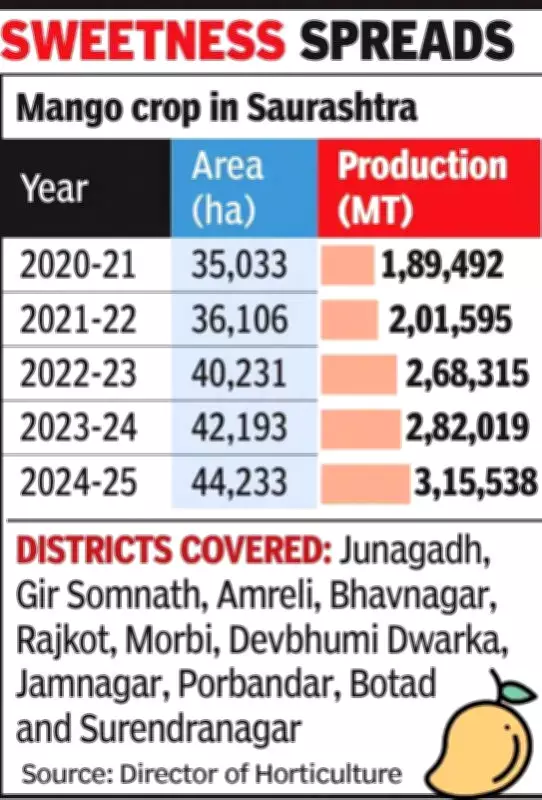
According to data from the Gujarat horticulture department, mango cultivation has experienced a substantial surge over the past five years. The area dedicated to mango farming has expanded by nearly 10,000 hectares, while production has increased by over 1 lakh metric tonnes. This growth represents a significant shift in agricultural practices and crop preferences in the region.
Once primarily concentrated in traditional growing areas like Junagadh and Gir Somnath, mango cultivation has now spread to nearly all talukas of Saurashtra. Farmers are experimenting with various varieties, including hybrid types such as sonpari and pusa arunima, as well as heirloom varieties from the Nawab era like dudh pendo and begam pasand. However, it is the kesar mango that dominates this agricultural expansion.

The Dominance of Kesar Mango
Official figures highlight the remarkable growth of kesar mango cultivation. In the 2020-21 season, the area under kesar cultivation was approximately 35,000 hectares, producing 1.89 lakh metric tonnes. By the 2024-25 season, this had increased to over 44,000 hectares, with production reaching 3.15 lakh metric tonnes. Data for the 2025-26 season, including the most recent mango harvest, is still pending release.
Experts attribute the success of kesar mango to several key factors:
- Superior flavor that appeals to both domestic and international markets
- Natural resistance to common diseases, reducing the need for chemical interventions
- Strong export demand, particularly from the Gujarati diaspora in countries like the United States, Canada, Australia, and Europe
Changing Investment Patterns and Agricultural Shifts
The expansion of mango cultivation is also being driven by changing investment patterns. Several high-net-worth individuals are reportedly "parking" money in farmland, especially in the Gir region, and choosing mango cultivation as a preferred agricultural activity. As one farmer explained, "These people don't grow for profit but as a hobby. They want mango orchards where they can relax with family and friends and distribute the fruit in their groups."
The cultivation map of Saurashtra is undergoing a visible transformation. D K Varu, principal and dean of the College of Horticulture at Junagadh Agricultural University, noted that new pockets of growth are emerging across the region. "Young farmers are experimenting and expanding. New kesar-growing areas have developed, including the hilly terrain between Ranavav (Porbandar), Bhanvad and Kalyanpur (Devbhumi Dwarka), Upleta (Rajkot) and Jesar in Amreli district," he stated. He added that districts such as Bhavnagar, Rajkot, Morbi, and Jamnagar are also adopting kesar cultivation.
Youthful Shift Toward Horticulture
Tushar Dhameliya, director of a local Farmer Producer Organization in the Gir area, highlighted a significant trend among younger farmers. "Young farmers are moving towards horticulture from traditional crops and kesar mango is their first choice because it is a cash crop and requires minimal extra care after the initial two to three years," he explained.
Dhameliya further noted that while many traditional farm commodities struggle to fetch good prices in the market, "Mangoes guarantee a good price in the urban market and offer huge potential for exports, giving farmers a chance to earn in dollars." This economic incentive, combined with the crop's resilience and market demand, is driving the continued expansion of mango cultivation across Saurashtra.

The story of mango cultivation in Saurashtra represents a remarkable agricultural success story—one that demonstrates how traditional crops can adapt and thrive even in the face of climate challenges, while also reflecting changing economic patterns and generational shifts in farming practices.





