

Noida Gripped by Chaos as Industrial Workers Demand Wage Parity with Haryana
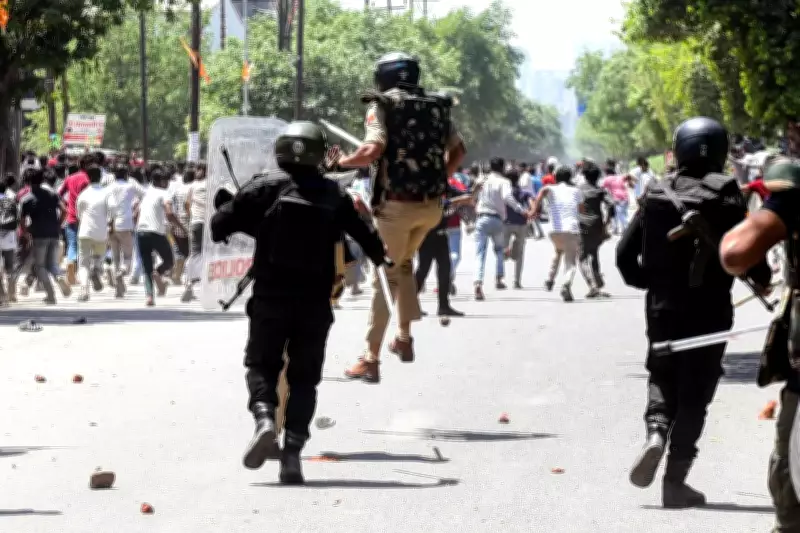
Noida descended into chaos on Monday as violent protests by industrial workers demanding that the Uttar Pradesh government follow Haryana's move to hike minimum wages by 35% brought the city to a standstill. The demonstrations, which began in the early morning, resulted in widespread arson, vandalism, and hours-long traffic gridlocks, leaving commuters stranded and businesses shuttered.
Violence Erupts in Key Industrial Hubs
The protests ignited around 9:30 AM in Sector 62, a hub for many Micro, Small, and Medium Enterprises (MSMEs), and quickly escalated. Mobs armed with belts and sticks ran amok, setting nearly a dozen vehicles ablaze, smashing glass facades of industrial units, and pelting anti-riot police with stones. Sector 62 and Phase 2, another major industrial area, bore the brunt of the violence.
Protesting workers, including many women, blocked critical roads in Sector 15, near the Chilla border, sectors 59, 60, and 82, and parts of Greater Noida through sit-in demonstrations. This choked traffic on the Noida Expressway, the Noida section of NH-9, Dadri Road, and other key routes connecting the city to Delhi. Police teams attempted to clear the roads but faced resistance from protesters who refused to move.

Commuters and Residents Bear the Brunt
The gridlock affected everything from cars and ambulances to school buses, with local shopkeepers forced to down shutters fearing vandalism. Commuters shared harrowing experiences of being stuck for hours.
- Parisha, stranded on Dadri Road for over an hour, said, "Traffic was at a standstill. There was no road management from police."
- Ankit Kumar, a college student, feared missing an exam, stating, "Even alternative routes are blocked. The entire city is choked."
- Neha Sharma lamented the collapse of public transport, calling it "frustrating."
- Depali, stuck near the Chilla border for nearly two hours while heading to work in Delhi, missed important meetings and had to work from her car due to the immovable traffic.
Root Causes of the Discontent
The protests stemmed from deep-seated frustration over wage disparities. Haryana's minimum wage for unskilled workers is currently Rs 3,907 more per month than Uttar Pradesh's. Workers in Noida were particularly upset that their counterparts in Gurgaon, employed by the same companies, earn substantially more across unskilled, semi-skilled, and skilled categories.
Dharmendra Nagar, a labour contractor, explained that workers learned about Haryana's wage revision from colleagues, sparking immediate discontent. "The message soon spread to factories, and workers began protesting at multiple units in Noida. The agitation remained mild for two to three days before turning violent on Monday," he said, noting that no union or organization led the protests.
Tularam, who works at a sports goods factory in Phase 2, highlighted the harsh realities: he earns Rs 13,000 monthly for 12-hour shifts from 9 AM to 9 PM without a weekly off, with leaves resulting in salary deductions. "With inflation rising, it is difficult to sustain my family," he said, spending Rs 6,000 on rent alone. "In case of illness, even medicines are unaffordable. That is why workers like me are protesting for higher minimum wages."
Escalation and Police Response
Protests initially peaceful turned violent after workers at Motherson began demonstrating outside their factory in Phase 2. A senior police officer recounted, "The workers came for their shift in buses but started protesting. Some climbed walls and cut wire fences, leading to more joining in and police being called." Police tried to pacify them, but stone-pelting ensued, forcing officers to use mild force.
Nearly 3,000 police personnel were deployed, gradually clearing roads and restoring normalcy, though protests continued into the afternoon. Vehicles set on fire included a police vehicle in Phase 2 and others outside Vipul Motors in Sector 63, where a mob smashed car windows and set 4-5 vehicles ablaze, also vandalizing the service center.

Demands and Broader Implications
Protesters, including women in sit-ins, demanded a minimum wage of Rs 20,000 monthly for eight hours of work, criticizing measly raises of Rs 280-300 every six months. Some cited soaring LPG prices due to geopolitical tensions to justify higher wages. Vishal Kumar, from a Sector 63 manufacturing unit, added that fixed duty hours, overtime pay, and compliance with new central labour codes were also part of their demands.
In a statement, Motherson attributed the issue to "misinformation being spread about wage revisions" affecting multiple industries, asserting compliance with laws and prioritizing employee safety. Authorities are working with industry to restore normalcy.
Legal Actions and Investigations
Noida Police registered an FIR against Congress social media coordinators Mir Ilyas and Anushi Tiwari for falsely claiming 14 deaths and 32 injuries on X. Five police personnel were injured. Police identified over 50 bot accounts created recently to spread misinformation, with the Uttar Pradesh STF investigating their digital trail.
Additional Commissioner of Police Rajiv Naraiyan Mishra said multiple FIRs are being registered, with more than 200 people detained. DGP Rajeev Krishna emphasized identifying "provocative elements" and "external elements" instigating violence, promising firm legal action. Later, DGP Krishna and ADG Amitabh Yash instructed SHOs via video conferencing to maintain a calm, sensitive approach while acting against violence, arson, vandalism, and rumor-mongering.
Eight companies of Provisional Armed Constabulary and Rapid Action Force have been stationed in Noida to prevent further violence, as the city grapples with the aftermath of a day marked by unrest and demands for economic justice.





