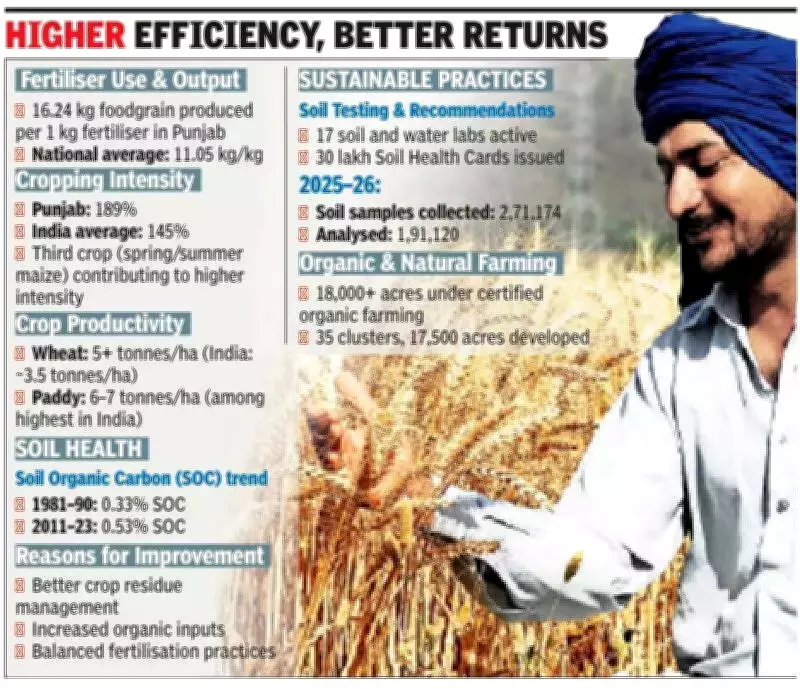
Punjab's Fertiliser Use Yields 16.24 kg Foodgrain per kg, Exceeds National Average
In a significant development, data from Punjab's Department of Agriculture and Farmers' Welfare reveals that each kilogram of fertiliser used in the state produces approximately 16.24 kilograms of foodgrain. This figure notably surpasses the national average of 11.05 kilograms per kilogram of fertiliser, highlighting Punjab's superior agricultural efficiency and countering narratives of excessive fertiliser application leading to soil degradation.
Enhanced Productivity and Farmer Returns
The findings, part of an affidavit submitted to the National Green Tribunal in a case concerning fertiliser impact on soil organic carbon, indicate that fertiliser use in Punjab not only boosts productivity but also translates into better financial returns for farmers. The department emphasised that Punjab's fertiliser consumption per kilogram of foodgrain produced is comparatively lower than national levels, suggesting more effective nutrient management practices. This efficiency contributes to higher profitability and improved investment returns in the state's agricultural sector.
Historical Context and Cropping Intensity
Punjab, renowned as India's breadbasket, underwent transformative changes post the Green Revolution of the 1960s and 1970s, with high-yielding varieties, mechanisation, and chemical inputs driving productivity gains. The state ranks among India's top performers in cropping intensity, standing at approximately 189%, significantly above the all-India average of about 145%. This high intensity, including the adoption of spring and summer maize as a third crop, reflects superior resource utilisation and soil management, enabling farmers to harvest more crops annually from the same land.

High Yields and Soil Health Improvements
Punjab maintains exceptional crop yields, with wheat productivity exceeding 5 tonnes per hectare compared to the national average of around 3.5 tonnes, and paddy yields consistently ranging between 6 and 7 tonnes per hectare, among India's highest. The department attributes these achievements to sustained soil fertility and efficient nutrient and water management. Contrary to perceptions of declining soil health, long-term data shows soil organic carbon levels in Punjab improved from 0.33% during 1981–90 to 0.53% during 2011–23, indicating enhanced soil quality and sustainability.
Promotion of Sustainable Practices
The state has implemented various initiatives to foster balanced fertiliser use. Integrated Nutrient Management encourages a mix of biofertilisers, organic manures, and chemical fertilisers, with farmers advised to apply inputs based on soil testing. Punjab operates 17 soil and water testing laboratories across districts and has issued over 30 lakh Soil Health Cards under the national scheme, providing crop-specific fertiliser recommendations. In the current fiscal year, 271,174 soil samples were collected, with 191,120 analysed, driving a shift towards sustainable agriculture.
Organic Farming and Consumption Trends
Punjab is expanding organic alternatives, with over 18,000 acres under certified organic farming and 35 clusters covering 17,500 acres developed under organic initiatives. Under the National Mission on Natural Farming for 2025–26, 5,410 farmers enrolled, transitioning 5,368 acres to natural practices. Data from the PM PRANAM scheme shows a 2.82% reduction in total fertiliser consumption in 2024–25 compared to the previous three-year average, with urea down by 4.97% and DAP by 12.49%, indicating a move towards balanced nutrient application rather than indiscriminate use.
Author Note: Vinod Kumar, with The Times of India's Punjab Bureau in Chandigarh, covers Punjab politics, health, education, employment, and environment.