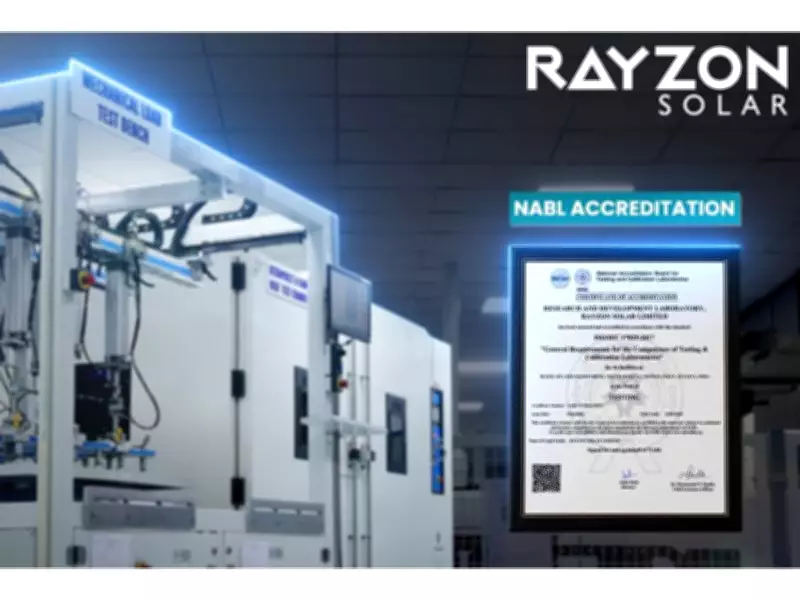
Rayzon Solar Limited has secured accreditation for its Research and Development (R&D) Laboratory from the National Accreditation Board for Testing and Calibration Laboratories (NABL) under the globally recognised ISO/IEC 17025:2017 standard. The accreditation, valid from 12 June 2026 to 11 June 2030, recognises the technical competence of the company's laboratory located in Karanj, Surat, Gujarat, to perform a comprehensive range of photovoltaic module testing according to internationally accepted standards. This achievement strengthens Rayzon Solar's quality assurance capabilities and reflects the increasing maturity of India's solar manufacturing ecosystem.
Why Accredited Testing Matters More Than Ever
The solar industry has undergone a remarkable transformation over the last decade. Advances in photovoltaic technology have resulted in higher-efficiency cells, improved module designs, and longer product lifecycles. At the same time, solar installations are being deployed across diverse climates—from scorching deserts and humid coastal regions to snow-covered mountains and industrial environments. For manufacturers, this means every module must be capable of maintaining performance despite years of exposure to fluctuating temperatures, ultraviolet radiation, moisture, mechanical loads, and severe weather conditions.
Laboratory testing has therefore become one of the most critical stages in product development and quality assurance. Accreditation under ISO/IEC 17025:2017 confirms that a laboratory follows internationally accepted technical procedures, maintains calibrated equipment, employs qualified personnel, and operates a robust quality management system. It ensures that testing results are accurate, repeatable, and globally credible. For customers and industry stakeholders, such accreditation provides greater confidence that product claims are supported by scientifically validated evidence rather than internal quality checks alone.

A Broad Scope of Photovoltaic Module Testing
Rayzon Solar's NABL-accredited laboratory covers 35 testing methods for photovoltaic modules, enabling comprehensive evaluation of product performance, durability, and safety. The laboratory performs testing in accordance with internationally recognised standards, including IEC 61215 for photovoltaic module design qualification and type approval, IEC 61730 for module safety qualification, IEC TS 62804-1 for Potential Induced Degradation (PID), IEC TS 63342 for Light and Elevated Temperature Induced Degradation (LETID), and IEC TS 63126 for module qualification under high-temperature operating conditions. Together, these standards provide a comprehensive framework for assessing the long-term performance and operational safety of photovoltaic modules before they are deployed in real-world applications.
Simulating Decades of Field Performance
One of the most valuable functions of a modern solar testing laboratory is its ability to replicate years of environmental exposure within controlled testing environments. Rayzon Solar's accredited facility performs an extensive range of environmental, electrical, and mechanical tests that help predict long-term module performance. These include thermal cycling tests, damp heat exposure, humidity freeze testing, UV preconditioning, mechanical load assessments, hail resistance testing, wet leakage current evaluation, insulation performance testing, maximum power determination, outdoor exposure studies, and additional reliability assessments covering critical operational parameters. The insights generated from these evaluations help engineers optimise module design, validate manufacturing consistency, and identify opportunities for continuous product improvement before products enter commercial production.

Faster Innovation Through Integrated Research
Research and development are central to progress in photovoltaic manufacturing. Whether introducing advanced cell technologies, optimising module architecture, or evaluating new materials, every innovation must undergo extensive validation before reaching customers. By establishing comprehensive NABL-accredited testing capabilities in-house, Rayzon Solar significantly enhances its ability to accelerate product development. Instead of depending exclusively on external testing facilities, engineering teams can perform design verification, material evaluation, reliability analysis, and comparative studies within the company's own research infrastructure. This integrated approach enables faster decision-making, shorter development timelines, and more efficient commercialisation of new products while maintaining internationally recognised quality standards.
By investing in world-class testing capabilities today, Rayzon Solar is helping build a stronger foundation for the future of renewable energy, delivering greater confidence to customers, supporting industry-wide quality standards, and contributing to India's emergence as a trusted global hub for solar manufacturing.