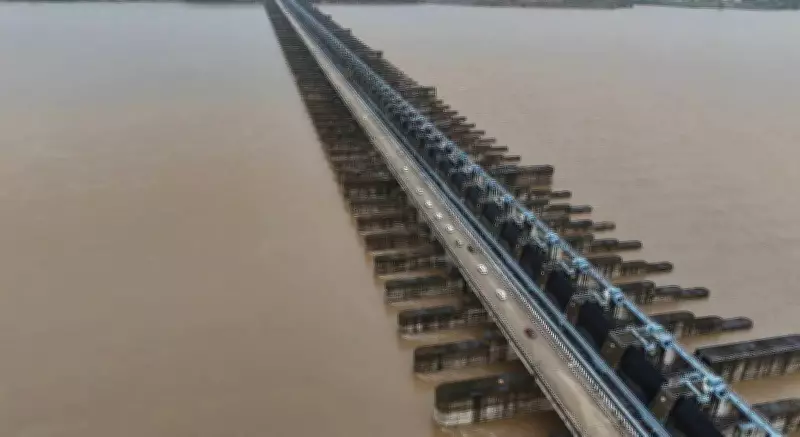
The Telangana Retired Engineers Association (TREA) of the irrigation department has formally requested the state government to undertake comprehensive model and feasibility studies prior to finalizing the location of the Tummidihatti barrage, which is part of the ambitious Pranahitha-Chevella lift irrigation project. In a meeting held on Wednesday, TREA president M Shyamprasad Reddy and honorary president D Damodar Reddy presented their recommendations to irrigation advisor Adityanath Das, emphasizing the need for technical scrutiny.
Key Observations on River Flow Patterns
The association, which played a pivotal role in the Kaleshwaram lift irrigation project and previously submitted a report to the then BRS government, highlighted critical concerns regarding the proposed barrage site. According to TREA, the full reservoir level (FRL) of the proposed Tummidihatti barrage is limited to 148 metres, based on the current ground reality and the agreement with Maharashtra. Consequently, the association stressed that the barrage location should only be finalized after obtaining positive results from technical feasibility studies.
“After studying the location, we came across a few observations regarding the flow patterns of the two rivers, Wardha and Wainganga, which have different catchment areas, rainfall patterns, and hydrographs. Their velocities, discharges, and peak timing differ significantly. This produces non-uniform inflow to the barrage sections and the connecting bund,” the association stated. They further warned that large eddies, cross-currents, and secondary (helical) flows are likely to form, especially near the 2.1 km link zone and the artificial confluence created by the structure.

Alternative Sites and Next Steps
TREA suggested that different alternatives for the barrage should be studied. One such alternative, a site near Borepally located 9 km from Tummidihatti across Pranahitha, was already referred to the consultant Arleen Associates for feasibility studies in January this year. The association recommended that before finalizing the location and configuration of the barrage, model studies should be carried out for the present proposed site at the confluence of the two rivers, as well as for all other alternatives, in accordance with the Central Water Commission’s detailed project report norms.
The association members reiterated that such studies are essential to ensure the structural integrity and operational efficiency of the barrage, preventing potential hydrological issues that could arise from the complex river dynamics. The government has been urged to consider these recommendations promptly to avoid future complications in the project execution.