

Maharashtra Permanently Abolishes Non-Agricultural Tax to Accelerate Urban Redevelopment
In a landmark decision, Maharashtra has permanently abolished the non-agricultural (NA) tax, a move directed by Chief Minister Devendra Fadnavis and announced by State Revenue Minister Chandrashekhar Bawankule on Wednesday. This reform, which comes after nearly one-and-a-half years of deliberation, is set to significantly boost redevelopment and regularization efforts in major urban centers such as Pune, Mumbai, and Thane.
Notification and Legal Amendments
The official notification, issued late on Tuesday, amends the Maharashtra Land Revenue Code to eliminate the annual NA tax. Additionally, it removes the requirement for separate non-agricultural land-use permission from district collectors. An official clarified that this applies only if the proposed land use aligns with the applicable development plan, regional plan, or development control regulations.
Industry and Legal Perspectives
Suhas Patwardhan, president of the Maharashtra State Cooperative and Apartment Association, welcomed the change, stating that the outdated British-era law should have been scrapped long ago. "The issue was pending across four different governments. We had demanded a waiver on the steep tax hikes, penalties, and interest from the past two decades, and a petition was filed in the high court. We will now make an appropriate decision following this government resolution," he said.

Advocate Shreeprasad Parab, expert director of the Maharashtra State Cooperative Housing Federation Ltd, highlighted that the reform addresses long-standing concerns, including inconsistencies between urban areas. "The graded and rational one-time premium structure protects public revenue while freeing housing societies and landowners from recurring and disputed demands. This is a structural correction that restores fairness and certainty, benefiting lakhs of citizens," he emphasized.
Operational Changes and New Framework
Advocate Satya Muley explained that the amendment stems from a Public Interest Litigation seeking exemptions for urban areas. "From now on, no collector approval is needed for NA conversion if the land is within a development plan or regional plan and already designated for non-agricultural use," he said. Muley added that development authorities can now directly grant permissions, and municipal corporations will update land-revenue records, with a one-time premium applied at the building-plan approval stage.
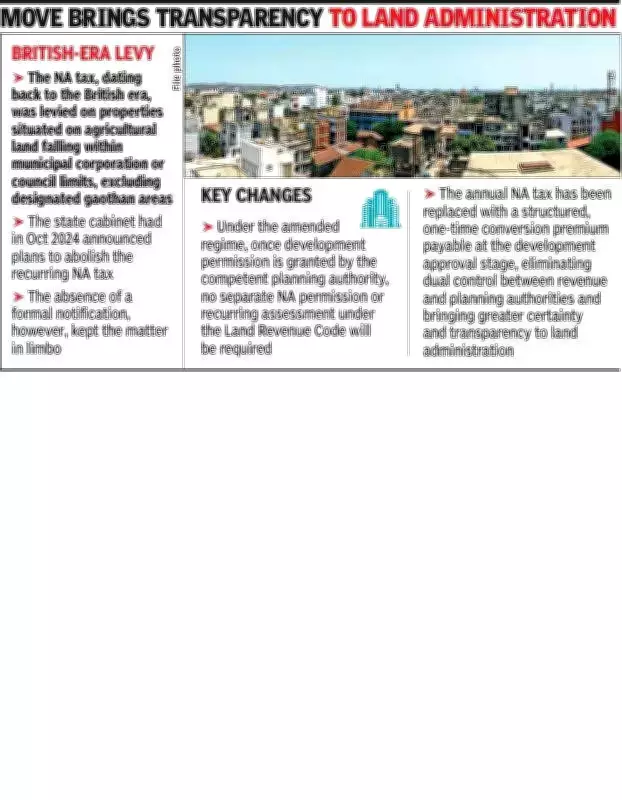
Under the revised framework, once planning authorities grant development permission, no separate NA clearance or recurring assessment under the Land Revenue Code will be required. The annual NA tax is replaced with a structured, one-time conversion premium, ending dual control by revenue and planning departments and enhancing transparency in land administration.
Concerns and Future Implications
However, Muley raised concerns about provisions affecting landholders whose lands were converted to NA use in 2001-02. "A one-time premium will be levied on lands converted within the past 25 years—0.10% of ready reckoner rates for plots up to 1,000sqm, 0.25% for 1,000-4,000sqm, and 0.50% for plots above 4,000sqm. This arbitrary provision may cause injustice, and we have urged the government to withdraw it or face a high court challenge," he warned.
Further simplifying processes, no sanad (conversion certificate) is now required. "Landowners no longer need this certificate for bank loans, property transactions, or other legal purposes. These measures are expected to boost real estate and industrial activities, resolve legacy issues for plot owners in gunthewari and small parcel areas, enhance transparency through digital integration, and discard the British-era law," Bawankule concluded.






