Maharashtra Congress Leader Issues Apology Over Historical Figures Remarks
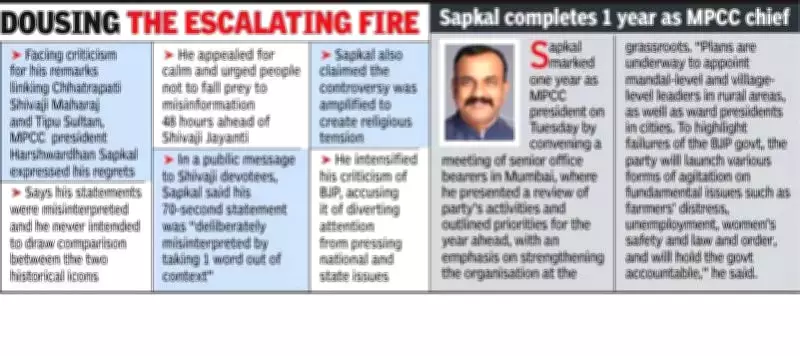
Nagpur: Maharashtra Congress president Harshwardhan Sapkal has formally expressed regret for his recent comments that appeared to link Chhatrapati Shivaji Maharaj and Tipu Sultan, stating his words were taken out of context and misinterpreted. The apology comes just 48 hours before the celebration of Shivaji Jayanti, with Sapkal urging for calm and cautioning against misinformation.
Clarification on Social Media
In a detailed social media post, Sapkal firmly denied making any comparison between the two historical icons. "I did not say anything wrong about Chhatrapati Shivaji Maharaj. The question of comparison does not arise; I did not make one," he asserted. He emphasized that Shivaji Maharaj remains "my ideal, my inspiration and my pride," describing the legendary Maratha ruler's legacy as completely "unmatched."
Context of the Controversy
Sapkal explained that his original 70-second statement was "deliberately misinterpreted by taking 1 word out of context." He claimed the controversy was amplified to create religious tension, referencing protests in Pune as evidence. "What happened in Pune shows how the issue was used," he noted. Addressing Shivaji devotees directly, he added, "If any Shiv devotees' sentiments were hurt because of misuse of my words, I sincerely express regret. It was never my intention to hurt anyone's feelings. Let us put this matter to rest here."

Original Intent and Political Criticism
The Congress leader maintained that his remarks were made in response to a question about displaying portraits of historical personalities in government offices to promote unity. According to Sapkal, he mentioned that the 18th-century Mysore ruler Tipu Sultan drew inspiration from Chhatrapati Shivaji Maharaj in fighting the British, and the intent of such displays should be to convey harmony rather than division.
Simultaneously, Sapkal intensified his criticism of the Bharatiya Janata Party (BJP), accusing it of diverting attention from pressing issues such as concerns over a proposed trade deal with the United States and farmers' distress. "If BJP wants to cut my tongue because I expose them, then go ahead, but I will not stop," he declared, referring to statements by some BJP leaders who allegedly announced a reward for anyone who would "cut" his tongue. He asserted that such threats would not deter him from speaking out.
The timing of this apology, just before Shivaji Jayanti, highlights the sensitivity surrounding historical figures in Maharashtra's political landscape. Sapkal's call for unity and his firm stance against BJP tactics underscore the ongoing tensions in state politics, with both sides leveraging historical narratives for contemporary political gains.