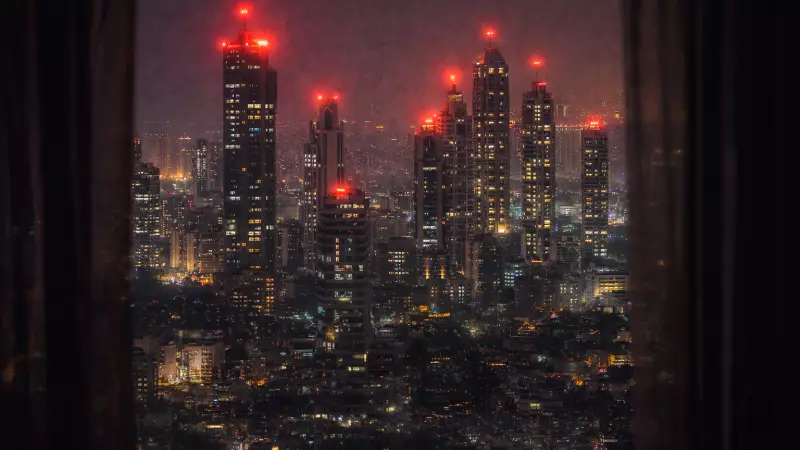
Mumbai's iconic skyline, dotted with soaring skyscrapers, is facing a new urban challenge. Residents in numerous high-rise apartments are reporting persistent sleep disruption, not from noise, but from the relentless flashing of aviation safety lights installed on neighbouring towers. These bright pulses penetrate through curtains, creating a strobing effect in bedrooms and altering sleep patterns across the city.
The Regulatory Mandate Behind the Glare
The source of this luminous intrusion is a critical safety feature. Aviation Obstruction Lights (AOL) are a legal requirement under International Civil Aviation Organization (ICAO) Annex 14 regulations, which India strictly follows. The rule is clear: any structure exceeding 45 meters in height must install these warning systems. This is especially crucial for Mumbai, given its dense airspace and proximity to several helipads.
The current framework dictates that buildings standing between 45 and 150 meters require Medium Intensity Obstruction Lights. Installation isn't just a top-of-the-building affair. For structures wider or longer than 45 meters, lights must also be placed along external edges at uniform intervals. This ensures the building's silhouette is visible to pilots from every approach angle, preventing collisions.

Beyond the Default Flash: Exploring Compliant Alternatives
However, a critical gap in awareness is exacerbating the problem for residents. While building managements and developers comply with the law, many are unaware that ICAO regulations offer multiple lighting options tailored for different contexts. For medium-intensity systems, three compliant choices exist:
- Type A: White flashing lights, primarily for daytime visibility.
- Type B: Red flashing lights.
- Type C: Red steady-burning lights, specifically designed for nighttime use.
The most widespread installation across Indian metros, including Mumbai, is the "Dual Type A/C" system. This system flashes white during the day and switches to red at night. The crucial detail often overlooked is that the nighttime red component can be either flashing or steady-burning. Both are fully legal and meet safety standards.
The flashing red light has become a default choice, but the steady-burning red light achieves the identical safety objective for aircraft while being significantly less disruptive to those living nearby. The choice is not about compliance but about community consideration.
Balancing Safety with Urban Liveability
ICAO guidelines themselves acknowledge that while highly visible, flashing lights can cause visual disturbances in densely populated residential zones. The regulations explicitly permit steady-burning alternatives in such urban contexts. In Mumbai, where new towers often rise mere meters from existing homes, the impact of lighting choices radiates far beyond the building's footprint.
Aviation safety experts confirm that steady-burning red lights provide adequate visibility for aircraft at night. They maintain the required intensity of 2,000 candela—sufficient for detection—without the pulsating effect that disturbs sleep. For existing buildings, retrofitting is possible. Switching from flashing to steady night lights typically requires coordination with the lighting contractor and possibly reprogramming the control system. Importantly, this modification does not need fresh approvals from aviation authorities, as both configurations satisfy ICAO Annex 14 standards.
As Mumbai's vertical growth continues, urban planners and developers are being called to integrate aviation safety with residential well-being. Building management associations and resident welfare groups in affected areas are now raising awareness about these alternatives. The path forward involves a more informed selection process, ensuring the safety of Mumbai's airspace does not come at the unnecessary cost of its residents' peaceful nights.