

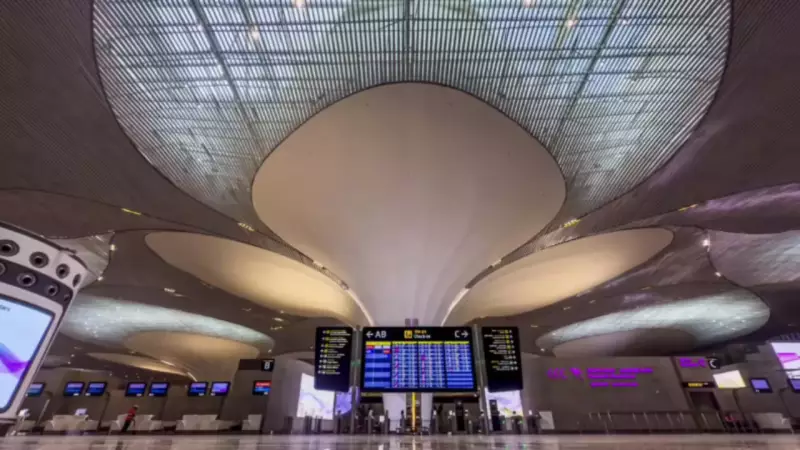
Navi Mumbai Airport Welcomes First Passengers, Marking Historic Milestone
The Mumbai Metropolitan Region's long wait for a second airport ended on Thursday as the Navi Mumbai International Airport (NMIA) formally commenced commercial operations. The airport's entry into India's aviation map was marked by the ceremonial arrival and departure of its first scheduled passenger flights, heralding a new era for air travel in the country's financial capital.
Inaugural Flights and Day One Operations
The historic day began at 8 am when an IndiGo flight, 6E460 from Bengaluru, touched down on the tarmac, receiving a traditional water cannon salute. This was followed over half an hour later by the airport's first departure, IndiGo flight 6E5315 to Hyderabad, which took off at 8:40 am. On its first day, NMIA successfully handled 48 flights connecting nine domestic destinations, serving over 4,000 passengers. Peak traffic was recorded between 5 pm and 7 pm. Operations commenced with four carriers: IndiGo, Akasa Air, Air India Express, and Star Air.
Developed and operated by Adani Airports Holdings Limited (AAHL), NMIA stands as one of India's largest greenfield airport projects. Gautam Adani, Chairman of the Adani Group, personally welcomed passengers from the inaugural flight and interacted with staff and first-time flyers. He later participated in a ceremonial walk through the departure terminal with employees and community representatives.

Passenger Experience: Food, Lounges, and Local Culture
While the terminal was operational, some amenities were still rolling out on day one. Only one hot meals option, 'Gully Kitchen' by Semolina Kitchens Pvt Ltd, was available, leading to early morning queues for breakfast. Restaurant staff noted that while idlis and dosas were expected front-runners, poha and upma also saw high demand. Pricing started at Rs 250 for upma, with poha and idli sambar beginning around Rs 350. Passenger Niraj Pratap praised the "absolutely delicious and filling" dosa pockets and rolls, which cost about Rs 450 each.
An airport source stated that a temporary lounge with 100 seats would open in the central terminal area within a few days. This will be followed in about a month by the 'Adani-1 lounge' with over 125 seats, offering segregated seating for business and economy class passengers. The airport also plans to launch a curated 'foodhall' or food court featuring gourmet offerings from different cuisines in the coming months.
The local Maharashtrian culture was prominently featured through performances of Lezim (folk dance), Dhol (percussion drums), and Tutari (a ceremonial wind instrument). In a heartwarming initiative, farmers, underprivileged families, and colleagues with disabilities experienced their first-ever flight via a special chartered aerial tour of Mumbai.
A New Name for Air Traffic and a Boost for Mumbai
In an interesting detail for aviation enthusiasts, the airport will be referred to simply as "Navi" in all radio communications between pilots and air traffic controllers. "When the first IndiGo flight was handed over from the Mumbai approach to Navi Mumbai tower control, we radioed to the pilots, 'Welcome to Navi'," an aviation official explained.
Jeet Adani, Director of AAHL, emphasized that NMIA establishes a resilient multi-airport system for the Mumbai Metropolitan Region (MMR). This development is crucial as the existing Mumbai airport, operating from a single runway, handles about 950 flights in 24 hours and has been constrained for decades. The new airport is set to significantly boost capacity, enhance passenger experience, and future-proof the region's aviation growth.
The launch celebrations concluded with a flag-hoisting ceremony and the national anthem, led by Param Vir Chakra awardees Captain Bana Singh and Subedar Major Sanjay Kumar, alongside sportspersons Suryakumar Yadav, Mithali Raj, and Sunil Chhetri. India Post also released a commemorative 'First Flight Carried Special Cover' featuring the NMIA terminal, flown on an IndiGo service to Goa.
"It's a proud day for Mumbai and for India," said Gautam Adani, capturing the significance of an infrastructure project that promises to reshape air connectivity for the nation's economic powerhouse.






