

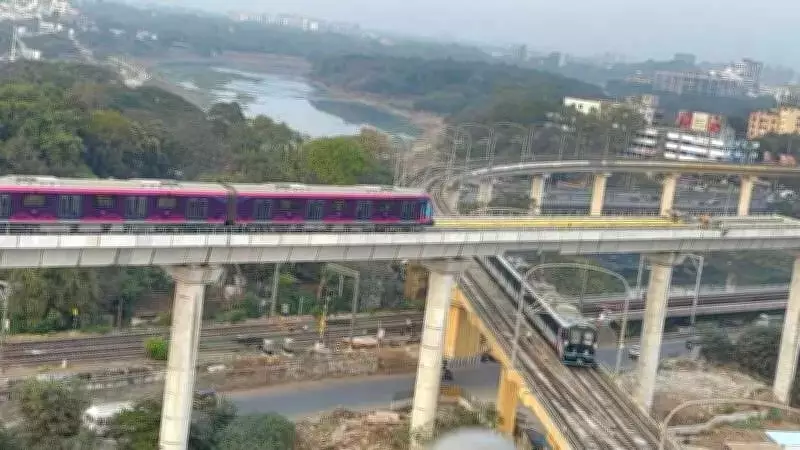
Pune's Third Metro Corridor Delayed, Full Service Now Expected by June-July
The ambitious 23-kilometer third Metro corridor in Pune, which aims to connect Hinjewadi and Shivajinagar, is unlikely to meet its original March-end completion deadline. Officials from the Pune Metropolitan Region Development Authority (PMRDA) have indicated that full passenger services across the entire route may not commence until June or July this year.
Construction Progress and Pending Work
The project, being developed under a public-private partnership (PPP) model with the Tata Group-led Pune IT City Metro Rail Limited, is currently about 94% complete. According to the initial schedule, the corridor was expected to be finished by the end of March, with operations beginning in April following necessary trial runs.
"Although trial runs are being conducted across the entire stretch, substantial work is still pending, especially at several stations," a senior PMRDA official stated on Saturday. Out of the 23 stations along the corridor from Maan to MITCON Institute of Management, only 13 have been fully completed so far.

Construction and finishing works are actively underway at the remaining stations. Sources reveal that approximately 15 to 17 stations are nearly 90% complete, and efforts are being intensified to accelerate the remaining construction activities along the alignment.
Operational Readiness and Approval Process
Senior PMRDA officials confirmed that trial runs are already in progress across the full Metro alignment. However, passenger services can only begin once the concessionaire formally confirms operational readiness and all necessary regulatory approvals are secured.
"The final letter from the concessionaire regarding the start of operations is awaited," an official explained, adding that a definitive timeline decision will be made once the operator provides confirmation of operational preparedness.
Challenges with Phased Operations
While there has been some pressure to open the corridor in phases, transport experts emphasize that the PPP structure of this project makes partial operations particularly challenging.
"In a project structured under a PPP concession agreement, operating only a section of the corridor is not financially or operationally viable," said a transport planning expert familiar with the project details.
Officials have suggested that a more practical approach would involve starting operations along the entire route while temporarily keeping a few stations closed if their finishing work remains incomplete.
Public Reaction and Safety Concerns
Local residents have expressed frustration over the repeated extension of deadlines, though many acknowledge that safety and thorough testing should take precedence over meeting political timelines.
Rohan Kulkarni, an IT professional and resident of Baner, noted that commuters have been hearing revised deadlines for years, which has naturally led to frustration given the heavy traffic congestion on this stretch.
"However, it would be better to start services only after all tests and approvals are completed rather than rushing the launch to meet a political deadline, as it could create bigger problems later," Kulkarni emphasized.
A Wakad resident echoed similar sentiments, stating, "The delay is disappointing, but caution is also necessary. People are eager for the Metro to begin services as it would significantly improve daily travel, but operations should start only once the system is fully prepared and safe."
Project Significance and Future Expansion
This Metro line represents the first fully elevated corridor in India to be developed under a PPP model, marking a significant milestone in urban infrastructure development.
Earlier, Pune MP Murlidhar Mohol reviewed the project's progress and indicated that 13 stations are expected to be ready by April 2026, while work on several others is nearing completion. He also instructed officials to prepare a detailed project report for a proposed Metro line linking Khadakwasla and Hinjewadi as part of broader plans to expand Pune's Metro network.

The delay in the Hinjewadi-Shivajinagar corridor highlights the complexities involved in large-scale urban transport projects, particularly those implemented through public-private partnerships that require meticulous coordination between multiple stakeholders.





