

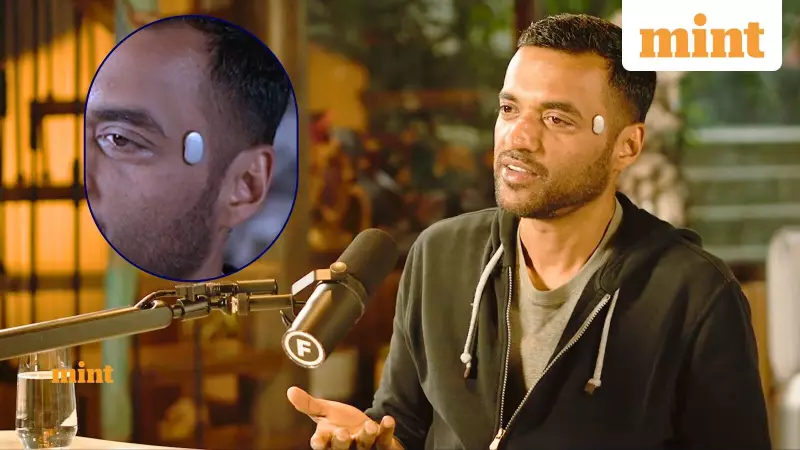
Zomato and Eternal CEO Deepinder Goyal recently set the internet abuzz, not with a business announcement, but with a mysterious device spotted on his temple during a podcast appearance. The small, metallic object sparked a wave of humorous guesses online, from "chewing gum" and "external SSD" to "pimple patch" and "his brain."
Unveiling the 'Temple' Device: A Window to the Brain
In reality, the device is an experimental tool aptly named 'Temple'. It is a small sensor, coloured gold or silver, designed to be worn near the temple. Its primary function is to continuously measure blood flow to the brain in real-time. This data is considered a crucial indicator of neurological health and the ageing process.
Goyal clarified that this is not a Zomato product. It is a personal research initiative developed privately under his parent company, Eternal. The device is currently an experimental prototype and is not available for public or commercial use.

The $25 Million Quest: Understanding the Gravity Ageing Hypothesis
The 'Temple' device is a key instrument in Deepinder Goyal's deep dive into what he calls the 'Gravity Ageing Hypothesis'. He has personally committed $25 million (approximately ₹225 crore) to expand this research under his 'Continue Research' initiative.
Goyal first publicly shared his thoughts on this hypothesis in November 2025 on X (formerly Twitter). He presented it as an open-source idea backed by preliminary science, inviting discussion on human longevity. "Newton gave us a word for it. Einstein said it bends spacetime. I am saying gravity shortens lifespan," he wrote.
The core of the hypothesis suggests that gravity slowly reduces blood flow to the human brain, accelerating its ageing. Since humans spend most of their lives upright with the brain above the heart, gravity constantly pulls blood downward. Over decades, this reduced circulation may damage the brain. As ancient brain regions controlling vital functions like heart rate, hormone regulation, and immunity weaken, the entire body ages faster, according to the theory.
Goyal claims the idea was tested over a two-year period through research and discussions with global doctors and scientists, and no strong scientific contradiction has been found so far.
Bats, Yoga, and Height: The Gravity Connection
The research draws interesting parallels to support its viewpoint:
- Bats: Cited as the longest-living mammals for their size, often living ten times longer than expected. The research notes they spend long durations inverted, with the head below the heart.
- Yoga: Points out that over 50% of yoga poses involve 'head below heart' postures, with many yogis linking inversion practice to a longer lifespan.
- Height: References the known scientific fact that shorter people tend to live longer than taller people, proposing a possible reason: a shorter distance for the heart to pump blood against gravity to the brain.
However, the hypothesis has faced scepticism on social media. Many users have called it "stupid logic," with one critic questioning, "If gravity is the main cause, then why are crocodiles, rats, snakes, etc not living at least 1000s of years!?"
Despite the mixed reactions, Deepinder Goyal's 'Temple' device and his substantial personal investment highlight a growing private interest in unconventional longevity research, blending personal curiosity with a quest for scientific exploration.






