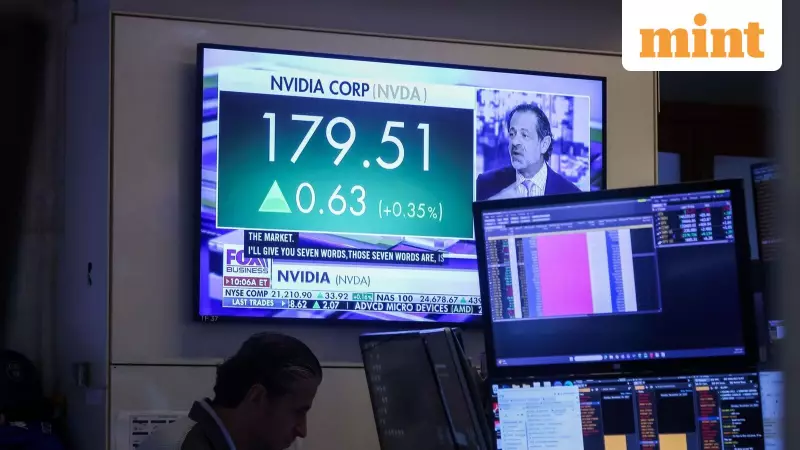
December has opened on a cautious note for Wall Street, with markets painted in red after a strong Thanksgiving week. The initial optimism has been tempered by renewed concerns surrounding the high-stakes artificial intelligence (AI) trade, focusing on massive capital expenditures and intensifying competition.
The AI Divide: Winners and Losers in the Current Shakeout
The market's nervousness was evident on Monday, December 2, 2025. An announcement of an expanded partnership between Nvidia and Synopsis provided a boost to those specific stocks but came at the expense of others like Broadcom, which is the design partner for Alphabet's Tensor Processing Units. This selective movement highlights a growing divergence within the AI sector.
Dennis DeBusschere, President of 22V Research, explains this by categorising AI stocks into two camps. He identifies the current winners as the "GOOG Complex," which includes Alphabet (Google), Broadcom, TTM Technologies, Celestica, and Lumentum. On the other side are players in the "OpenAI complex," such as Nvidia, SoftBank, Oracle, Advanced Micro Devices, CoreWeave, and Microsoft, which he labels as temporary losers.

The key differentiator, according to DeBusschere, is leverage. "The OpenAI complex has more debt, and that does introduce some economic risk, i.e. capex plans eventually collapse for the levered players," he states. This sentiment reflects a broader market skittishness about how even well-funded tech giants are increasingly relying on debt to finance their ambitious AI development plans.
Short-Term Pain for Long-Term Gain: The Investment Thesis
Despite the current volatility, DeBusschere argues this performance gap is not a major macroeconomic problem. "Winners and losers in AI, as opposed to all AI disappointing on return on investment, is not a bad thing," he writes. He expects margins for successful AI companies to remain stable.
He advises investors to anticipate bumpiness in research and development, given AI's relative infancy. Historically, while capital spending ultimately boosts productivity, for S&P 500 companies, it initially drags on productivity for about eighteen months. Therefore, the current heavy AI investments are likely to positively impact future earnings growth while creating headwinds for nearer-term earnings growth. This dynamic also reduces cash for other uses and increases earnings volatility.
A Supportive Economic Backdrop for 2026
Investors may be willing to tolerate these short-term negatives due to the compelling long-term potential. A significant positive factor is the economy's apparent ability to expand without triggering inflationary pressures that would force the Federal Reserve to hike interest rates.
"Thanks to strong productivity growth, it looks like the economy can run at a +2% growth without inflation being a problem," DeBusschere notes, adding that just months ago, economists believed the limit was 1%-1.5%. This creates a supportive environment for stocks, contingent on a stable labour market and contained inflation.
DeBusschere is not alone in his optimism. Multiple strategists foresee a strong economy driving another year of double-digit gains for the S&P 500 in 2026. In a preview published on Monday, HSBC strategist Alastair Pinder highlighted AI's transformative potential. He projected that if AI adoption across the S&P 500 delivers even a modest 1% cost saving, it could generate nearly $130 billion for the index and raise EBIT margins by 50 basis points to 18.5%.
"We see sectors such as pharma, banks, and software & services positioned to benefit most from this shift," Pinder concluded. Thus, while the December wobbles serve as a reminder of the sector's volatility, the overarching narrative from analysts remains firmly focused on a prosperous 2026 driven by AI-led efficiency and growth.