

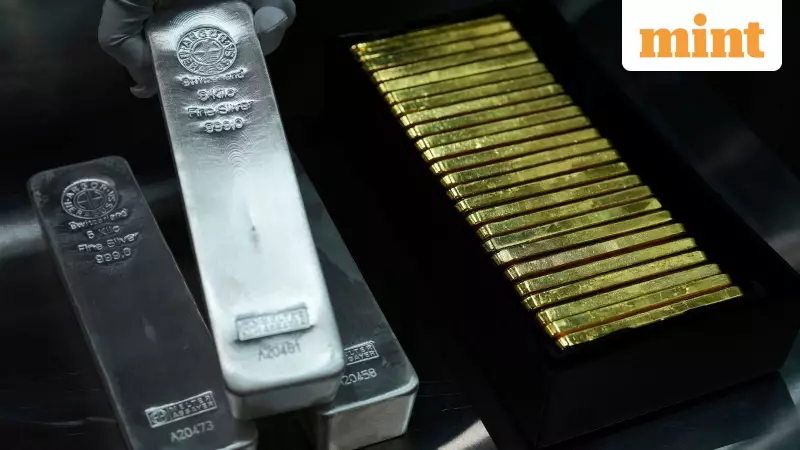
Global financial markets witnessed a classic flight to safety on Monday, as a dramatic geopolitical development in Latin America sent investors scrambling for traditional safe-haven assets. The trigger was the U.S.-led ousting, arrest, and extradition of Venezuela's President Nicolás Maduro, an event that has injected significant uncertainty into the new year.
Market Reaction: Precious Metals and Dollar Rally
The immediate response was a sharp rally in precious metals. Gold prices jumped 2.5% to $4,436 per ounce, while silver saw an even steeper rise of 4.75% to $76.25 per ounce. The U.S. dollar, another beneficiary of risk-averse sentiment, also strengthened. The U.S. dollar index, which measures the greenback against a basket of major currencies, climbed 0.33% to 98.75. This move subsequently pushed U.S. Treasury bond prices higher, lowering their yields.
President Donald Trump's subsequent vow to "run" Venezuela and control its vast oil reserves, coupled with pointed threats towards Mexico, Cuba, and Colombia, amplified market anxieties. Trump stated to Fox News that "American dominance in the Western Hemisphere will never be questioned again," signaling a potential era of more assertive U.S. foreign policy in the region.

Geopolitical Undercurrents and Analyst Views
Analysts were quick to point out the broader strategic dimensions of the Venezuela move. Nel Shearing, group chief economist at Capital Economics, noted that while it represents a shift in hemispheric policy, it also ties into the wider U.S.-China strategic competition. "Venezuela had become China’s (and Russia’s) most steadfast ally in Latin America, a position that generated unease across the political spectrum in Washington," Shearing explained.
The situation also raised concerns about potential ripple effects, including heightened political and military pressure from China on Taiwan, further fueling the demand for assets like gold perceived as immune to geopolitical strife.
Oil Market Paradox and Equity Calm
Interestingly, the global oil market showed limited reaction. Brent crude futures, the international benchmark, edged up a mere 0.2% to $60.63 per barrel. Analysts attribute this calm to two key factors. Firstly, Venezuela's current oil output is a negligible ~1% of global production in an already oversupplied market. Secondly, any recovery in the country's oil industry is seen as a long-term prospect.
Warren Patterson, head of commodities strategy at ING, emphasized the challenges, stating, "We will need to see significant investment in Venezuela’s oil infrastructure, following years of neglect." He highlighted the historical difficulty, referencing the expropriation of assets from Exxon Mobil and ConocoPhillips in 2007.
Despite the geopolitical shock, equity market volatility remained contained. The Cboe VIX index, a fear gauge for the S&P 500, rose a modest 1.5% to 15.17. Charu Chanana, chief investment strategist at Saxo Markets, suggested that "global equities are likely to keep looking through the geopolitical shock unless it threatens the broader supply chain or tightens financial conditions." She added that while headline risks cause sector rotations, supportive earnings and liquidity could allow markets to grind higher.
The event sets a tense stage for global markets, underscoring how political actions can swiftly alter asset class dynamics, with investors once again turning to the timeless security of gold and silver in times of turmoil.






