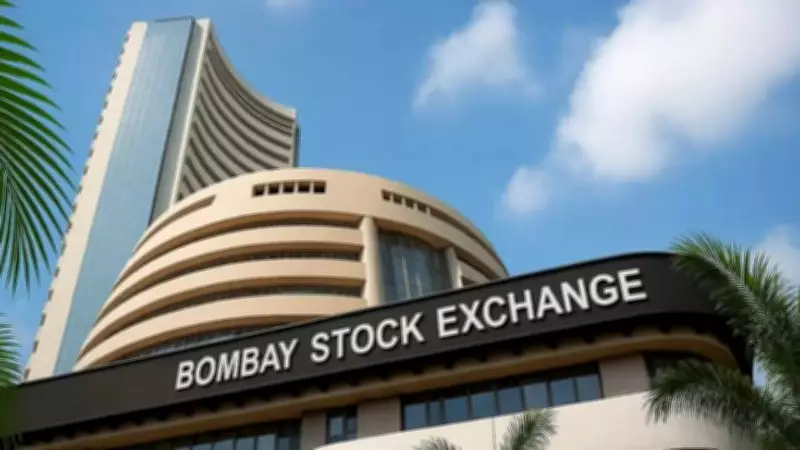
India's Stock Market Loses $240 Billion as West Asia Conflict Triggers Global Sell-Off
India's financial markets have experienced a severe downturn as escalating military tensions in West Asia created widespread global financial uncertainty. This geopolitical shockwave has prompted investors to rapidly exit riskier assets, resulting in the evaporation of billions of dollars in market value within a remarkably short timeframe.
Massive Wealth Erosion in Volatile Trading
Calculations based on changes in the combined market capitalization of Bombay Stock Exchange listed companies indicate that approximately $240 billion in investor wealth was wiped out over approximately one week as the international crisis intensified. This dramatic sell-off demonstrates how swiftly geopolitical disturbances can propagate through financial systems, particularly in economies like India that maintain strong connections to global trade networks, energy markets, and international capital flows.
The turmoil has significantly impacted Dalal Street, with benchmark indices recording sharp declines as market participants reassess risks associated with climbing oil prices and the potential for broader regional conflict expansion.

Sudden Shock to Investor Portfolios
The recent market correction has eliminated billions of dollars from the valuation of companies trading on Indian exchanges. This downward movement reflects a comprehensive shift in investor psychology as worldwide funds migrate toward safer assets during periods of geopolitical instability. Financial markets typically respond rapidly to international emergencies, and the current downturn has followed this established pattern precisely.
Institutional investors and professional traders have adopted extremely cautious positions, initiating widespread selling across multiple sectors including:
- Financial services and banking
- Automobile manufacturing
- Infrastructure development
- Aviation and airline operations
The selling pressure pushed Indian benchmark indices into official correction territory, meaning they declined more than 10% from recent peak levels, highlighting the magnitude of the market's reaction to global developments.
Oil Price Surge Intensifies Economic Concerns
At the core of the market turbulence lies the escalating conflict involving Iran, Israel, and the United States, which has amplified fears regarding potential disruptions to worldwide energy supplies. Crude oil prices experienced sharp increases as traders anticipated possible supply interruptions in the Middle Eastern region.
Brent crude oil briefly surpassed $100 per barrel, exacerbating worries about inflationary pressures and economic stability in oil-importing nations. For India, the consequences are particularly significant since the country represents the world's third-largest crude oil importer, with approximately one-fifth of global oil supplies transiting through the strategically vital Strait of Hormuz near Iran.
Any interference with tanker navigation through this critical maritime passage could propel oil prices even higher, elevating expenses for transportation, manufacturing, and power generation throughout India. Elevated energy prices additionally threaten to expand India's current account deficit, weaken the national currency, and intensify inflationary forces across the economic spectrum.
Benchmark Indices Reflect Risk-Averse Sentiment
The consequences of these developments have become unmistakably evident in India's primary stock indices. Both the BSE Sensex and Nifty 50 have registered substantial declines, with the Sensex plummeting more than 1,300 points during a single trading session amid the sell-off. This descent brought benchmark indices near their lowest levels in approximately one year.
Market strategists emphasize that such volatility represents typical behavior when geopolitical tensions escalate, especially when those tensions directly influence energy markets. Rising petroleum prices generally depress investor sentiment because they heighten inflation risks and diminish corporate profit margins in sectors heavily dependent on fuel and transportation.

Foreign Capital Exodus Amplifies Market Pressure
Another crucial factor driving the downturn has been the withdrawal of foreign portfolio investment from Indian equity markets. International investors extracted roughly ₹52,704 crore (approximately $5.7 billion) from Indian stocks during March's first half as global uncertainty mounted. Such capital outflows can magnify volatility since foreign institutional investors maintain substantial positions in Indian equities.
When worldwide investors reduce exposure to emerging markets during geopolitical crises, stock prices in those markets frequently decline rapidly. The outflows have simultaneously exerted pressure on the Indian rupee, which typically depreciates when foreign capital exits domestic markets.
Sector-Wide Losses Demonstrate Broad Risk Aversion
The market downturn has extended beyond any single economic segment. Losses have permeated multiple sectors, illustrating comprehensive movement toward risk avoidance among investors. Financial stocks, which constitute a considerable portion of Indian indices, have declined alongside companies in automobiles, infrastructure, aviation, and other cyclical industries.
Smaller enterprises have likewise encountered heavy selling pressure as investors transfer capital into relatively safer assets. Market statistics reveal that hundreds of listed stocks have fallen sharply during the sell-off, emphasizing the extensive nature of the decline across the marketplace.
Global Markets Experience Parallel Pressures
India's market volatility mirrors a broader pattern observable across international financial markets. Geopolitical conflicts frequently initiate a "risk-off" environment wherein investors channel money into traditionally safer assets such as gold, United States government bonds, and the American dollar.
Emerging markets customarily undergo capital outflows during such periods, rendering their stock markets especially susceptible to abrupt fluctuations in investor sentiment.
Domestic Institutions Provide Counterbalancing Support
Despite substantial selling by foreign investors, domestic institutional investors—including mutual funds and insurance companies—have continued purchasing equities throughout the downturn. Their acquisition activity has helped moderate the decline's pace, although analysts observe that persistent foreign outflows could maintain volatility in the immediate future.
Retail investors, who have assumed an expanding role in India's market rally in recent years, are also monitoring Middle Eastern developments closely before making new investment determinations.
Focus on Long-Term Fundamentals Recommended
Market specialists indicate that geopolitical crises often provoke sharp but temporary corrections rather than enduring structural declines in stock markets. Much will depend on how the conflict evolves during coming weeks. If tensions diminish and oil prices stabilize, investor confidence might return rapidly. However, prolonged escalation in West Asia could sustain market volatility, particularly if energy supply routes experience disruption.
Presently, the steep reduction in market capitalization serves as a powerful reminder of global economic interconnectedness. Conflicts occurring thousands of kilometers distant can rapidly influence financial markets in nations like India, where energy imports, trade flows, and international investment remain profoundly intertwined with geopolitical developments.