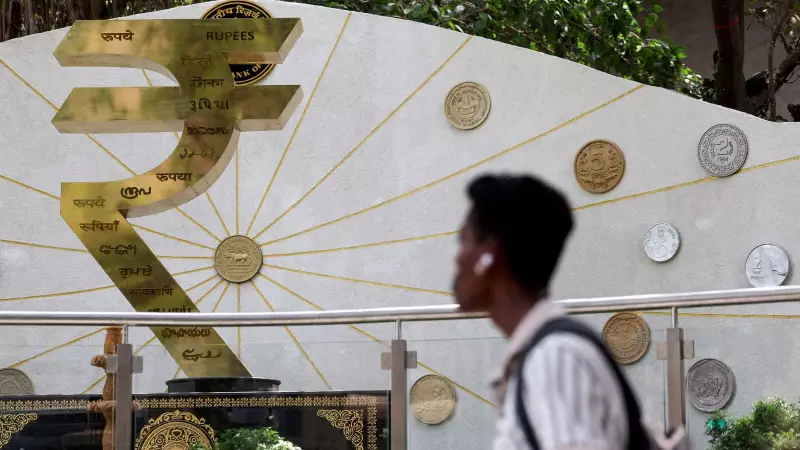
The Indian rupee tumbled to an unprecedented low against the US dollar on Wednesday, December 3, 2025, breaching the psychologically significant 90 mark for the first time in history. The currency extended its losses for the sixth straight session, pressured by a potent mix of global headwinds and domestic concerns.
Rupee's Historic Slide: The Numbers
The domestic currency slumped to an all-time low of ₹90.28 per US dollar during the trading session. It was last quoted at ₹90.24, marking a decline of 0.4% from its previous close. This relentless slide has resulted in a year-to-date (YTD) drop of 5.3%, setting the rupee on course for its most severe annual depreciation since 2022. This performance makes it the worst-performing Asian currency so far this year.
This decline is particularly notable as it occurred even while the broader dollar index, which measures the greenback against a basket of six major currencies, was trading lower by 0.18% at 99.17.

The Five Pillars of Pressure on the Rupee
Market experts point to a confluence of factors that have created a perfect storm for the Indian currency, leading to a significant supply-demand imbalance in the forex market.
1. Stalled India-US Trade Deal and Steep Tariffs
India remains one of the few major economies without a formal trade pact with the United States. The prolonged delay in finalising an agreement has cast a shadow of uncertainty, heavily weighing on investor sentiment. Compounding this, punitive US tariffs as high as 50% have severely impacted India's export competitiveness in its largest market. This dual blow has hurt trade flows and dampened foreign investor appetite, contributing substantially to the rupee's annual decline.
2. Relentless Foreign Investor Exodus
A major source of pressure has been the sustained withdrawal of funds by Foreign Institutional Investors (FIIs). Foreign investors have pulled out nearly $17 billion from Indian equities this year. Furthermore, net Foreign Direct Investment (FDI) inflows and overseas commercial borrowings have remained subdued. This massive FPI selling has dramatically widened the demand-supply gap for foreign currency, accelerating the rupee's depreciation.
3. Widening Current Account Deficit (CAD)
Despite robust Q2 GDP growth figures, concerns over India's external balance have resurfaced. The country's Current Account Deficit (CAD) stood at $12.3 billion, or 1.3% of GDP, in Q2 of FY26. Simultaneously, record-high prices for gold and silver have inflated the import bill, while elevated US tariffs continue to suppress export growth, putting further strain on the current account.
4. The RBI's Calibrated Stance
According to Swapnil Aggarwal, Director at VSRK Capital, while the Reserve Bank of India (RBI) is likely to intervene to manage volatility, its actions may remain measured. "The central bank’s focus is expected to be on preventing sharp and sudden volatility rather than defending any specific level of the rupee. As a result, some fluctuation in the currency may continue in the near term," Aggarwal explained. This calibrated approach has allowed the rupee to adjust gradually in line with global market dynamics, but has not arrested its slide.
5. Anticipation of an RBI Rate Cut
The RBI's Monetary Policy Committee (MPC) commenced its meeting on Wednesday, with its interest rate decision due on December 5. This precedes the US Federal Reserve's policy announcement on December 10. Market participants fear that a repo rate cut by the RBI could trigger further selling of the rupee. Such a move would widen the interest-rate differential with the US, making Indian assets less attractive to yield-seeking foreign investors.
Technical Outlook Points to Further Weakness
From a chart perspective, analysts see more pain ahead for the rupee. Ajay Kedia, Director of Kedia Advisory, noted that the USD/INR pair has delivered a strong weekly breakout above 89.64, signalling renewed bullish momentum for the dollar. "The pair has completed a large cup-and-handle formation... Sustained trading above 88.73 keeps the trend firmly positive. The next upside target lies near the 200% Fibonacci level at 91.50," Kedia stated.

Amit Pabari, MD of CR Forex Advisors, expects the USD/INR to trade between 88.90 and 90.20 for now, with the 88.80 – 89.00 band acting as firm support. "A clean break below 89.00 would be the first real sign that the rupee is finally ready to pull back and gather strength. Until then, 90 remains the wall to watch. It’s technical, it’s psychological, and it’s where the market wants to test the RBI’s resolve," Pabari remarked.
In summary, the rupee's record-breaking fall is driven by a complex interplay of trade tensions, capital outflows, macroeconomic imbalances, and central bank policies. With technical charts suggesting the dollar could strengthen further, the Indian currency may remain under pressure in the near term as global and domestic uncertainties persist.