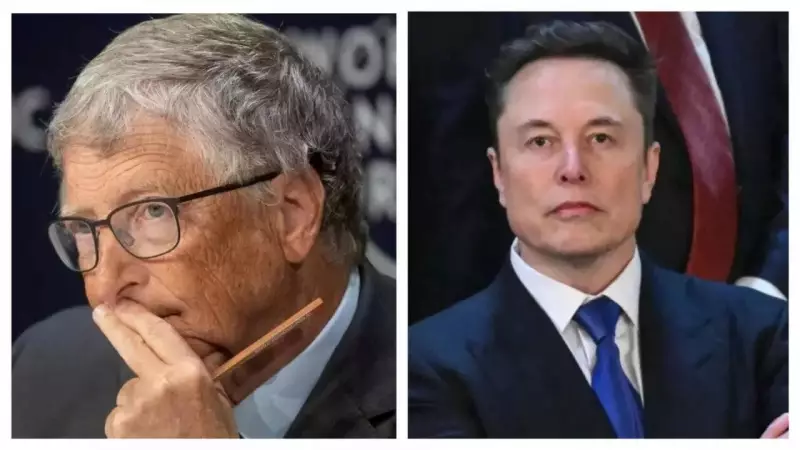
In a fresh salvo in their long-running public spat, tech mogul Elon Musk has claimed that Microsoft co-founder Bill Gates may have suffered losses exceeding a staggering $10 billion due to his bet against electric vehicle giant Tesla. Musk's comments came in response to a social media post discussing Gates' wealth and investment choices.
The Spark: A Social Media Exchange
The controversy ignited on X, the platform formerly known as Twitter. A user posted a speculative thread suggesting that if Bill Gates had not diversified his holdings by selling Microsoft shares on Warren Buffett's advice, he would be the world's first trillionaire, worth twice as much as Elon Musk today. Responding to this, Musk shifted the focus to Gates' investment strategy concerning Tesla.
"Bill Gates placed a massive short bet against Tesla of ~1% of our total shares, which might have cost him over $10B by now," Musk wrote. This is not an isolated critique; the Tesla CEO has repeatedly called out Gates for this financial move, which he views as a direct bet on Tesla's failure.

Understanding the Short Position and the Stakes
What exactly is a short position? It is an advanced investment strategy where an investor borrows shares of a company and sells them at the current market price, hoping to buy them back later at a lower price. The profit is the difference between the selling and repurchase price. However, if the stock price rises instead, the investor faces potentially unlimited losses, as they must buy back the shares at a higher price.
Gates publicly acknowledged his short position against Tesla in 2022, stating his decisions were financial, not personal. However, Musk has framed it as a deeply hypocritical act, especially given Gates' public advocacy for environmental causes.
As of the 2025 Forbes billionaires list, Bill Gates is ranked 18th with a net worth of $103.8 billion, a decline of approximately $24 billion in 2024. While not all of this can be attributed to the Tesla short, Musk's comments highlight the significant financial ramifications of betting against his company's stock surge.
A History of Tension and Accusations
The short bet has been a persistent source of friction. In December 2024, Musk took his criticism further, suggesting that Gates' position could lead to financial ruin for the Microsoft founder if Tesla's valuation continues to climb. "If Tesla does become the world's most valuable company by far, that short position will bankrupt even Bill Gates," he stated.
In a September 2024 post, Musk elaborated on his grievances. He argued that a large short position like Gates' not only profits most if a company goes bankrupt but also artificially drives down the stock price, harming everyday investors. "The lack of self-awareness and hypocrisy of Gates who had the nerve to ask me to donate to his mostly window-dressing environmental causes, while simultaneously aiming to make $500M from Tesla's demise," Musk added.
This ongoing dispute underscores a fundamental clash between two of the world's most prominent billionaires—one betting on a sustainable electric future and the other, according to Musk, financially betting against its most visible champion while championing similar environmental goals.