

Budget 2026's STT Hike Triggers Market Meltdown, Sensex Plunges Nearly 2%
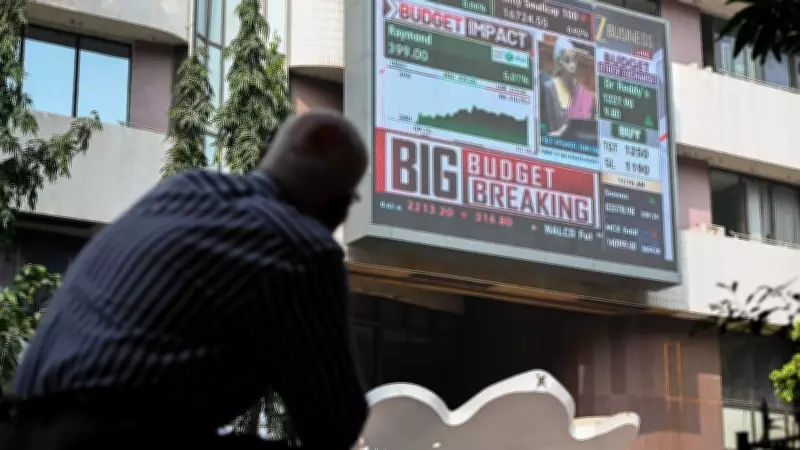
The Indian stock market witnessed a sharp correction on Sunday, with key indices slumping approximately 2% following the Union Budget 2026-27 announcement. The decline was primarily driven by the government's proposal to increase the Securities Transaction Tax (STT) on futures and options (F&O) trading, coupled with an absence of immediate positive triggers to bolster investor sentiment.
Market Indices Record Significant Declines
The 30-stock BSE Sensex experienced an intraday drop of as much as 2.9% post-announcement before settling at 80,722.94 points, marking a 1.9% decrease from Friday's closing. Simultaneously, the Nifty 50, the flagship index of the National Stock Exchange (NSE), closed 2% lower at 24,825.45 points. This represents the second-largest budget-day fall since the National Democratic Alliance, led by Prime Minister Narendra Modi, assumed power in 2014.
The negative market sentiment was vividly reflected in the India VIX, an indicator of market volatility, which surged 13% to conclude at 15.10. This spike underscores heightened investor anxiety and uncertainty following the budgetary proposals.

Government Rationale Behind STT Increase
In her Budget speech, Finance Minister Nirmala Sitharaman outlined the government's intent to raise STT on futures to 0.05% from the existing 0.02%. She described this move as a "reasonable course correction in the F&O segment of the capital market" aimed at generating additional revenues for the government. Additionally, STT on options premiums and the exercising of these options is proposed to be increased to 0.15% from 0.1% and 0.125%, respectively.
Revenue Secretary Arvind Shrivastava, addressing reporters after the Budget presentation in Parliament, clarified that the hike in STT for the F&O segment is designed to discourage speculative trading tendencies among investors.
Financial Implications and Market Reactions
The Centre aims to collect Rs 73,700 crore from STT in the 2026-27 fiscal year, up from the revised estimate of Rs 63,670 crore for the current fiscal. The Budget estimate for STT collections in 2025-26 stands at Rs 78,000 crore.
"The STT hike caught the market off guard, exacerbating the impact of relentless FII (foreign institutional investor) outflows," remarked Vipin Kumar, Assistant Vice President of equity research at Globe Capital Market. He added that while such volatility might be temporary, these measures inevitably bruise investor confidence, leading to broad-based selling.
Nilesh Shah, Managing Director at Kotak Mahindra Asset Management and a part-time member of the Economic Advisory Council to the Prime Minister, noted that while speculators' reactions to the STT proposal drove the market downturn, Indian markets had already been subdued due to high valuations amid modest earnings growth. "While the Budget has several key announcements that will augur long-term growth prospects, execution and implementation will remain key," Shah emphasized.
Broader Context of FII Outflows and Retail Losses
The market slump coincides with significant foreign investor withdrawals. Recent data indicates that FIIs divested Indian shares worth $4 billion in January alone, marking the sixth instance of net selling in the past seven months. In 2025, net FII outflows totaled nearly $19 billion.
The government's latest STT hike is part of ongoing efforts to curb retail trading in equity derivatives, where individual traders often incur substantial losses. A Securities and Exchange Board of India (Sebi) study from last year revealed that individual traders' losses in equity derivatives widened by 41% to Rs 1.06 lakh crore in 2024-25, up from Rs 74,812 crore in 2023-24. Alarmingly, the average loss per retail trader in the last quarter of 2024-25 rose to Rs 57,920 from Rs 34,606 in the first quarter, despite a 20% year-on-year decline in unique traders between December 2024 and May 2025.

Sector-Specific Impacts and Regulatory Background
The Budget's STT proposal particularly affected stockbrokers and depositories. Companies like Billionbrains Garage Ventures (parent of Groww), Angel One, and Central Depository Services saw their shares drop 5-9%, as they derive significant revenue from F&O trading fees. BSE shares also slumped 8% due to anticipated adverse impacts from reduced derivatives trade.
Prior to the Budget presentation, Zerodha founder Nithin Kamath expressed on social media platform X his perennial hope for STT reduction, noting its consistent increase instead.
Banking stocks faced pressure after Sitharaman announced a high-level committee to review the sector in alignment with the Viksit Bharat target. Conversely, information technology stocks rallied on Budget proposals related to safe harbour provisions, which reduce compliance and litigation burdens. Healthcare stocks gained following the announcement of a scheme to establish five Regional Medical Hubs, promoting India as a medical tourism hub. Additionally, sports equipment maker Cosco India surged 8% on a proposal for a dedicated initiative to boost manufacturing and innovation in sports goods.
This market reaction occurs against a backdrop of regulatory scrutiny and declining F&O trade volumes. Following a Sebi crackdown in October 2024, F&O trade volumes on the NSE plummeted from a peak of 12.94 billion contracts in October 2024 to 2.3 billion by February 2025, before marginally recovering to 3.18 billion by December 2025.





