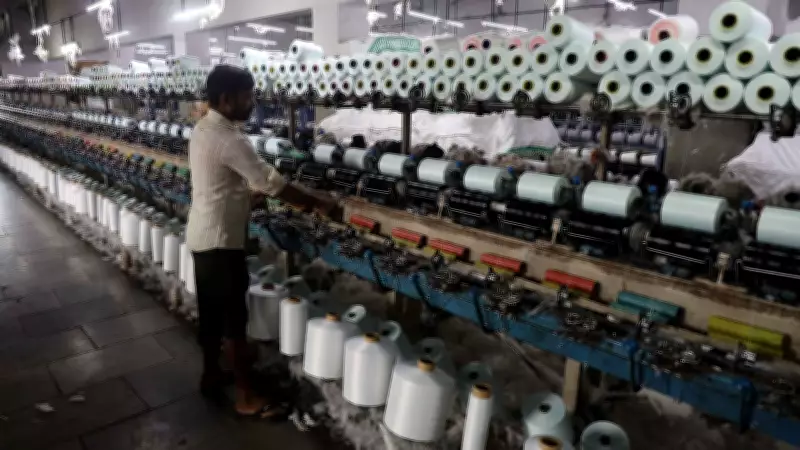
Bhiwandi's Textile Industry Adopts Wait-and-See Approach Following US Tariff Reduction
The recent announcement by the United States to reduce tariffs on Indian goods from 50 percent to 18 percent has generated a mixed and cautious response from Bhiwandi's historic textile market. While the reduction offers some relief from last year's sharp hike, powerloom owners and traders in this traditional manufacturing hub remain uncertain about the practical implications for their businesses.
From Thriving Hub to Challenged Industry
Bhiwandi, located near Mumbai, has long been recognized as a significant powerloom center in India. According to a report from the National Institute for Micro, Small and Medium Enterprises (NI-MSME), the region once hosted approximately 12 lakh powerlooms, contributing to an annual industry turnover estimated at Rs 10,000 crore. These powerlooms, which evolved from traditional handlooms, primarily produce grey cloth—raw material that is subsequently distributed to merchants and processing centers for conversion into finished textile products.
However, the landscape has changed dramatically in recent years. The total number of operational powerlooms in Bhiwandi has declined to below 4 lakh, a consequence of multiple economic challenges. The unorganized sector faced significant blows from demonetization, the immediate implementation of the Goods and Services Tax (GST), and persistently high power tariffs, all of which contributed to this contraction.

The Tariff Rollercoaster: From 3% to 50% to 18%
The sharp tariff increase imposed by the United States in August 2025, which elevated duties on several Indian goods beyond 50 percent, had sparked fears of a severe impact on Bhiwandi's textile industry. Textiles represent the largest share of Indian exports to the US, making the sector particularly vulnerable to such trade policy shifts.
Monday's announcement of a reduction to 18 percent has brought a measure of relief to some sectors, but loom owners in Bhiwandi emphasize that the situation remains far from clear. "For us, the picture remains pretty unclear as we still don't know the tariff bracket on textiles. It is too early to judge how it will impact us," stated Akram Ayub Ansari, a powerloom owner whose family has been engaged in the trade since 1942.
Ansari further elaborated, "While the overall tariff has been cut to 18 percent, it is significantly higher than the tariffs of 3–4 percent which was previously imposed on the raw material exports to US." This sentiment is echoed by other industry stakeholders who note that the reduction does not fully address the fundamental disadvantage now faced by the sector.
Persistent Challenges and Domestic Market Insulation
Another powerloom owner highlighted the ongoing challenges, remarking, "Textiles and other Indian goods were previously facing tariffs of 3 percent in the US which shot to 50 percent last year. Now, the tariff may be slashed to 18 percent but our position remains the same, if not worse as our tariffs have increased nearly 7 times from what it used to be."
Despite these concerns, some traders point to Bhiwandi's primarily domestic market focus as a potential buffer. Saleem Ansari, a second-generation powerloom owner, explained, "In Bhiwandi, we largely make raw clothes and trade in local markets. Since we do not make export quality clothes, our units did not face as much impact after the steep increase in US tariffs last year as the big manufacturing units exporting to US did. Similarly, the impact of the tariff slash may also not impact Bhiwandi directly but it may certainly give a boost to the textile business on the large."
Awaiting Clarity and Categorization Details
For now, traders and powerloom owners in Bhiwandi are adopting a cautious stance, awaiting further clarity on how textile products will be categorized under the revised US tariff structure. The uncertainty continues to loom over the region's powerlooms, with industry participants emphasizing the need for detailed information to assess the true impact of the policy change.

The reduction from 50 percent to 18 percent represents a positive step, but for Bhiwandi's textile market, the journey back to pre-hike competitiveness remains uncertain. The industry's resilience will be tested as stakeholders navigate this evolving trade landscape, balancing domestic strengths with international market dynamics.