

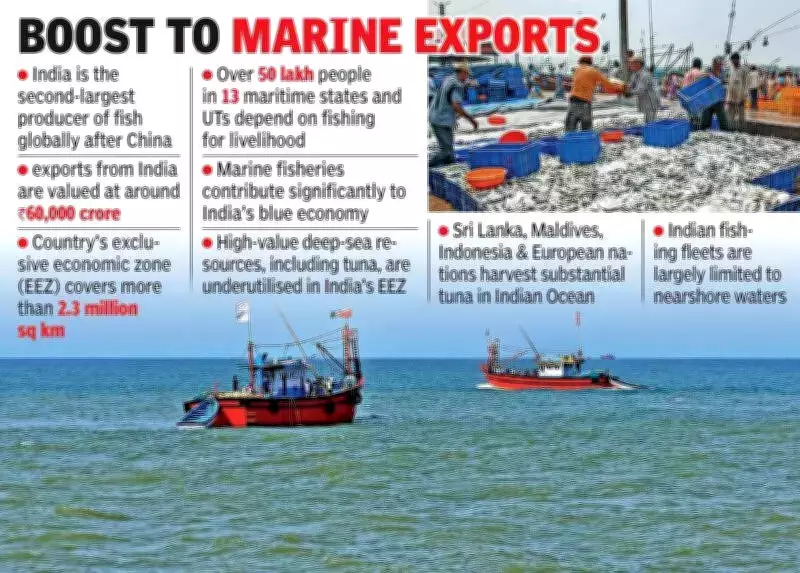
Union Budget Proposes Duty-Free Status for Fish Caught in EEZ and High Seas
The Union budget has introduced a significant policy change for India's marine fishing sector. Fish caught in the exclusive economic zone (EEZ) or on the high seas will now be made free of duty. Additionally, the landing of such fish at foreign ports will be treated as export of goods, creating new opportunities for direct international trade.
Unlocking Economic Potential of Marine Resources
These measures are expected to unlock the economic potential of marine resources beyond coastal waters. For states like Andhra Pradesh, which boasts a long coastline and a substantial marine fishing workforce, this policy could open new export opportunities and support the crucial transition from coastal to offshore fishing.
With adequate investment in deep-sea vessels and cold-chain infrastructure, Andhra Pradesh could significantly expand its marine exports and improve fishermen incomes. The EEZ extends 200 nautical miles (approximately 370 kilometers) from the coastline and covers about 2.3 million square kilometers of the Indian Ocean.

Industry Perspectives on Implementation Challenges
Pawan Kumar G, president of Seafood Exporters Association of India, acknowledged the benefits of these measures while highlighting current limitations. "Indian fishing vessels are currently not adequately equipped for such long-distance operations or for sustained voyages requiring onboard freezing facilities," he noted.
Pawan added, "The announcement may now attract investment in modern vessels. In the budget, the value limit of duty-free imports of specified goods for use in seafood processing has been increased from 1 percent to 3 percent of the free-on-board value of seafood products exported during the previous financial year. This will help bring in more ingredients for high-end value addition such as marinated and breaded products."
Current Fishing Practices and Investment Requirements
Currently, fishermen are venturing up to 70-80 kilometers offshore to target high-value species such as tuna, marlin, and billfish. Arjili Dasu, national general secretary of the Federation of Indian Fisher Organisations, provided insights into the financial aspects.
"Existing fishing vessels cost between Rs 20 lakh and Rs 1 crore, depending on size and capability. However, a vessel capable of operating in the EEZ requires an investment of Rs 2 to Rs 3 crore. If these measures attract investment into the sector and advanced vessels become a reality, it could help reduce migration, as many fishermen are currently moving to states such as Gujarat," Dasu explained.
Aligning with Global Maritime Standards
Prof Kalyan Kolukuluri, a faculty member in economics at the Indian Institute of Management, Visakhapatnam, provided international context. "Many countries, including the US and China, follow similar rules for deep-sea fishing. With the proposed changes, India is aligning its customs regulations with global maritime standards."
He elaborated further, "Earlier, Indian catch from its EEZ and the high seas had to return to Indian ports for customs compliance. Now, fish can be sent directly to international destinations such as Japan or Singapore — for example, fresh bluefin tuna, which commands high prices — without the risk of value loss due to return to Indian shores."
Addressing Current Customs Framework
At present, there is no separate concessional duty framework specifically recognizing fish caught in the EEZ as domestic produce. In practice, fish caught by Indian vessels beyond territorial waters and landed in India has often been treated as an import under customs law.
The budget proposals aim to rectify this situation by creating a more favorable regulatory environment for India's marine fishing industry, potentially transforming how Indian fishermen access and profit from the country's extensive marine resources.






