

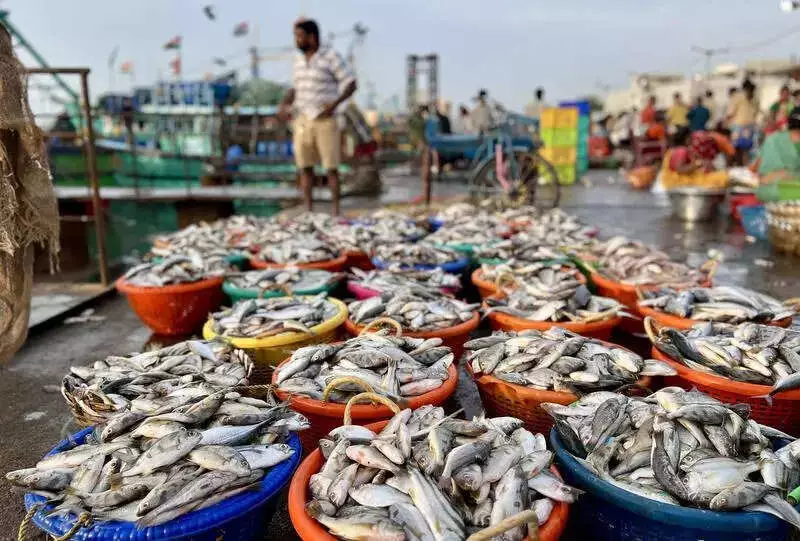
Deep-sea fishing boat owners operating from Chennai's Kasimedu harbour are caught in a severe financial crisis, a situation made more bitter by a remarkably abundant season. Despite landing a massive, export-quality catch of skipjack tuna, their profits are being wiped out due to alleged price manipulation by a powerful cartel of middlemen and exporters.
A Bounty That Brings No Joy
For the past ten days, the harbour has witnessed an extraordinary influx of skipjack tuna, with approximately 100 tonnes of the fish landing daily. B Muthukumaran, the secretary of the deep-sea fishing boat owners association, confirmed the scale of the catch. He described skipjack as the smallest and most plentiful variety of tuna, which is ideally suited for international exports.
However, this seasonal bounty has not translated into financial security. Boat owners are grappling with exorbitant operational costs and the immense physical labour of deep-sea fishing, only to find their earnings severely diminished. The core issue, they assert, is not a lack of fish but a deliberate suppression of prices.

The Alleged Cartel and Crushed Viability
V Balaji, a boat owner, directly accused a group of local fishermen working in collusion with an exporter of forming a cartel to control the market. "This cartel manipulates prices, leaving those of us who face the real risks at sea unable to earn a decent livelihood," Balaji alleged. The current price at Kasimedu has been driven down to a mere ₹70 per kilogram, a rate the fishermen say is far below what is viable for their survival.
The problem is compounded by limited domestic demand. In Tamil Nadu, skipjack tuna is not commonly consumed. While neighbouring Kerala offers some market, buyers there also offer low rates, forcing the fishermen to depend almost entirely on exports. This reliance makes them vulnerable to the whims of the few exporters who dominate the supply chain from the harbour.
Plea for a Kerala-Model Intervention
Facing this market failure, the boat owners are urgently appealing for state government intervention. Muthukumaran pointed to the successful model implemented in Kerala, where a government society directly procures the entire export-quality catch, handles processing, and manages exports. "This system effectively eliminates middlemen and breaks cartels, ensuring fishermen receive a fair share of the final value," he explained. He proposed that a similar mechanism in Tamil Nadu, with a floor price raised to at least ₹100 per kg, could provide immediate relief.
The irony of their predicament is not lost on the fishermen. Raghu Segar, another boat owner, highlighted the stark value addition. The low-priced raw skipjack they sell is canned and processed, eventually appearing on supermarket shelves as a premium imported protein product for fitness enthusiasts, selling for up to ₹1,000 per kg. "We bear all the costs and risks, but the major profits are reaped by processors and exporters," Segar lamented.
With the seasonal abundance being short-lived, the window to generate crucial annual revenue is narrow. Boat owners, already under severe financial strain, have called for urgent action from the state fisheries department and the Tamil Nadu government to regulate the market and ensure their hard work is justly rewarded before the opportunity vanishes with the tide.






