

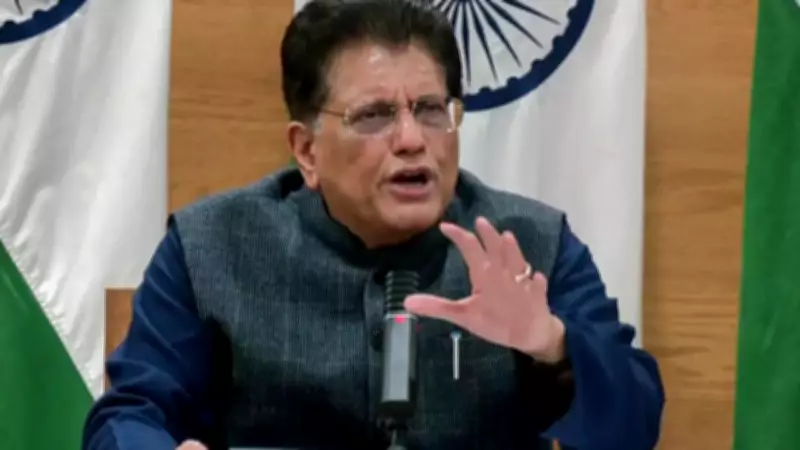
Commerce Minister Piyush Goyal Defends India-US Trade Framework, Slams Opposition
Union Commerce and Industry Minister Piyush Goyal launched a sharp critique against opposition parties on Saturday, accusing them of deliberately misleading the public and working against the interests of Indian farmers regarding the newly announced India-United States trade agreement. In a strongly worded statement, Goyal emphasized that the interim framework represents a historic achievement for the nation.
Veiled Dig at Opposition Over Farmer Concerns
"There are some people in the nation who are against the interests of the farmers. They don't worry about the farmers' interests; they mislead the public of the nation," Goyal declared during his address. "They are surprised to see that no steps have been taken in the India-US trade agreement that go against the interests of the farmers of the nation." The minister's comments came as political tensions escalated over the trade deal's implications for agricultural sectors.
Historic Trade Framework Announced
Goyal highlighted the significance of the interim framework agreement between India and the United States, describing it as a "historic moment that would be etched in golden letters." The joint statement released by both nations outlines a reciprocal trade arrangement expected to be formally signed in the coming weeks, marking a substantial development in bilateral economic relations.

Key Benefits and Tariff Reductions
The commerce minister provided specific details about the agreement's advantages for Indian exporters:
- US tariffs on Indian exports have been significantly reduced to 18 percent from the previous 50 percent
- Access to a $30 trillion American economy for Indian businesses
- Zero duty benefits for sectors including gems and pharmaceuticals
- Complete protection for farmers, MSMEs, artisans, and craftsmen
"I can say with absolute certainty that the farmers, MSMEs, artisans, and craftsmen of India will not suffer any kind of loss," Goyal asserted confidently. He characterized the joint statement as a source of renewed optimism and opportunity for Indian enterprises across multiple industries.
Executive Order on Russian Oil Tariffs
In a related development, US President Donald Trump signed an executive order revoking the 25 percent tariffs previously imposed on India over its purchase of crude oil from Russia. This move removes a significant trade barrier that had strained economic relations between the two countries in recent months.
Opposition Criticism and Concerns
Congress MP Jairam Ramesh earlier criticized the trade framework, suggesting that Prime Minister Narendra Modi's much-publicized friendship with President Trump had deteriorated. Ramesh expressed specific concerns about the agreement's impact:
- Alleged favoritism toward American farmers at the expense of Indian farmers
- India's reported commitment to halt crude oil imports from Russia
- Potential reimposition of 25 percent penalties if India resumes Russian oil purchases
"Nothing in the recently released US-India joint statement has been made clear regarding the details. But from what has come to light so far, it's evident that India will no longer import oil from Russia," Ramesh stated in a social media post. "Separately, the US has also announced that if India buys oil from Russia, directly or indirectly, a 25 percent penalty could be reimposed."
Broader Implications for Indian Economy
The India-US trade agreement framework represents a strategic shift in international trade relations for both nations. While the government emphasizes the economic opportunities created by reduced tariffs and market access, opposition voices continue to raise questions about agricultural protections and energy security. The coming weeks will see further developments as both countries work toward formalizing the interim agreement and addressing the concerns raised by various stakeholders.






