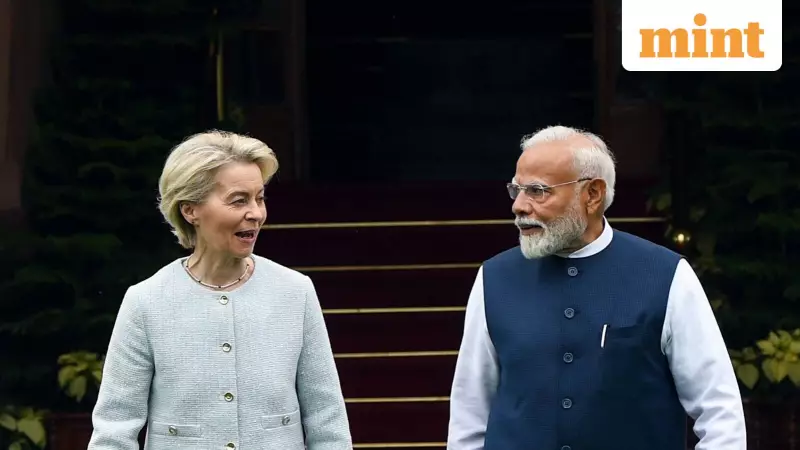
India-EU Free Trade Agreement Negotiations Set to Conclude on January 27
Negotiations between India and the European Union regarding their long-awaited free trade agreement are reportedly scheduled to conclude on January 27, Tuesday, according to a Reuters report citing sources from both governments. This development marks a significant milestone in bilateral trade relations, with the FTA expected to facilitate reduced tariffs on European automobiles and wines while simultaneously opening up expanded market opportunities for India's electronics, textiles, and chemicals sectors.
High-Level Meetings and Summit Coincide with Negotiation Timeline
Notably, Prime Minister Narendra Modi is set to meet with European Council President Antonio Costa and European Commission President Ursula von der Leyen from January 25 to 28. During this visit, von der Leyen is also scheduled to co-chair an India-EU summit, as confirmed by Indian government sources. The commerce ministry has not yet responded to official queries regarding these developments.
Key Sectors Poised to Benefit from the India-EU Trade Deal
As per the report, the European Union imports approximately $125 billion worth of textiles annually, with India currently holding a 5–6% market share compared to China's dominant 30%. The FTA is anticipated to yield substantial gains for India in this sector, particularly in light of elevated US tariffs affecting global trade patterns.

Furthermore, analysis from Jefferies indicates that India's automotive, chemical, electronics, pharmaceutical, and textile industries are likely to emerge as primary beneficiaries of the potential agreement. It is important to note that certain sensitive agricultural products have been deliberately excluded from the negotiation parameters, according to an Indian trade ministry official.
Timeline for Implementation and Current Trade Dynamics
Once finalized, the agreement must undergo ratification by the European Parliament—a process that typically requires at least one year to complete. Upon implementation, the India-EU trade pact is projected to significantly boost Indian exports, particularly in textiles and jewellery sectors.
Bilateral trade between India and the EU reached $136.5 billion during the 2024/25 fiscal year ending in March, solidifying the 27-nation bloc as one of India's most substantial trading partners. However, negotiators continue to work through several sensitive issues, including India's cautious approach toward sharply reducing tariffs on automobile imports, as noted by an EU government source.
Recent Progress and Geopolitical Context
At the World Economic Forum 2026 in Davos on January 20, European Commission President Ursula von der Leyen indicated meaningful progress, stating that the EU is nearing completion of the agreement while acknowledging that additional work remains. This development follows the EU's recent pivotal pact with the South American Mercosur bloc, along with agreements last year with Indonesia, Mexico, and Switzerland.
Meanwhile, India has actively pursued trade deals with Oman, New Zealand, and the United Kingdom, reflecting an evolving geopolitical landscape influenced by factors such as Donald Trump's assertive foreign policy moves. The India-EU negotiations were relaunched in 2022 after a nine-year hiatus, gaining momentum last year amid escalating global trade tensions when former US President Donald Trump imposed substantial 50% tariffs on Indian goods.
Potential Challenges and Regulatory Considerations
The report highlights that beyond tariff discussions, India has expressed concerns regarding the EU's newly implemented carbon levies on imports of steel, aluminium, and cement. Industry experts suggest there is limited flexibility for relaxation in these areas.

Ajay Srivastava, founder of the Delhi-based think tank Global Trade Research Initiative, explained to Reuters that duty-free access to the EU could help compensate for losses experienced by Indian textile and jewellery exporters in the US market. An India-EU FTA would reduce tariffs on textiles, garments, and leather, enabling Indian exporters to compete more effectively with counterparts in Bangladesh and Vietnam. However, Srivastava also emphasized that regulatory hurdles remain a significant consideration in the finalization and implementation of the agreement.