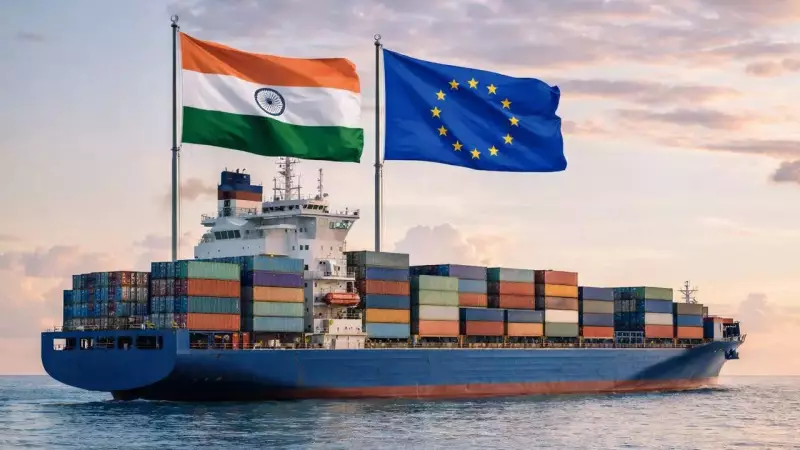
In a historic development for global trade, India and the European Union announced on Tuesday the conclusion of a comprehensive free trade agreement, widely being hailed as the "mother of all deals". This landmark pact arrives at a critical juncture marked by heightened global uncertainty and trade disruptions, largely influenced by shifting international policies.
A New Blueprint for Shared Prosperity
Prime Minister Narendra Modi emphasized the unprecedented scale of this agreement, calling it the largest FTA India has ever signed. The pact was finalized following high-level summit discussions with European Commission President Ursula von der Leyen and European Council President Antonio Costa, representing the 27-member bloc.
"This is not just a trade agreement. This is a new blueprint for shared prosperity," Modi declared in a media statement, highlighting the broader strategic significance that extends beyond mere commerce.

Alongside the trade agreement, both sides formalized a strategic defence partnership and concluded a mobility agreement, reinforcing cooperation across multiple domains beyond traditional trade relationships.
Beginning of a New Chapter
European Council President Antonio Costa described the agreement as marking the start of a "new chapter" in India-EU relations, encompassing trade, security, and people-to-people engagement. He emphasized how such agreements strengthen rules-based economic systems and foster shared growth, noting this pact ranks among the most ambitious ever signed.
European Commission President Ursula von der Leyen echoed this sentiment, stating simply: "We delivered the mother of all deals."
India-EU FTA: Key Questions Answered
Why has the EU negotiated this FTA with India?
The agreement strengthens economic and political ties between two of the world's largest democracies during a period of rising geopolitical tensions and global economic challenges. Despite India being the world's fourth-largest economy with the largest population, EU exports to India remain relatively low compared to other markets, primarily due to high tariffs and administrative barriers.
This deal will reduce tariffs and administrative burdens, making trading easier, cheaper, and faster for EU companies and farmers. EU exports to India already support 800,000 European jobs, with potential for significant growth.
How will the agreement affect EU exports?
The agreement is expected to potentially double EU exports to India. Enhanced access to India's services market, particularly in financial services, maritime services, and other key sectors, will open new business opportunities and foster job creation across Europe.
What are the key benefits for EU exporters?
- Tariffs on over 90% of EU goods exports will be eliminated or reduced
- Annual savings of up to €4 billion in duties on European products
- Competitive advantage with India's biggest trade opening to any partner
- Privileged access for EU service providers in financial and maritime services
- Simplified customs procedures for quicker, easier exports
- Protection of EU intellectual property including trademarks
- Dedicated chapter supporting small EU businesses
How does the agreement benefit EU industry?
India will grant the EU tariff reductions unavailable to other trading partners, dramatically improving market access. For example:
- Car tariffs will gradually decrease from 110% to 10% with a quota of 250,000 vehicles annually
- High tariffs up to 44% on machinery, 22% on chemicals, and 11% on pharmaceuticals will be mostly eliminated
How does the agreement benefit EU farmers?
The agreement removes or reduces often prohibitive tariffs (averaging over 36%) on EU agri-food exports, opening India's massive market to European farmers. Sensitive European agricultural sectors like beef, sugar, or rice remain protected without liberalization.
A separate agreement on Geographical Indications (GIs) is being negotiated to help traditional EU farming products sell more in India by removing unfair competition from imitations.

How will the agreement help EU service providers?
The pact grants EU companies privileged access to India's services market, including key sectors like financial and maritime services. It contains India's most ambitious commitments on financial services in any trade agreement, surpassing what they've offered other partners.
How will the agreement help small businesses?
A dedicated chapter supports small businesses with easy access to information about doing business in both regions. SME contact points will work on simplifying trade processes, while tariff reductions, removal of regulatory barriers, and transparent rules will make importing and exporting cheaper and more effective.
How will the agreement promote sustainable trade?
Dedicated sustainability provisions will enhance environment and climate protection, promote workers' rights, support women's empowerment, strengthen dialogue and cooperation, and ensure effective implementation mechanisms.
How will the agreement protect workers' rights and women's empowerment?
The agreement requires respect for core International Labour Organisation principles and includes legally binding commitments on decent working conditions, labor inspection, and responsible business conduct. It contains provisions advancing women's economic empowerment and gender equality through UN and ILO conventions.
How will the agreement support the green transition?
Both the EU and India commit to working together on climate change issues and sustainable management of natural resources, implementing agreements like the Paris Agreement, the Convention on Biological Diversity, and the Convention on International Trade in Endangered Species.
How will sustainability commitments be enforced?
Many Trade and Sustainable Development commitments are legally binding and enforceable through a dedicated consultation mechanism addressing labor, environmental, and gender equality issues sustainably and inclusively.
How will the deal prevent non-Indian products from benefiting?
Agreed rules of origin ensure only products significantly processed in either party can benefit from tariff preferences, preventing third countries from simply exporting through India to access EU markets.
What does the FTA do to cut red tape?
Simplified procedures maintain a transparent, predictable regulatory environment and ensure quicker customs release of goods. The agreement also deepens cooperation on supply chain security and strengthens risk management at EU borders.
How does the deal protect EU health and safety?
All imports from India to the EU remain subject to strict EU health and product safety rules without exception, with compliance ensured through controls. The deal creates a framework for cooperation on developing sustainable, inclusive, healthy, and resilient food systems.
How does the agreement promote digital trade?
The digital trade chapter contributes to a predictable, secure, and fair digital trade environment with rules that build consumer trust, ensure legal certainty for businesses, support innovation while maintaining regulatory rights for public policy, privacy, and security.
How does the agreement protect intellectual property?
The agreement provides high-level protection and enforcement of intellectual property rights, including copyright, trademarks, designs, trade secrets, and plant varieties, with measures ensuring effective enforcement.
How does the deal address trade disagreements?
A dispute settlement mechanism helps avoid or efficiently settle disagreements through independent panels with pre-established expert lists for quick resolution. Panel reports are binding and enforceable through concession suspensions, with transparent procedures and mediation options for quicker processes.
What needs to happen for the deal to start working?
- Publication of negotiated draft texts
- Legal revision and translation into all official EU languages
- Proposal to the Council for signature and conclusion
- Adoption by the Council
- Signing between the EU and India
- European Parliament's agreement
- Council's decision on concluding the deal
Once India also ratifies the agreement, it can enter into force, marking a transformative moment in India-EU economic relations.