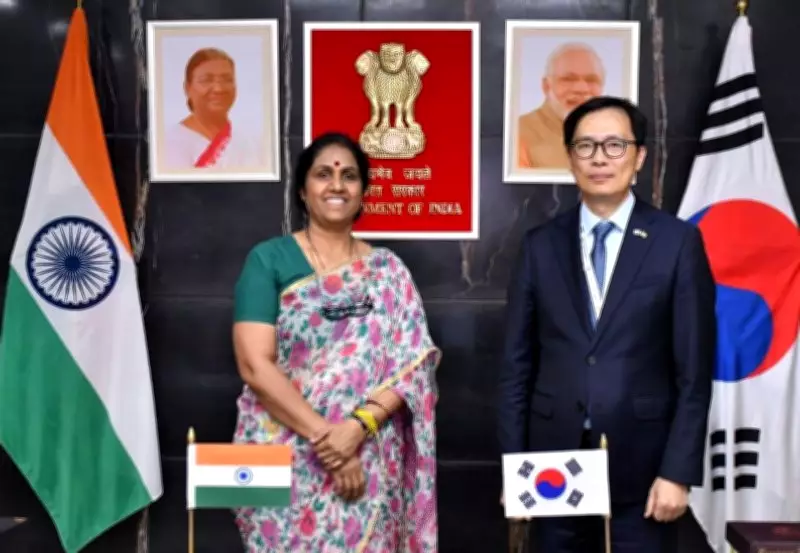
India and South Korea have agreed to upgrade their Comprehensive Economic Partnership Agreement (CEPA) to address the growing bilateral trade deficit and enhance economic cooperation. The decision was taken during a meeting between Indian Commerce and Industry Minister Piyush Goyal and South Korean Trade Minister Ahn Duk-geun in New Delhi on Wednesday.
Key Points of the Agreement
Both sides recognized the need to revise the existing CEPA, which came into effect in 2010, to make it more beneficial for businesses and to reduce the trade imbalance. The bilateral trade deficit has been a concern for India, with South Korea enjoying a surplus. In 2022-23, bilateral trade stood at $27.8 billion, with India's exports at $8.5 billion and imports at $19.3 billion.
Areas of Focus
The upgraded agreement is expected to cover areas such as tariff reduction, rules of origin, services trade, investment, and digital trade. Both ministers emphasized the importance of enhancing market access for goods and services, and fostering a more predictable and transparent trade environment.

Minister Goyal stated that the upgrade would help in realizing the full potential of the economic partnership and contribute to the goal of achieving $50 billion in bilateral trade by 2030. Minister Ahn echoed this sentiment, highlighting that the revised CEPA would strengthen supply chain resilience and boost cooperation in emerging sectors like semiconductors, electric vehicles, and renewable energy.
Next Steps
The two sides have agreed to form a joint committee to negotiate the terms of the upgrade, with the aim of concluding the talks by the end of 2024. The committee will also address non-tariff barriers and facilitate greater investment flows.
This development comes as part of India's broader strategy to review and update its free trade agreements to better serve its economic interests. The upgrade is expected to benefit Indian exporters in sectors such as textiles, pharmaceuticals, and agricultural products, while also attracting more South Korean investments into India's manufacturing and technology sectors.