

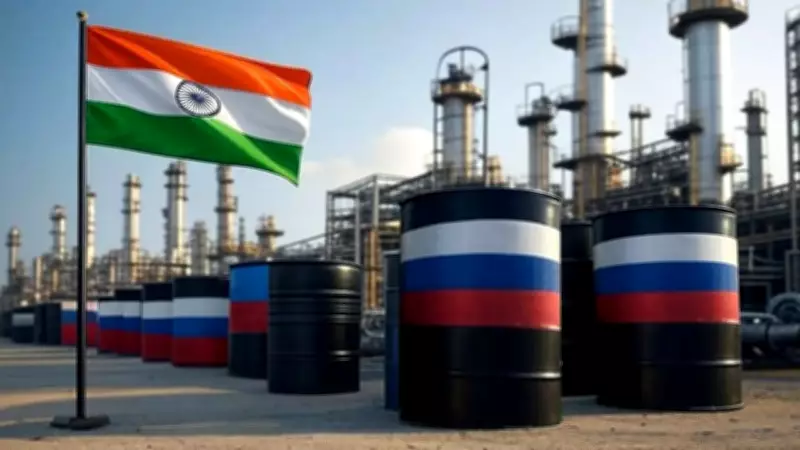
NEW DELHI: The recently announced India-US trade agreement is unlikely to lead to any immediate reduction in India's imports of Russian crude oil, according to energy analysts and government officials. While supplies from sanctioned Russian entities like Rosneft and Lukoil have been halted, imports from other Russian sources continue to flow steadily.
Government Response to Trump's Claims
Although the Indian government has yet to officially comment on US President Donald Trump's assertion that India will stop purchasing Russian crude, officials have pointed out that imports from Russia had already begun declining since November due to sanctions targeting specific entities. "The deal is unlikely to result in a near-term reduction in India's Russian crude imports," explained Sumit Ritolia, lead research analyst at Kpler, a prominent data and analytics provider.
Economic Considerations Drive Import Decisions
Ritolia emphasized that Russian volumes remain largely locked in for the next 8-10 weeks and continue to be economically critical for India's complex refining system. This is primarily due to the deep discounts on Urals crude relative to ICE Brent, making Russian oil financially attractive despite geopolitical pressures.

Changing Import Patterns
Recent data reveals significant shifts in India's crude import sources. Russia's share in India's crude imports declined to 33.7% between April and November 2025, compared with 37.9% during the same period in 2024. Meanwhile, the United States' share increased substantially to 8.1% from just 4.6% previously.
Projected Import Trends
According to Kpler's analysis, Russian crude imports have shown a downward trend, falling from 1.8 million barrels per day in November to 1.2 million in December and projected to reach 1.16 million in January 2026. However, experts anticipate imports will remain broadly stable through the first and second quarters of the 2026-27 fiscal year.
Energy analysts suggest that any recent moderation in Russian imports is likely to be offset by increased inflows from West Asian suppliers. They note that a rapid disengagement from Russian oil would be both commercially challenging and politically sensitive, making any policy-driven recalibration gradual rather than immediate.
Historical Context of India's Oil Imports
While Russia's share of India's crude imports appears substantial in recent years, it's important to note that this represents a dramatic shift from pre-2022 levels. Before the Ukraine conflict, Russia accounted for just about 2% of India's crude imports. Prior to that period, nearly two-thirds of India's crude oil and petroleum product imports originated from West Asia, a share that has since fallen to approximately 45% in 2025.
Future Sourcing Strategies
Despite President Trump's statements suggesting India would increase oil purchases from the United States and possibly Venezuela, experts believe Indian refiners are more likely to turn to West Asian suppliers to replace any potential reduction in Russian imports. This reflects India's long-standing approach to energy security and economic pragmatism.
Energy expert Narendra Taneja highlighted that India's crude sourcing decisions have always been driven primarily by price considerations rather than geographical preferences. "India has significantly diversified its oil imports and now sources crude from 41 different countries," Taneja noted, emphasizing the country's strategic approach to maintaining energy security while optimizing costs.
The complex interplay of economic factors, refining requirements, and geopolitical considerations suggests that India's transition away from Russian oil will be measured and gradual, with the India-US trade deal representing just one factor in a multifaceted energy policy landscape.






