Odisha's Seafood Industry Set for Major Revival Through India-EU Free Trade Agreement
Kendrapada: The seafood sector in Odisha is poised for a substantial transformation following the signing of the free trade agreement (FTA) between India and the European Union. This development brings renewed optimism for recovery among exporters who faced severe financial setbacks due to steep tariffs imposed by the United States last year, according to industry officials and government data.
US Tariff Crisis and Market Dependence
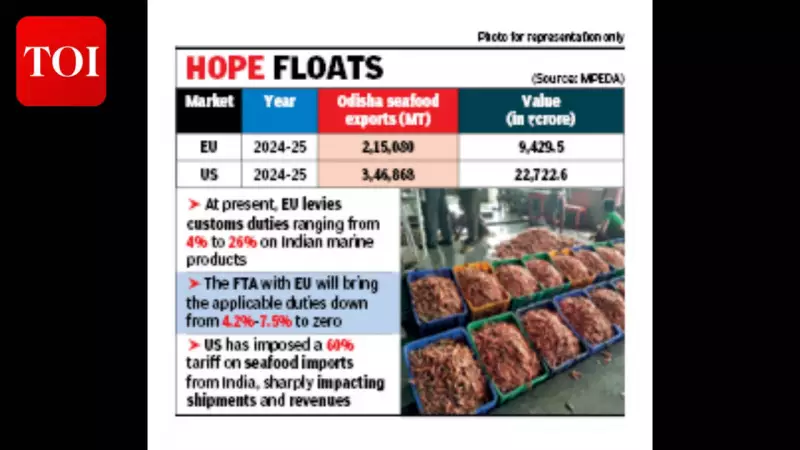
Frozen shrimp and frozen fish represent Odisha's primary export commodities, with the United States historically serving as the largest market for Indian seafood products. However, this reliance turned problematic when Washington implemented a substantial 60% tariff on seafood imports from India, dramatically affecting shipment volumes and revenue streams for exporters across the state.
Sangram Kumar Das, president of the Seafood Exporters Association of India's Odisha chapter, explained the predicament: "All seafood exporters of Odisha were in deep trouble as they depend heavily on the US market, which traditionally absorbs the bulk of Indian seafood exports. The FTA with EU has opened a fresh window of opportunity that could transform our industry's prospects."

Das highlighted the significant price differential, noting that processed shrimp typically fetches $8-$10 per kilogram in the US market compared to just $5–$6 per kilogram in other international markets. "After the FTA with EU, exporters will target European markets more aggressively to revive and sustain the sector," he emphasized, outlining the strategic shift in market focus.
EU Market Access and Tariff Elimination
The European Union currently imposes customs duties ranging from 4% to 26% on various Indian marine products, including shrimp, frozen fish, squid, and value-added seafood items. Under the newly established free trade agreement, these tariffs will be completely eliminated, providing Indian exporters with a substantial competitive advantage in pricing.
Specifically, the applicable duty on key products will decrease from 4.2%-7.5% to zero, ensuring parity with competing nations and making Indian seafood more attractive to European buyers. This tariff reduction represents a significant breakthrough for an industry that has faced multiple regulatory challenges in accessing EU markets.
Historical Context and Export Statistics
Kamalesh Mishra, former president of the association's Odisha chapter, provided historical context: "Exporters had earlier supplied marine products to EU member nations, but shipments declined significantly after the European Commission introduced stringent hygiene norms and regulatory requirements nearly a decade ago."
Mishra explained that the European Commission's regulations mandated validated catch certificates for consignments of fish, shrimp, squid, cuttlefish, and octopus. "As these were compulsory for all sea-caught consignments, many exporters stopped shipping to EU countries. The FTA is a timely move that will significantly boost the sector by addressing these barriers," he added.
According to data from the Marine Products Export Development Authority (MPEDA), India exported seafood worth $1.1 billion to the European Union during the 2024-25 fiscal year. Within this total, Odisha contributed marine products valued at Rs 9,429.5 crore ($1,125.6 million), with a shipment volume of 215,080 metric tonnes.
Broader Export Landscape and Strategic Response
In response to parliamentary questioning on August 19 last year, Union Commerce and Industries Minister Piyush Goyal revealed comprehensive export figures. India exported marine products worth $2.68 billion to the United States during 2024-25, with additional significant exports to China ($1.21 billion), Japan ($408.45 million), Vietnam ($381.77 million), and Thailand ($381.77 million).

MPEDA data further indicates that seafood export companies from Odisha shipped marine products worth Rs 22,722.6 crore ($2,714.9 million) during the 2024-25 fiscal year, with a total volume reaching 346,868 metric tonnes. Frozen shrimp accounted for the largest share in both export quantity and value, while the United States alone absorbed nearly 30% of India's total seafood exports during this period.
Subharakant Mohapatra, state coordinator of MPEDA, confirmed the economic impact of US tariffs: "Exporters were facing major economic losses due to US tariffs. MPEDA is now preparing comprehensive strategies to help exporters diversify their market presence and expand shipments to EU markets following the signing of the FTA."
The India-EU free trade agreement represents a strategic pivot for Odisha's seafood industry, offering diversification from over-reliance on the US market while addressing previous regulatory barriers that limited European market access. Industry experts anticipate that this agreement will not only provide immediate relief from tariff pressures but also establish sustainable long-term growth pathways for one of Odisha's most important export sectors.