

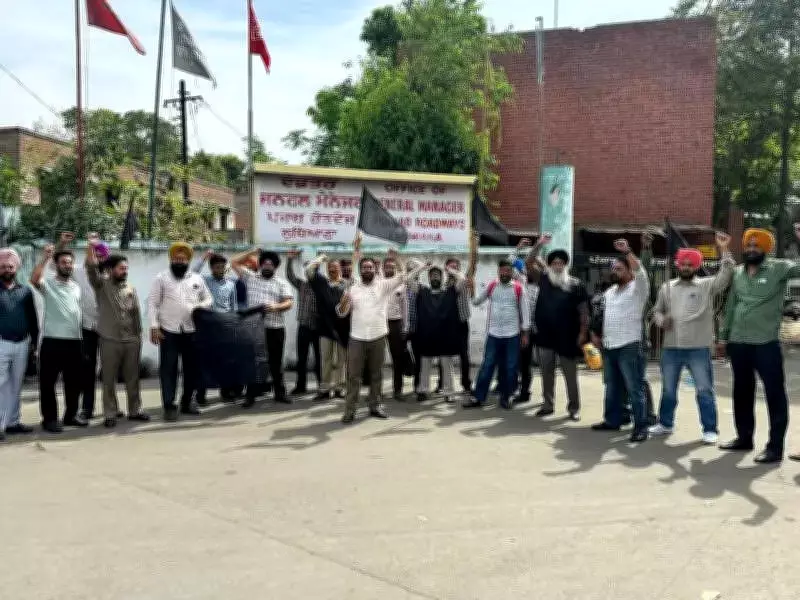
Punjab Transport Workers Stage 'Black Day' Protest Against Labour Codes
Contract workers' unions from Punjab Roadways, PUNBUS, and PRTC, alongside other trade unions and workers, observed a "Black Day" in Ludhiana to vehemently protest the implementation of four labour codes. The demonstrators assert that these reforms are fundamentally anti-worker and would lead to widespread exploitation and diminished job security.
Massive Gathering at Depot with Black Flags
The protest was concentrated outside the Punjab Roadways PUNBUS depot, where members of various unions assembled in large numbers. They raised powerful slogans against both the Central and state governments, carrying black flags as a stark symbol of their dissent. The atmosphere was charged with opposition to what participants uniformly labeled as "anti-labour policies" threatening their livelihoods.
Union Leaders Decry Government's Authoritarian Push
Union leaders highlighted that workers across India had already staged a nationwide strike on February 12, 2026, in opposition to the labour codes. Despite this significant show of resistance, they accused the government of proceeding in an authoritarian manner, blatantly ignoring the grave concerns raised by workers and employees. This disregard has fueled further unrest and mobilization.

Criticism of Policies and Fear of Privatization
The unions also launched a scathing critique of specific policies, such as the kilometre scheme in the transport sector. They allege that this scheme promotes privatization by favoring private bus operators, which not only reduces employment opportunities but also opens the door to potential corruption. The members expressed deep concern that the implementation of the labour codes would lead to both mental and physical exploitation of workers, creating a hostile work environment.
Furthermore, they argued that regular recruitment is being deliberately curtailed, reflecting a broader intent to gradually weaken public sector institutions. This, they claim, is part of a larger strategy to suppress the voice of employees, paving the way for the enforcement of what they describe as "harsh" and unjust reforms.
Threat of Intensified Agitations
In a firm ultimatum, the union members declared that if the labour codes are not withdrawn or if any attempt is made to implement them, trade unions will be compelled to launch intensified and widespread agitations in the coming days. This warning underscores the escalating tension and the potential for more disruptive protests as workers fight to protect their rights and secure their futures in the face of what they perceive as oppressive legislative changes.






