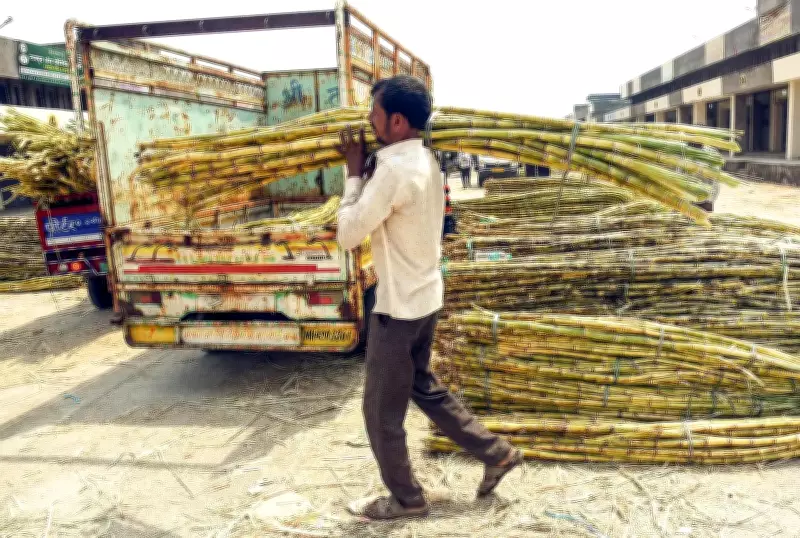
Kolhapur: The Centre's decision to prohibit sugar exports until September 30 has been defended by industry experts, even as farmers and political leaders said it would limit potential returns and income.
Government's Precautionary Measure
The Centre announced its decision on Wednesday as a precautionary measure to ensure adequate opening stock for the next crushing season, amid fears that a strong El Niño could hit sugarcane output. Currently, sugarcane output after diversion to ethanol is estimated at around 280 lakh metric tonnes (lmt), roughly matching domestic consumption.
With opening stock at about 50 lmt and sugarcane production expected to dip, availability at the start of the next crushing season may be tight, analysts say. A recent precedent underscores the concern. During the 2023–24 season, a strong El Niño led to deficient rainfall, reducing sugarcane output to 45 crore tonnes annually from 49 crore tonnes a year earlier. Sugar production also declined by about 8 lmt to 320 lmt.

Expert Opinion on Crop Vulnerability
“We don’t know how sugarcane cultivation will progress. In case of strong El Niño and water scarcity early in the monsoon, crop growth may suffer,” said Vijay Autade, an industry expert. “About 50% of the crop is ‘khodwa’ (ratoon cane), which is more vulnerable, and that will ultimately affect sugar production.”
The export ban and rise in fair and remunerative price (FRP) will have an impact on sugar mills, said industry stakeholders.
Political and Farmer Reactions
NCP (SP) MLA and former minister Jayant Patil termed the decision a “double whammy” for Maharashtra’s mills. “Excess stock, increased FRP, and ban on exports could spell financial disaster. The decision is hasty and needs rollback,” he said.
Farmer leaders have also raised concerns. Swabhimani Shetkari Sanghatana chief Raju Shetti warned that weakening mills would hurt farmers, noting that unpaid FRP dues already stand at around Rs 3,000 crore. “Any move that weakens the industry ultimately impacts cultivators,” he said.
Ajit Nawale of the All India Kisan Sabha pointed out that many sugar-producing countries are shifting towards ethanol, creating export opportunities for India. “A ban on exports limits potential returns and ultimately affects farmers,” he said.
Madhukar Jadhav, a farmer from Pandharpur, hoped sugarcane prices don’t crash just like onion rates have dropped. “Many farmers from our tehsil have not received FRP in full. The mills continue to delay payment even though it is mandatory for them to pay farmers within two weeks of harvesting. While introducing the export ban, the government should also consider how the sugar mills will pay the farmers.”
Export and Financial Context
In November, the government had allowed export of 15 lmt of sugar, but mills — primarily from Maharashtra and Karnataka — have shipped only about half that quantity so far. Production estimates are typically firmed up between July and August, when monsoon progress and crop growth become clearer.
The financial strain on mills has been compounded by the recent hike in Fair and Remunerative Price (FRP) to Rs 3,650 per tonne, while sugar prices remain around Rs 3,100 per tonne. Sugar prices currently stand at around Rs 37 per kg at the factory gate (plus 5% GST), Rs 41–44 per kg wholesale, and Rs 50–51 per kg retail in metros, with transportation costs pushing up consumer prices.
Ananda Khade, a sugarcane grower from Sangrul village of Karvir tehsil of Kolhapur district, said the hike in FRP will bring them some money but they hardly get additional revenue earned from other sources available for mills. “The mills have options to earn through ethanol and export of sugar. If export is banned, we will have no say in demanding our fair share.”