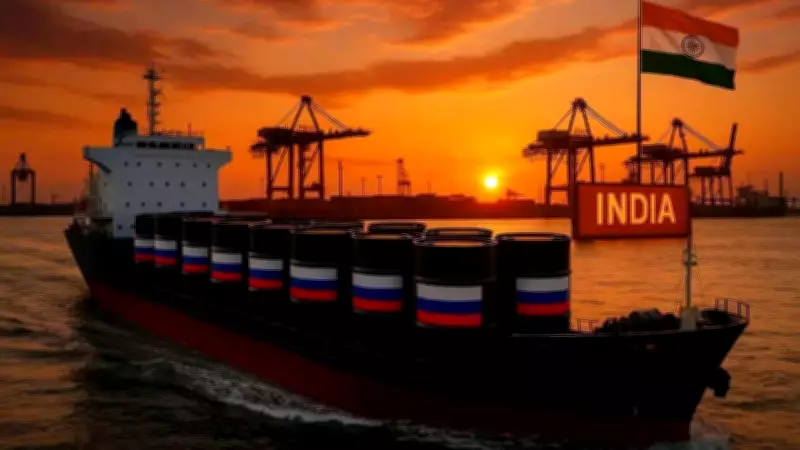
Russia could experience a significant decline in oil revenues if US President Donald Trump successfully pressures India to scale back or completely halt purchases of Russian crude oil, according to analysts and traders. This development might compel Moscow to implement substantial price cuts to attract alternative buyers in an increasingly constrained market.
Trump's Trade Deal Provisions Target Russian Oil
The situation has intensified following Trump's recent statement that a US-India trade agreement included specific provisions linked to India potentially halting Russian oil imports. This comes as Washington increases pressure on Moscow amid ongoing Ukraine peace negotiations, creating a complex geopolitical landscape for energy markets.
While India has not officially suspended Russian crude purchases, citing critical energy security needs and the importance of accessing cheaper oil, recent data reveals that Indian refiners have adopted a more cautious approach. This shift is already affecting Russia's earnings from oil exports, creating financial strain for Moscow's budget.

Sharp Decline in Indian Imports Documented
According to detailed calculations, India's imports of Russian oil fell by 22% to 1.38 million barrels per day in December compared to November levels. This represents the lowest import volume since January 2023, marking a significant downturn from the peak of nearly 2 million barrels per day recorded in June 2025.
Russia's share in India's overall oil imports dropped substantially to 27.4%, while OPEC's share increased to 53.2% during the same period. This redistribution highlights the shifting dynamics in global oil trade patterns and India's strategic diversification efforts.
Limited Alternative Markets for Russian Crude
David Wech of Vortexa consultancy emphasized the market constraints, stating, "Any further reduction would already be meaningful, because there is only one relevant alternative buyer — China — which has also its limitations in taking in sanctioned crude."
Analysts note that widening discounts and shrinking buyer pools are already pushing Russian oil prices to record lows, creating additional pressure on Moscow's energy-dependent economy. The combination of sanctions pressure and reduced demand from traditional partners is creating a perfect storm for Russian energy revenues.
Sanctions Pressure and Supply Re-routing Challenges
Russia has navigated nearly 30,000 Western sanctions related to the Ukraine conflict since 2014, successfully redirecting oil flows from European markets toward China, India, and Turkey. However, this strategy faces new challenges as Turkey has also reduced purchases in recent months, further limiting Russia's market options.
According to International Energy Agency data, Russia's total oil exports stood at 4.91 million barrels per day in December, with China accounting for approximately 2.3 million barrels per day. This heavy reliance on Chinese markets creates vulnerability if India significantly reduces imports.
Potential Production Cuts and Market Impacts
Igor Yushkov of Russia's government-run Financial University explained the potential consequences: "If India were to sharply cut imports, Russia would likely need to divert supplies to China at deeper discounts or cut production. Output and export cuts would lead to an oil shortage. Hence we are not seeing a full US ban on Russian oil imports — they would suffer themselves from higher oil prices."
Short-term Flows May Decline Further
Industry sources indicate that Indian refiners have not received formal instructions to stop buying Russian oil and would require substantial time to wind down existing contracts. However, imports could decline further in April when Nayara Energy, a Russian-backed refinery with capacity of 400,000 barrels per day, undertakes scheduled maintenance for one month.
Beyond April, trade flows will likely depend on the trajectory of Russia-Ukraine peace negotiations and India's broader strategic stance in balancing energy security with geopolitical considerations.

Alternative Supply Sources and Quality Considerations
Trump has suggested that India could increase purchases from the United States or Venezuela to replace Russian crude. However, Alexandra Hermann of Oxford Economics noted significant challenges: "US crude differs in quality and cannot directly substitute Russian grades, while Venezuela's export capacity remains limited."
Instead, crude from Saudi Arabia, the United Arab Emirates, and Iraq may emerge as more practical alternatives for Indian refiners. Despite these options, analysts suggest that steep discounts may continue to make Russian oil economically attractive for Indian buyers, even amid increasing geopolitical pressure.
The evolving situation represents a complex intersection of energy economics, geopolitical strategy, and market dynamics, with significant implications for global oil trade patterns and regional energy security considerations.