

Trump Slashes India Tariffs to 18% in Historic Trade Agreement
In a significant development for international trade relations, US President Donald Trump has announced a major reduction in tariffs on imports from India, lowering them from 50 percent to 18 percent. This historic decision came following a late Monday phone conversation with Indian Prime Minister Narendra Modi, marking what Trump described as a reciprocal trade agreement between the two nations.
The Announcement and Geopolitical Context
Trump took to his Truth Social platform to announce the agreement, stating: "He agreed to stop buying Russian Oil, and to buy much more from the United States and, potentially, Venezuela. This will help END THE WAR in Ukraine, which is taking place right now, with thousands of people dying each and every week!"
The President further elaborated: "Out of friendship and respect for Prime Minister Modi and, as per his request, effective immediately, we agreed to a Trade Deal between the United States and India, whereby the United States will charge a reduced Reciprocal Tariff, lowering it from 25% to 18%."

This move represents a substantial shift in US-India trade dynamics and comes with significant geopolitical implications, particularly regarding India's energy procurement strategies and the ongoing conflict in Ukraine.
Reciprocity: Historical Context vs. Contemporary Application
While President Trump framed the tariff reduction as an act of reciprocity—a concept deeply embedded in America's early trade policy—the comparison reveals complex historical nuances. The First Tariff Act of 1789, enacted during the formative years of the United States, treated reciprocity primarily as a safeguard against discrimination and a mechanism for nation-building rather than as a coercive instrument of foreign policy.
Founding Fathers' Perspective on Trade
Over two centuries ago, America's Founding Fathers, influenced by Enlightenment principles and opposition to British mercantilism, generally favored free and open commerce among nations. Figures like Benjamin Franklin, George Washington, and Thomas Jefferson advocated for the abolition of trade restraints that inhibited economic exchange.
As academic Douglas A. Irwin notes in his comprehensive work Clashing Over Commerce: A History of US Trade Policy (2017), Franklin observed that "Most of the restraints put upon it in different countries seem to have been the projects of particulars for their private interest, under the pretense of public good."
However, the term "free trade" during this period did not imply the complete absence of tariffs or government regulations. Irwin clarifies that it was more accurately characterized as "open trade in which countries could impose import duties and regulate shipping but did so in a non-discriminatory manner."
The First Tariff Act of 1789: Purpose and Provisions
Enacted on July 4, 1789, and signed by President George Washington, the First Tariff Act represented the second law passed by the newly established federal government. The legislation's preamble explicitly stated that import duties were necessary "for the support of government, for the discharge of the debts of the United States, and the encouragement and protection of manufactures."
The tariff structure consisted of three key components:
- Specific duties on selected products including hemp, cordage, nails, and iron and glass manufactures
- Ad valorem duties on most other imported goods
- Duty-free treatment for a limited number of items
Economist F.W. Taussig, in his seminal work The Tariff History of the United States (1909), observed that "These articles were selected, and made subject to the specific duties, with the clear intent of stimulating domestic production."

Evolution of Tariff Policy: From Nation-Building to Geopolitical Leverage
The Founding Fathers recognized that while free trade principles were desirable, practical considerations often necessitated protective measures. Some argued for safeguarding domestic industries crucial to national defense—a lesson learned during the American Revolution when the country depended on imported essentials like gunpowder and clothing.
Irwin summarizes this balanced approach: "Thus, while the founding fathers favoured free and open trade in principle, they were also deeply concerned about national defense and foreign discrimination against American commerce."
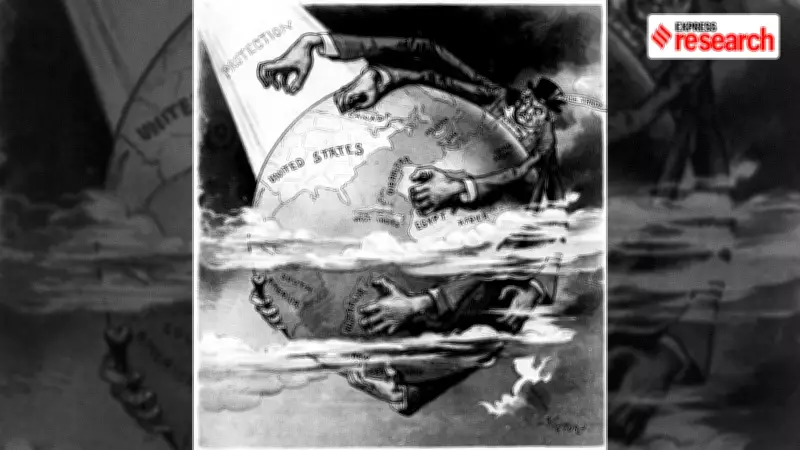
This historical context highlights how tariff policies have evolved significantly over time. The First Tariff Act of 1789 was fundamentally designed to secure the young republic and protect its position in global commerce. In contrast, Trump's decision to lower tariffs on India—explicitly linked to reductions in India's oil imports from Russia—demonstrates how tariffs have transformed from instruments of state formation into tools of geopolitical influence and strategic bargaining.
The contemporary application of reciprocity in trade policy raises important questions about whether tariffs serve primarily as economic instruments or as diplomatic weapons in international relations. This historic US-India agreement illustrates the complex interplay between economic policy, geopolitical strategy, and historical precedent in shaping modern trade relationships.





