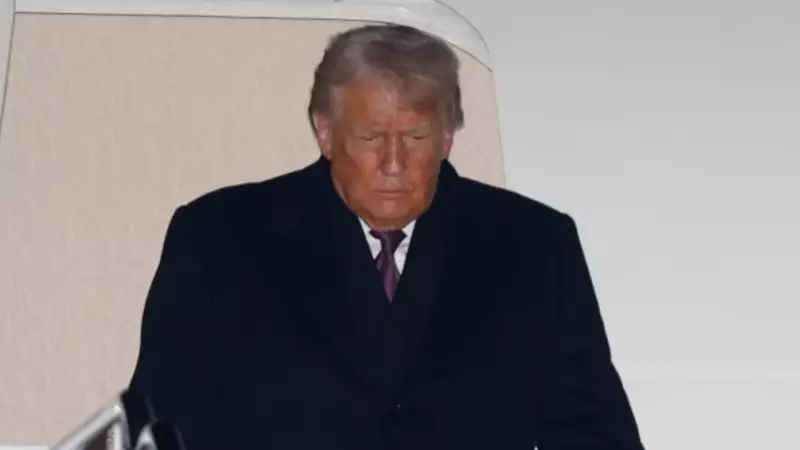
Trump Threatens 100% Tariff on Canada Over Potential China Trade Deal
In a dramatic reversal of his previous position, US President Donald Trump has issued a stark warning to Canada, threatening to impose a 100 per cent tariff on all Canadian goods entering the United States if the country proceeds with a trade deal with China. This threat marks a significant escalation in tensions between the two North American neighbors, coming just days after Trump had indicated he was "okay" with such an agreement.
Social Media Post Sparks Diplomatic Firestorm
The threat was delivered via a social media post on Saturday, where Trump lashed out at Canadian Prime Minister Mark Carney, whom he mistakenly referred to as "Governor Carney." In his post, Trump asserted that if Carney believes Canada can serve as a "Drop Off Port" for Chinese goods destined for the US market, he is sorely mistaken.
"China will eat Canada alive, completely devour it, including the destruction of their businesses, social fabric, and general way of life," Trump warned. "If Canada makes a deal with China, it will immediately be hit with a 100% Tariff against all Canadian goods and products coming into the U.S.A."

Background: Carney's Davos Address and Trump's Reaction
Trump's threat appears to be a direct response to a remarkable address delivered by Prime Minister Mark Carney at the World Economic Forum in Davos. In his speech, Carney raised a banner of revolt against US hegemony, urging middle powers to unite and create a "third path" in the face of great power rivalry.
"Middle powers must act together because if we are not at the table, we are on the menu," Carney declared, in a statement that was widely acclaimed globally but seemingly enraged Trump.
Just last week, Trump had stated that if Carney struck a deal with China—which the Canadian leader did during a visit to Beijing ahead of Davos—he should proceed, and Trump was "okay with it." However, at Davos, where Carney was celebrated by global leaders, Trump's tone turned sour. He complained that Canada receives many "freebies" from the US and "should be grateful," suggesting Carney's remarks indicated ingratitude.
Escalating Rhetoric and Historical Context
The diplomatic spat has deepened with Trump's assertion that "Canada lives because of the United States," a comment that offended many Canadians and prompted a sharp retort from Carney. The Canadian Prime Minister firmly stated, "Canada does not 'live because of the United States.' Canada thrives because we are Canadian."
Carney emphasized Canada's sovereignty, declaring, "We are masters in our own house. This is our country. This is our future. The choice is ours." He positioned Canada as a "beacon" in an era of democratic decline, highlighting values like inclusivity and diversity—a clear swipe at Trump's America, which has often focused on issues of immigration and national identity.
This incident is not isolated; Trump has previously discussed making Canada the 51st state and recently posted an altered map showing Canada, Greenland, Venezuela, and Cuba as part of US territory. Such actions are taking a toll on over two centuries of generally amicable US-Canada relations, which feature the world's longest and mostly unguarded border.
Potential Economic Impact
A 100 per cent tariff on Canadian goods would be devastating for Ottawa, as the United States is Canada's largest trade partner. In the full year of 2025, total bilateral trade in goods and services is estimated to have exceeded $900 billion, with Canada maintaining a surplus of over $85 billion. Such a tariff could disrupt this vital economic relationship, impacting industries and consumers on both sides of the border.
The escalating tensions underscore the fragile state of international trade and diplomacy, with middle powers like Canada navigating complex relationships between global giants. As Trump and Carney exchange barbs, the world watches to see how this dispute will unfold and what it means for future trade policies and alliances.