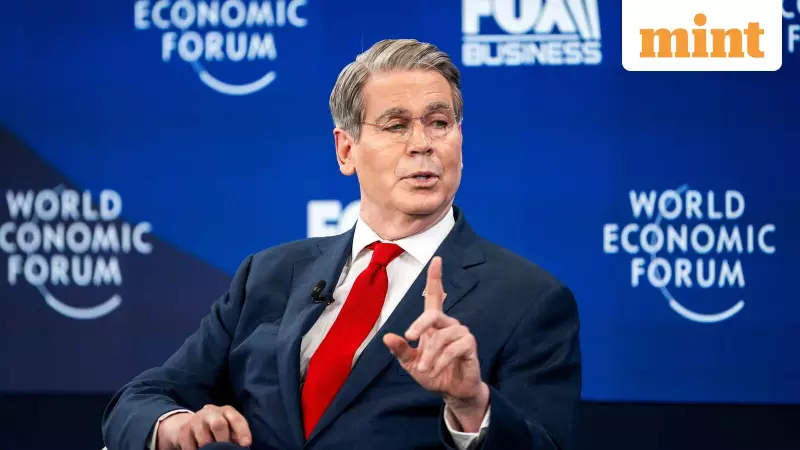
US Treasury Secretary Slams European Allies Over India Tariffs Policy
US Treasury Secretary Scott Bessent has launched a sharp criticism against European countries for their failure to impose duties on India while addressing tariffs levied on New Delhi under the previous Donald Trump administration. In a revealing interview with Politico, Bessent pointedly remarked, "Our virtue-signalling European allies refused to do it (impose tariffs) because they wanted to sign this big trade deal with India." This statement highlights growing transatlantic tensions over trade strategies and geopolitical alignments.
India-EU Free Trade Agreement Nears Conclusion
Bessent's comments emerge at a crucial juncture as negotiations between the European Union and India on their comprehensive free trade agreement are reportedly approaching conclusion. According to a Reuters report, the agreement is likely to be finalized on January 27, marking a significant milestone in India-EU economic relations. The anticipated FTA is expected to bring substantial benefits to both parties, including reduced tariffs on European automobiles and wine exports while simultaneously expanding market access for Indian sectors such as electronics, textiles, and chemicals.
Accusations of European Financing of Russia's War Efforts
In perhaps his most controversial assertion, Bessent alleged that European nations are indirectly financing Russia's military operations through their purchase of oil refined in India. He stated with dramatic emphasis, "But in the ultimate act of irony and stupidity, guess who was buying the refined products from the Indian refineries made from Russian oil. The Europeans. They are financing the war against themselves." When pressed about his characterization of European actions as "stupid," Bessent clarified, "I said there was an act of stupidity," maintaining his critical stance while slightly moderating his language.

US Tariffs on India Deemed a Strategic Success
The US Treasury Secretary highlighted what he described as the successful impact of tariffs imposed on India, particularly the 25% duty on New Delhi's imports of Russian oil. Under the Trump administration, comprehensive tariffs of 50% were levied on India, including specific measures targeting its Russian oil purchases, which significantly strained bilateral relations. Bessent defended these measures, stating, "We put 25% tariffs on India for buying Russian oil. And the Indian purchases by their refineries of Russian oil have collapsed. So that is a success. The tariffs are still on. The 25% Russian oil tariffs are still on."
He further elaborated on potential diplomatic pathways, noting, "I would imagine that there is a path to take them off. So that's a check and a huge success," suggesting that the tariffs have achieved their intended effect while leaving room for future normalization.
India's Shift in Oil Import Patterns Following Ukraine Invasion
Bessent provided detailed analysis of India's changing energy procurement patterns in response to global market shifts. According to his assessment, "Before the Ukraine invasion, approximately 2 per cent or 3 per cent of Indian oil that went into their refineries came from Russia. The oil was sanctioned. It got deeply discounted and moved up into the high teens- 17,18,19 per cent was being refined. Huge profits from the refiners." This dramatic increase in Russian oil imports following the Ukraine conflict has become a focal point in international economic diplomacy.
India has consistently defended its energy policy decisions, with official statements characterizing US actions as "unfair, unjustified, and unreasonable," while reaffirming that its strategic choices are fundamentally driven by national interests and energy security considerations.
Broader Context of US-Europe Trade Tensions
These developments occur against a backdrop of ongoing friction between the United States and its European allies, which previously surfaced during discussions about Trump's interest in acquiring Greenland. Earlier confrontations saw the US President threatening to impose tariffs on European nations before ultimately backing down, illustrating the volatile nature of transatlantic trade relations in recent years.

The convergence of trade negotiations, energy security concerns, and geopolitical alignments creates a complex diplomatic landscape where economic policies intersect with strategic national interests across multiple continents.